On July 11th, at the age of 76, Charlie Haden passed away. Described by Time magazine as “one of the most restless, gifted and intrepid players in all of jazz,” Haden left his mark on hundreds of records as both a member and a leader. He was the anchor of the Ornette Coleman Quartet and helped define The Shape of Jazz to Come. In recent years he struggled with the degenerative effects of post-polio syndrome, and up until 2010 he was still in the studio and performing live. A month before his passing ECM releasedLast Dance, a set of informal songs between Haden and Keith Jarrett recorded at Jarrett’s Cavelight home studio in 2007.
While Haden is known as one of the most significant bassists in jazz, his influences and recordings touch on many musics, from classical to his own country, spiritual, and bluegrass roots. His early music roots culminate on his 2008 recording Rambling Boy, an album that features his immediate family, all of whom follow his musical path. His music and art will live on and continue to inspire others. As Haden once said, “We’re here to bring beauty to the world and make a difference on this planet. That’s what art forms are about.”
Dennison Smith’s Fermata and Catherine Owen’s Trobairitz are two poetic texts significant not only for the sounds they make, but for what they withhold. For all the cacophony and multivoicedness sustained in each text, there are plenty of moments that give the reader pause. Fermata (a lyrical text of Zen-like suspension) and Trobairitz (a text that weds twelfth-century troubadours and their female counterparts, the trobairitz, with twenty-first century metalheads) are worlds apart; yet, both texts resonate with silences, shift between suffering, love, and desire, and combine and reclaim traditional materials with the alchemical power of the fearless poetess who conducts language at the centre of each narrative.
To read the full review at Canadian Literature, click here.
My article, “Listening to a Listening: The Disruptive Jazz Poetics of Dionne Brand’s Ossuaries (a call towards freedom)” is now out in MaComère’s most recent issue, Volume 14 Numbers 1 & 2 (2013-‐2014), titled Critical Perspectives on Dionne Brand.
MaComère is the first journal to publish an issue dedicated to providing sustained, critical focus on Brand’s works. For over thirty years, Dionne Brand has been testing the capacity of language to address ethical questions of global consequence. Her work spans a wide range of genres, including poetry, prose (novels and short stories), the essay and documentary film. Poet Laureate for the City of Toronto from 2009 to 2012, Brand has won many awards for her writing, including the prestigious Griffin Poetry Prize in 2011 for her narrative poem Ossuaries.
The renowned African American poet, writer, and activist Maya Angelou has left the planet. She was 86. She is most known for her bestselling autobiographical work, I Know Why the Caged Bird Sings, which gets its title from Paul Laurence Dunbar’s line “I know why the caged bird sings” from his poem, “Sympathy.” Dunbar’s “Sympathy” was a cry against slavery of all forms, as well as about the shackles that imprison the poet amid cyclical prejudges he feels incapable of destroying. Angelou’s own work was about dispelling prejudices to envision a more just society.
She writes, “Prejudice is a burden that confuses the past, threatens the future and renders the present inaccessible.” In I Know Why the Caged Bird Sings, she describes how her mother told her that she must “always be intolerant of ignorance but understanding of illiteracy. That some people, unable to go to school, were more educated and more intelligent than college professors.” These lines are an important reminder, especially for us hyper educated types, that we don’t have all the answers. The notion of absolute authority can be extremely dangerous—for who gets to decide what is true is a mater of power.
Education takes many forms, as Angelou poignantly points out that her education was an improvisatory process that often took place outside the classroom: “my education and that of my Black associates were quite different from the education of our white schoolmates. In the classroom we all learned past participles, but in the streets and in our homes the Blacks learned to drop s’s from plurals and suffixes from past-tense verbs. We were alert of the gap separating the written word form the colloquial […] It be’s like that sometimes.” She was truly an inspirational person, who endured and overcame much, and although she is now gone, she leaves a lasting literary and civil rights legacy.
Featured Image: Amiri Baraka and Maya Angelou dance on the 89th birthday of the poet Langston Hughes at the The Schomburg Center for Research in Black Culture, where Hughes’ ashes were buried beneath the floor, in New York, Feb. 22, 1991.
Since January 2012 I’ve curated an Oral Histories Special Project for the Improvisation, Community, and Social Practice Project. The ICASP project plays a leading role in defining a new field of interdisciplinary inquiry in Improvisation Studies.The project’s core hypothesis is that musical improvisation is a crucial model for political, cultural, and ethical dialogue and action.
Oral Histories is a showcase of interviews, performances, and articles by and about improvising musicians, artists, writers, and scholars. This monthly feature offers an intimate look inside the minds and practices of some of the many dynamic, innovative people whose energy and ideas make improvisation studies such a vibrant field of inquiry. The Oral Histories project provides a space for improvising artists to be heard in their own words, often in dialogue with other improvisers, scholars, and practitioners. Back in 2012, I wrote a short reflective piece on the idea behind the project, musing on the relationship between orality and improvised musical practices. That short reflection can be found here.
The project has also been useful for my PhD thesis, Soundin’ Canaan: Music, Resistance, and Citizenship in African Canadian Poetry, since the thesis contains audio/visual interviews (many archived under the Oral Histories project) with several poets explored in the thesis (including M. NourbeSe Philip, George Elliott Clarke, Cecil Foster, d’bi.young, Wayde Compton, and others). Future Oral Histories will include the legendary South African pianist Abdullah Ibrahim, the late Amiri Baraka in conversation with William Parker, and more!
The Toronto Review of Bookshas just published my interview with the renowned poet, M. NourbeSe Philip. In the interview we focus on her work Zong!, and touch on music, improvisation, slavery (including the film 12 Years a Slave), the haunting of modernity, and more!
As he emerged into the world, red and dazzling like a phoenix, something deep inside of me changed forever. The time was 4:43 in the morning, and for a brief moment the room went still, and I felt myself overcome with a joy and release I’ve never felt before. I’m not afraid to admit I wept. This is my version of our birth story.
For starters, Hollywood gets it wrong. Yet, to be fair, Hollywood is about the imaginary. If only births were as simple and came as quickly as they do on film. Water breaks. Woman has baby in ten minutes in elevator. But then again, such is to cheapen the experience of birth, which is an incredible and challenging universal that, as a man, I can only experience from the sidelines. And women do this everyday. I did my best to be present for my wife Meg’s pregnancy. I attended prenatal classes, met with our doula, read the baby book daily, played my favourite records for baby in utero, and happily gave my wife all the prostaglandins she needed. Despite my best efforts, the experience could never be fully mine. I could only feel our baby move by placing my hand on my wife’s round belly. My body stayed roughly the same, give or take a few sympathy pounds from our nightly chocolate treat and movie. Ultimately, I was there for support. Don’t get me wrong; I loved my baby before I ever met him. Even though I’ve only known him in the flesh for a week it feels like he has always been part of my life.
When we got pregnant ten months ago some people thought we were crazy. They didn’t quite say this, but their facial expressions, and the question, “was it planned?,” speaks volumes. I was (and still am) in the writing stages of my PhD; we were (and still are) living in a 725sqft apartment in downtown Toronto; and while we don’t have loan sharks after us, we’re not as financially secure as some people say you should be when you plan to have a family. We simply knew it was time. The very same month we decided to try, we got pregnant. Sometimes things happen faster than you can plan. Sometimes you don’t even have time to turn the Barry White, or Al Green, record over.
When Meg told me she was pregnant I almost didn’t believe her. Rather than embrace her like a normal human being, I ran to throw her favourite happy record on: Rick James’s “Give It To Me Baby.” Of course, I then came running back and embraced her. I guess I’m always trying to soundtrack life’s special moments. In hindsight, I should have just hugged her, and then put the record on. After that we had a secret to keep, not quite understanding at that point how much things would one day change. Once we had a due date, it was go time to finish a draft of my thesis.
Working as hard as I could—my own version of academic labour—I managed to finish a full draft three days before our due date of March 27th. I sort of assumed that the moment I sent the thesis to my committee Meg would go into spontaneous labour. Once again, when it comes to babies, or life in general, you can’t always plan how you want things to happen. Up until this point, Meg’s labour had been fantastic, and in my opinion, she was as sexy as ever.
Meg at 7 months.
We were still doing well, but as the due date passed and time went on, our resolve to organically wait was certainly tested. Our baby decided to arrive 20 days late—or, according to his schedule, right on time. This was our first lesson in parenthood: patience. We could have induced labour, but Meg remained adamant that a natural labour at home was what she wanted. In fact, I admired her resolve and trust in her body. Not that we didn’t try to kick start things. To get things moving we tried everything: Meg ate pineapple; we went out for spicy Ethiopian, Mexican, Indian, and Meg even ate a whole bowl of banana peppers while lunching with a friend; Meg went to acupuncture; we went for long walks, including a 10 km walk that involved stopping at six different indie coffee shops; Meg mixed various homeopathies; and she desperately drank castor oil after the two week mark. And, of course we had plenty of sex. Meg’s mom even texted the awkward message: I heard doing sex helps with contractions... Contractions did start. But then they would stop. At some point, with the advice of our midwife we decided, somewhat reluctantly, to go in for an induction—19 days past Meg’s initial due date. From the medical community’s perspective, this is dangerously late, even mad behavior. From a midwifery perspective, in Amish communities, and traditionally and organically speaking, sometimes babies need a little extra time. According to one 2004 American study cited in Midwifery Today, written by Gail Hart, more than 90% of hypothetically “late” babies born at 43 weeks show no signs of post-maturity. And while I don’t buy it, Jackie Chan claims to have spent 12 months in the womb, being nicknamed Pao-Pao, meaning Cannonball, by his mom. Fortunately, Meg was already 4cm dilated when we arrived at the hospital and so no induction was necessary. Maybe the lunar eclipse from the night before got things moving. Of course, in what had been a warm April, it was atypically snowing. Two hours after our arrival Meg was 6cm and the doctor broke her water. Because the water had a thin layer of meconium (mēkōnion: literally, “poppy juice”) and because she was GBS positive (also fairly common in pregnancy) we no longer had the option of a home birth. Fortunately our care was transferred back to our wonderful midwife, and we prepared for the fact that our baby was coming—likely today.
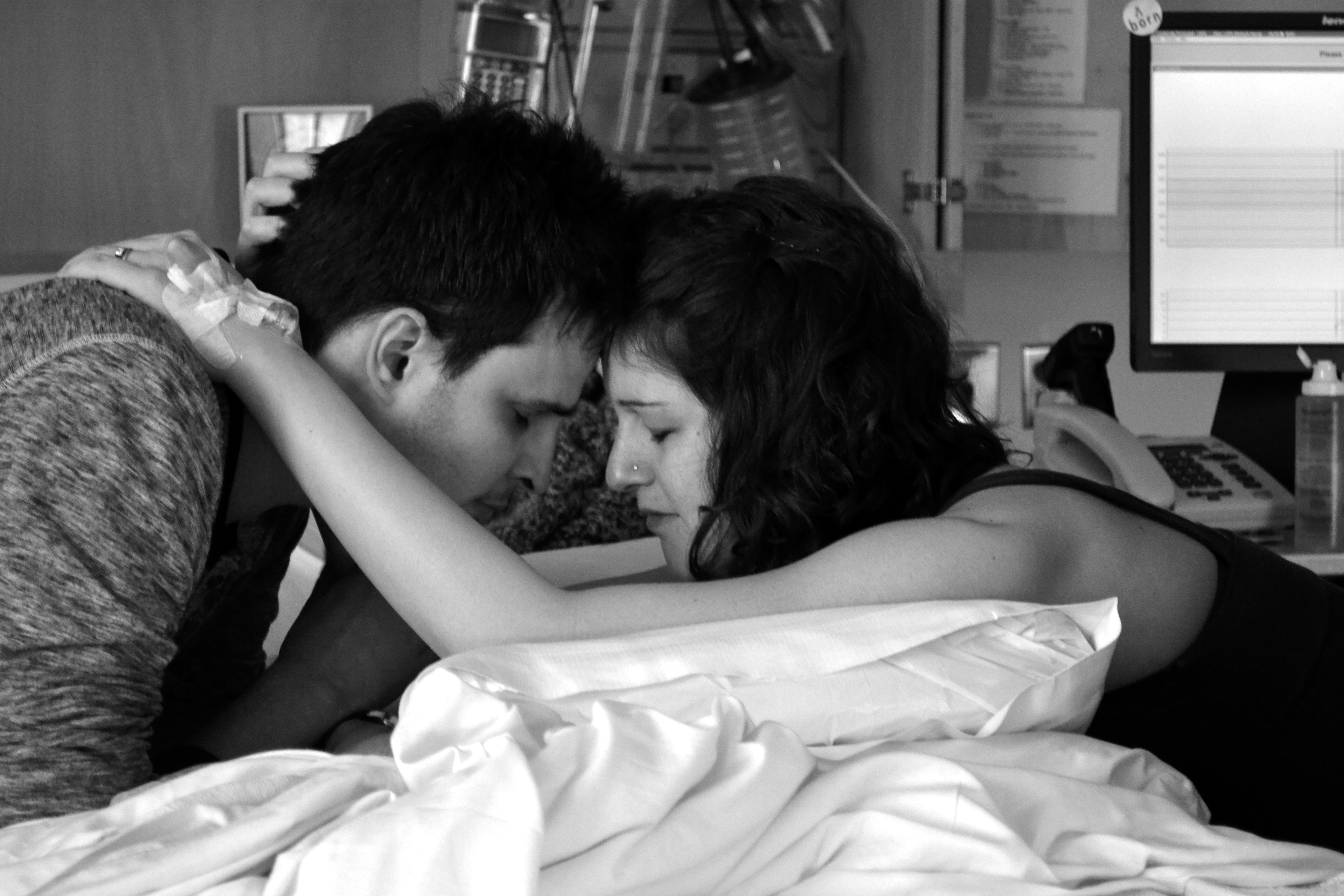
The first eight hours of active labour was somewhat what it might have been like at home. We kept the lighting low and let things progress naturally, played our baby playlist (that moved between Crosby, Stills, and Nash, Miles Davis, Abdullah Ibrahim, Nick Drake, Alexi Murdoch, and even Justin Timberlake). At times we danced a little, at others we were overcome by the heaviness of the situation. Occasionally, we fell into the fold of the moment and transcended the physical space of the hospital. We were in this together and nothing could take that away.
Sharing a moment. Photo taken by Amélie Delage.
The first eight hours of labour were relatively smooth. Given Meg went into active labour the morning of April 15th, we were sure our baby was coming that day. At this point we didn’t know the sex—some things in life are better as mysteries—but I was excited my child might share a birthday with Leonardo Da Vinci, Bessie Smith, and Jackie Robinson Day. Of course, every day has its share of tragedies, the 15th being the day the Titanic sunk and the day Lincoln died. But our baby, or the creator, depending on how you want to frame it, had other plans. Unfortunately, much of the tranquility of the birth changed when the baby’s heart rate dropped after a considerable contraction. This led hospital staff to enter the room in a flurry and attach a fetal heart monitor to the head of our baby. A few hours after this experience Meg went from 8cm dilated down to 6cm. The mind and body truly are connected. Shortly after this incident Meg’s mom arrived at the hospital. We switched spots for 30 minutes, and given we live (literally) across the street from the hospital, I had time to scurry home. I fed the cats, and took a shot of tequila.
When I returned we reset the mood. We keep the music tranquil, focused on deep breathing and prepared again to enter into the experience we had prepared for over the last ten months. It certainly is challenging to maintain peace when you have an IV in your hand to administer antibiotics for the GBS, a monitor wrapped around your belly to measure contractions, and a monitor attached to the baby’s head to observe heart rate. Meg remained resolved that she would, under no circumstances, have an epidural. I don’t think I could be so strong. Earlier on, before the baby had a monitor attached to him, our midwife let Meg disconnect and enjoy a nice soak in the Jacuzzi in our room. It relieved a lot of tension, and I’m quite certain a doctor would not have allowed this. Twelve hours into the birth (11 pm) and things significantly slowed down. At this point we were getting mentally and physically exhausted and so we began Oxytocin (hooked up by IV) at the lowest possible level. This was the one and only time the midwife asked Meg if she wanted an epidural. Meg, the powerful and resolved woman that she is, refused. Within half an hour we were back up and running.
I’ve done some exigent and incredible things in my life. I wrote and defended my Master’s Thesis. I recently wrote a 400-page PhD thesis. I’ve gone scuba diving. I’ve slept outside on the ground in freezing temperatures. I’ve done volunteer work in the poorest communities in Mexico. I’ve backpacked throughout Southeast Asia and Europe. I once killed a spider far beyond the size of my comfort level. They all pale in comparison to the endurance test of giving birth. In many ways, raising a child, I’m learning, is an extension of that larger birth experience. As midnight struck Meg began to enter the transition phase, the intense period between 8cm-10cm that prepares enough space for the baby to begin its descent. So, I guess we were having an April 16th baby.
I can live with that. By this date in 1912 the Titanic was on the front page of every newspaper. It is said that on April 16th, in 1178 BC, a solar eclipse marked the return of Odysseus, the legendary King of Ithaca, to his kingdom after the Trojan War. In 1935, Babe Ruth played his first National League game for the Boston Braves and hit a homerun. In 1963, Dr. Martin Luther King, Jr.—a hero of mine—penned his Letter from Birmingham Jail while incarcerated in Birmingham, Alabama for protesting against segregation. In that letter he wrote the inspirational words: “Oppressed people cannot remain oppressed forever. The yearning for freedom eventually manifests itself, and that is what has happened to the American Negro. Something within has reminded him of his birthright of freedom, and something without has reminded him that it can be gained […] the United States Negro is moving with a sense of great urgency toward the promised land of racial justice.” I like the idea that my baby would enter the world on the day that one of twentieth century’s greatest activists imagined a more just society for all people. April 16th is the birthday of Charlie Chaplin (1889): that master of comedic timing, and arguably the single most important and universal icon in cinema’s history. April 16th also marks the passing of the Ralph Ellison, the author of Invisible Man, my favourite novel. Of course, the achievements and tragedies that befall a given date don’t interest me as much as what will become my child’s milestones. Who knows what Wikipedia might say about him one day?
After that needed historical reprieve, I return to the birth. The last 4.5 hours of birth were challenging and exhausting beyond what I had imagined. As the Oxytocin increased so did the power of the contractions and their frequency. If you’ve met Meg, you know she is one of the sweetest people on the planet. I’ve never heard her use such foul language and then pick up a peaceful conversation shortly after a contraction. Additionally, I might have broke down and collapsed if our doula wasn’t there to provide needed support. I can’t stress the value of a doula enough. She provided important techniques for massage, breathing, and she not only helped Meg, but she also kept me calm a great deal. As things intensified, Meg needed the music off, and she—how to put this nicely?—demanded that we not touch her. But like all things in life, eventually you reach a summit point and begin your gradual descent back down.
The final hour of the transition stage was incredibly intense, especially in the hospital with such high levels of administered Oxytocin and no pain medication. No one wants to watch the person they care about most suffer. I’m sure Meg doesn’t quite think of the experience as suffering, as suffering and pain is a matter of perspective. In Buddhism, Buddha said “Human life is suffering,” and in Christianity, Jesus suffered and died on the cross in order to save humankind. The point being, with suffering can come great understanding, even transcendence. By the time the pushing stage came, Meg had been in active labour for 17 hours. By this time, I was physically drained, yet alert, and I could only imagine how Meg was feeling. With every contraction I focused on making deep chant-like breaths to help Meg with her breathing. I repeated one of our mantras: “surrender.” After about 20 minutes of pushing, I could see the head of my baby. I shouted, “I can see the head!”
By this point, Meg was so strained and fatigued she couldn’t quite push the baby out, at least not quickly enough for the midwife’s comfort. The baby’s heart rate was dropping a little more with every push, although recovering just fine. It was at this point that the midwives recommend the doctors come in and give the baby some final help with suction. I never heard Meg so happily accept an intervention. Everything after this point happened so fast. I had been looking forward to catching my baby, but at that moment I just wanted my wife to be ok, and for our baby to be safe. Sometimes in life we need a little help. It’s hard for us determined types to admit. As the Beatles once said, “I get by with a little help from my friends.” Of course, the word Meg called the doctor while he used the vacuum along with an episiotomy was not friend. I held her hand and told her she could do this and that she was the strongest person I knew. These words are true. And then it happened. The room froze. The doctors, residents, nurses, midwives disappeared. It was only Meg and myself as our beautiful baby boy was lifted into the air. “It’s a boy,” someone said. I cried. I can only assume every man cries when he sees his child for the first time. Meg told me to go over to him as the pediatricians cleared his lungs and checked him over. They told me he was long at 22 inches, but more importantly: he was healthy. He weighed 8.08 pounds — the universal number of bass in hip-hop thanks to the low-frequency sounds of Roland’s early drum machine: The Roland TR-808 Rhythm Composer. On lower notes—the subtonic—our baby arrived. After a few minutes he was given to me and I brought him over to Meg who held our baby close against her breast.
Baby, newly earthside, first 5 minutes.
I then took the baby and did skin to skin as Meg delivered what the midwife called a beautiful looking placenta. The body really is amazing. If we had a yard, we would have buried the placenta and planted a tree on top. Some people eat the placenta, what is called placentophagy, but that’s even too much for urban hippies like us. Instead it ended up in a bin with other placentas that sustained babies in utero. After the midwife stitched Meg’s incision, I gave the baby back to her. There are few miracles in life. Birth might be one. Or perhaps I am conflating the natural with the mysterious, or maybe the mysterious is always natural, and the natural mysterious. The baby took right to breastfeeding. We did this. I’ll never look at another woman who has given birth the same. Birth without fear is possible, even 20 days late in a hospital setting with cascading (in our case, likely necessary) interventions. It wasn’t the orgasmic birth we had hoped for, but it was our birth: our story.
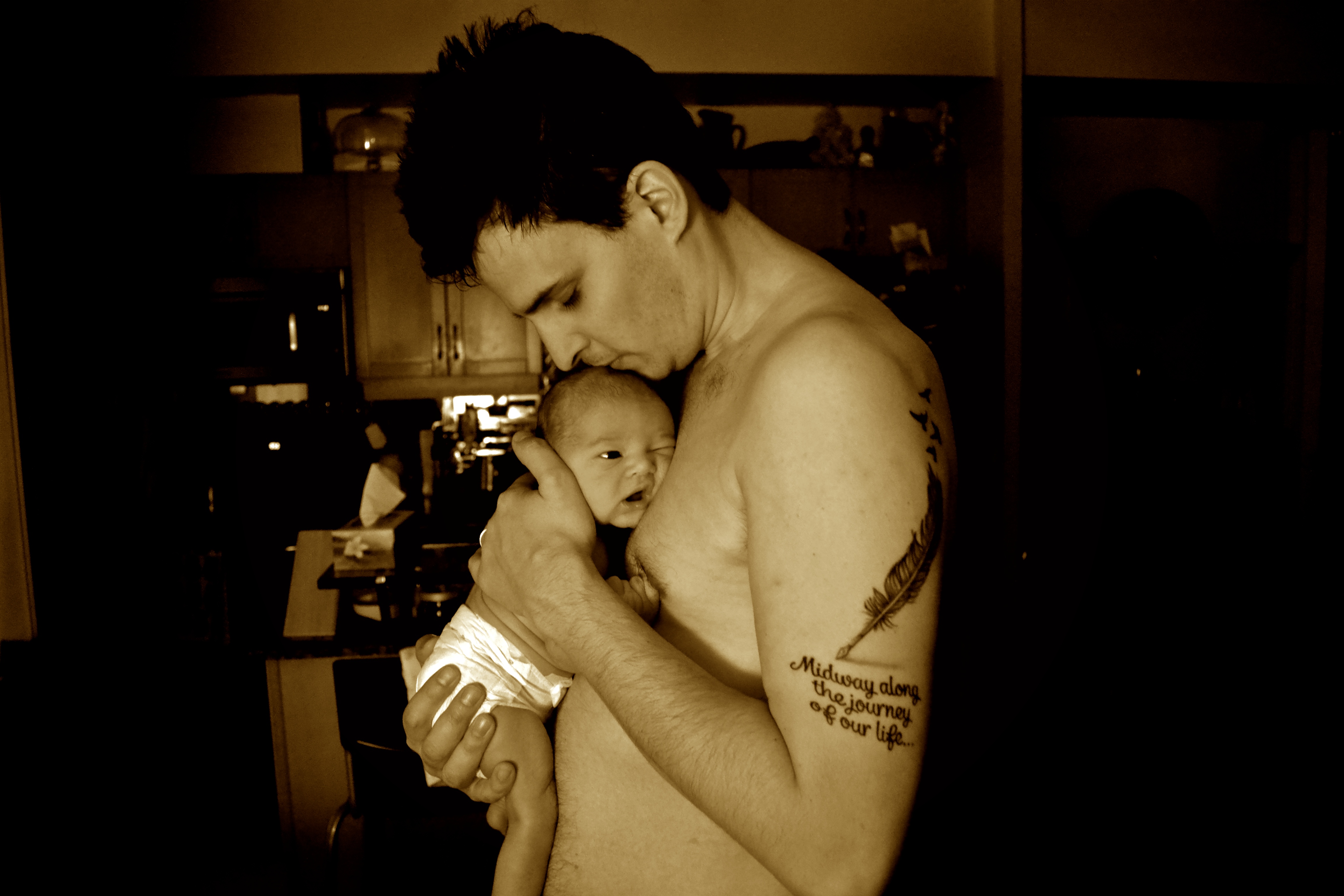
The total hospital experience wasn’t quite over. Although the baby was born at 4:43 am, we didn’t leave the hospital until that evening at 9:30 pm. Since the baby was “late,” his blood levels were monitored, and because Meg had a large episiotomy she needed to spend the day in the hospital bed. None of that mattered too much since we had a beautiful baby boy. We named him Phoenix: a perfect name for a baby born of a yogini mother and a literati father. Further, the phoenix, a symbol of rebirth, felt like an appropriate name after a long birthing experience. Moreover, it is fitting he was born so close to Easter, which is filled with the symbolism of resurrection and new life arising from suffering. In Greek mythology, a phoenix (φοίνιξ, phóinīx) is a bird associated with the sun that is cyclically regenerated or reborn. What renews one’s life and purpose more than new life? Phoenix has certainly renewed our lives and will continue to do so for the rest of our days, hopefully being reborn through his own children one day. Family lineages are really about rebirth. Phoenix will continue to challenge, surprise, and inspire us as we discover our footing as parents. Every day we make new decisions, improvise, and do what we believe best for our family. We’re all new here. From the ashes, we rise.
Holding my baby, day 2.Birth announcement, taken on day 2.
I was on the radio earlier today. I spoke about my own work, music, and read part of my poem, Soundin’ Canaan. I was asked to choose two pieces of music to bookend my interview, and selected Oscar Peterson’s moving “Hymn to Freedom,” and Marvin Gaye’s “What’s Going On.”
Jerry Prager, a local historian spoke first about his new book, Laying the Bed: The Native Origins of the Underground Railroard. I come in around 35 minutes after the Oscar Peterson piece.
Below are my top 15 films of 2013. As a rule I didn’t include documentaries, which given the slew of great docs released last year (The Act of Killing, Black Fish, TheSquare)would have made compiling the list more challenging.
There are a few films I still want to see, such as The Dirties, Fruitvale Station,and Nebraska, along with a few foreign films, and any list is subjective (and in this case a little androcentric), but if I had to choose 15…
1. 12 Years a Slave: The best film of the year. No, it doesn’t change history, and no it doesn’t provide the full picture of slavery, but it is a riveting and powerful two hours of cinema. 12 Years a Slave offers no artificial Hollywood catharsis; rather, it presents an honest and harrowing parable of the evil of slavery as told through the real life experience of a man who was sent to hell and lived to tell about it. Read my full review, here.
2. Prisoners: Given the incredible performances from the entire cast, there should have been some Oscar nominations for acting, especially for Jackman’s and Gyllenhaal’s standout performances. Given the subject matter, this is hardly a film for everyone, but it is a spellbinding English-language debut from Villeneuve. Read my full review, here.
3. The Wolf of Wall Street:Martin Scorsese’s latest offering The Wolf of Wall Street has divided audiences into two camps: those who praise the work as a masterpiece of cinematic verve, and those who say it glorifies white-collar crime along with the film’s antihero, real life penny stock criminal, Jordan Belfort. The Wolf of Wall Street is an irreverent and potent satire about greed, excess, and the perversion of the American dream. The writing is spot on, Scorsese’s directing is inspired, providing lots of room for his actors to improvise, and DiCaprio gives the most dynamic performance of his career. Matthew McConaughey, who also gave a great performance in Dallas Buyers Club, steals a scene in the movie. Read my full review, here.
4. Her: Spike Jonze’s Her is a fantastic film that mergesscience fiction with romantic dramedy to explore the state of modern human relationships in the age of technology. Joaquin Phoenix proves once again why he is one of the best actors working in cinema today (I thought Phoenix should have won Best Actor last year for The Master). It would have been really cool if Scarlett Johansson as Samantha (voice) received an acting nomination given she never physically appears on screen.
5. Dallas Buyers Club:Matthew McConaughey is on fire lately. He’s gone from romcom melodramatic hamming to a first rate actor who is a serious a contender for Best Actor at this year’s Oscars. He’s even taking on T.V.—well, HBO—in True Detective. In Dallas Buyers Club, McConaughey’s character, a homophobic electrician and rodeo cowboy, finds out he has AIDS and is told he has only 30 days to live. He ends up smuggling unapproved pharmaceutical drugs into Texas when he finds they are effective at improving his own symptoms and then distributes them to fellow AIDS sufferers through the eponymous “Dallas Buyers Club,” drawing the ire of the FDA. Dallas Buyers Club is a formidable film that deals squarely with the AIDS crisis in the 80s, which along with Leto’s spellbinding acting is carried by a scrawny McConaughey who gives one of his finest performances.
6. The Wind Rises: Likely maestro Hayao Miyazaki’s swan song, The Wind Rises is a beautiful and devastating lament concerning the distortion of beauty. A visually magnificent celebration of the ingenuity and creativity of prewar Japan the film hints at what is possible, but then shows how easily dreams can become impossible nightmares. While I was surprised like many that the protagonist was a warplane designer, and although the film skirts around some important political issues, I was, nevertheless, drawn deeply in by the story, images, and wonderment that will—like all Miyazaki films, from Totoroto Spirited Away—stay with me for a lifetime.
7. The Place Beyond the Pines:The only logical reason this film was completely snubbed at the Oscars is that is was released too early in the year, as the trend seems to go. The Place Beyond the Pines contains the best cinematic twist I saw on screen last year. The film—which veers towards Greek tragedy throughout—provides a salient discourse about the moral ambiguity we walk in order to protect our loved ones. Unlike most films of its style, there are no heroes, only shared fears and truths manifested through the ripple effects of a violent past.
8. Upstream Color: This film flew a little under the radar, perhaps because the unusual content alienated most viewers. Upstream Color is written, directed, produced, edited, designed, cast, and stars Shane Carruth whose last film was his 2004, Primer. Upstream Color focuses on two people whose lives and behaviours are affected by a complex parasite—that they are unaware of—that has a three-stage life cycle as it passes from humans to pigs to orchids. You need to see and experience this transcendent film to believe it.
9. Frances Ha: Directed by Noah Baumbach (The Squid and the Whale, and co-writer with Wes Anderson of The Life Aquatic with Steve Zissou and Fantastic Mr. Fox), Frances Ha is a quirky indie film with an endearing performance from Greta Gerwig. I agree with Stephanie Zacharek of The Village Voicewho praised Gerwig’s acting, writing: “No other movie has allowed her to display her colors like this. Frances is a little dizzy and frequently maddening, but Gerwig is precise in delineating the character’s loopiness: Her lines always hit just behind the beat, like a jazz drummer who pretends to flub yet knows exactly what’s up.” If you don’t know what’s up, check out this off beat picture.
10. All is Lost: This film has a similar feel to Gravity, only it takes place at sea and is, in my opinion, more riveting. This film captivated me in the same way that 2001: ASpace Odyssey did, except instead of classical music, the majority of sounds emit from a perilous ocean. Robert Redford is literally the only actor in this film, and his performance is one of his best. The lack of a Best Actor nomination for Redford is perhaps the biggest Oscar snub this year, but that’s hardly a surprise since this isn’t a Weinstein Company film.
11. Blue is the Warmest Color: The most controversial film of the year, entirely because it depicts two women having sex for 7 minutes (although that’s less than 5% of the film’s running time). Aside from offending puritans and some lesbians who contend it got the “sex” wrong—not that there is ever a right way to have sex—the film is an artful treatment of love in its many colourful brushstrokes, although blue is the primary colour. I found the polemical performances truly inspired, and the story feels very real, which sadly seems to be a rare treatment in same-sex love depictions in cinema, sans a few films I’ve seen such as Pariah and Weekend.
12. In a World… One of the best comedies of last year, In a World… is written, directed, co-produced, and stars Lake Bell. The film feels fresh with a straightforward plot focusing on a young woman doing voice-over work for film trailers. Bell’s performance is magnetic as she takes on the cutthroat male-dominated world of voice-over.
13. A Field in England: Ben Wheatley’s A Field in England is a British historical (although revisionist) thriller shot entirely in black-and-white and set during the mid-17th century English Civil War. The film is a gumbo concoction odyssey that breaks free of the historical thriller genre through the use of experimental film techniques: mixing humour, horror and hallucination, with a dissonant kaleidoscopic audio score—an homage to 60s psychedelia. Read my full review, here.
14. Blue Caprice: A cerebral and chilling depiction of the triviality of evil, based on the notorious Beltway sniper attacks from the point of view of the two killers. Blue Caprice is a striking and engrossing debut for writer-director Alexandre Moors, and the taut psychological thriller is made all the more eerie thanks to a great soundtrack provided by Colin Stetson and Sarah Neufeld.
15. Philomena: Based on the true story of Irish Catholic nuns who sold babies to the States because they were conceived out of wedlock, Philomena concerns injustice and hypocrisy, only to teach its audience a potent lesson about how forgiveness is far more difficult and significant than outrage. The film gracefully teeters between the BBC reporter’s slightly unrestrained antipathy (Steve Coogan) and Philomena’s (Judi Dench) heartfelt and humble demeanour.
~
Some other films (sans documentaries) I enjoyed, but didn’t quite make it to the top: Gravity, Enough Said, Blue Jasmine, Enemy, American Hustle, Ain’t Them Bodies Saints, Side Effects, Before Midnight, and Inside Llewyn Davis.
And a few of my picks for the 86th Oscars:
Best Picture: 12 Years a Slave Best Actor: Leonardo DiCaprio (Wolf, but will likely go to Matthew McConaughey in Dallas Buyers Club) Best Actress: Judi Dench (Philomena) Best Supporting Actor: Jared Leto (Dallas Buyers Club) Best Supporting Actress: Lupita Nyong’o (12 Years a Slave) Best Directing: 12 Years a Slave Best Documentary Feature: The Act of Killing Best Animated Feature: The Wind Rises
But, in any case, did not the black people in America, deprived of their own musical instruments, take the trumpet and the trombone and blow them as they had never been blown before, as indeed they were not designed to be blown? And the result, was it not jazz? Is any one going to say that this was a loss to the world or that those first Negro slaves who began to play around with the discarded instruments of their masters should have played waltzes and foxtrots? No! Let every people bring their gifts to the great festival of the world’s cultural harvest and mankind will be all the richer for the variety and distinctiveness of the offerings.
-Chinua Achebe, “Colonialist Critique”
In the above quote, Chinua Achebe uses the example of jazz to articulate his right and necessity to use the Western novel form to express the particular experience of African people. Achebe’s argument, with his cross-cultural and anticolonial positioning, describes how African Americans utilized the instruments they had access to in order to create a music that was uniquely their own: a music contributing to the “world’s cultural harvest,” growing and taking root in a variety of musics, cultures, and soils.
Achebe was a Nigerian novelist/storyteller, poet, professor, critic, and humanitarian. His most well known novel, Things Fall Apart (1958), which many consider his magnum opus, is the most widely read book in modern African literature. His critiques of racism in Joseph Conrad’s Heart of Darkness were instrumental to the postcolonial critical movement. Recalling his time as political prisoner, Nelson Mandela referred to Achebe as a writer “in whose company the prison walls fell down.” Last year, on March 21st, 2013, Achebe passed away. He remains an inspiration to people and writers around the world for the liberating potential of his literature and his depictions of life in Africa.



 In the above quote, Chinua Achebe uses the example of jazz to articulate his right and necessity to use the Western novel form to express the particular experience of African people. Achebe’s argument, with his cross-cultural and anticolonial positioning, describes how African Americans utilized the instruments they had access to in order to create a music that was uniquely their own: a music contributing to the “world’s cultural harvest,” growing and taking root in a variety of musics, cultures, and soils.
 PAUL db WATKINS