Excessus Mentis: A Defence of Scorsese’s The Wolf of Wall Street

How manye maladyes ffolwen of excesse and of glotonyes.
Chaucer, The Pardoner’s Tale 514

Martin Scorsese’s latest offering The Wolf of Wall Street has divided audiences into two camps: those who praise the work as a masterpiece of cinematic verve, and those who say it glorifies white-collar crime along with the film’s antihero, real life penny stock criminal, Jordan Belfort. While not quite the magnum opus some call it, I think The Wolf of Wall Street is an inspired parable and cinematic opera about greed, excess, and the perversion of the American dream.

Perhaps there was a time, as Percy Shelley writes in “A Defence of Poetry,” when “poets [were] the unacknowledged legislators of the world.” I say this with some unease, since my primary field of study is poetry, but today it seems that filmmakers are the cultural legislators of the Western World. Hollywood, like the stock market, is big business, netting profits in the billions every year. In many ways, Hollywood is emblematic of the American dream; certainly the cinema is a place where we exchange money to watch our dreams, fantasies, and even nightmares unfold on a big screen in a dimly lit room. Scorsese, who often challenges Hollywood sensibility, continues to be one of American cinema’s great dream makers and storytellers, gifting the world films like Mean Streets (1973), Taxi Driver (1976), Raging Bull (1980), Goodfellas (1990), and The Departed (2006).

The Wolf of Wall Street continues Scorsese’s fixation with crime, identity, and machismo, as well as his Roman Catholic concerns around guilt and redemption. However, unlike Scorsese’s other gangster films there is hardly any graphic violence in Wolf, although there remains, perhaps more than any of his films, his liberal usage of profanity. It could be argued, and probably should, that Belfort’s obsession with controlling women’s bodies, as well as his betrayal of his victim’s trust, is violence. The narrative techniques and do-it-yourself rise to power in Wolf parallels Goodfellas, but instead of mob bloodshed and revenge, Scorsese focuses his lens on robber baron, capitalistic sociopath, and real life penny stock criminal/self-made multi-millionaire, Jordan Belfort.

The Wolf of Wall Street is an orgiastic, hurly-burly, dizzying cornucopia of sex, drugs, and total debauchery. It is Scorsese’s most excessive film, with a three-hour running time (even after he left an hour on the cutting floor), and so many scenes of Belfort (manically acted by DiCaprio) and Donnie Azoff (Jonah Hill) popping Qualuudes (a very powerful pill based drug) and having sex with prostitutes that you feel, perhaps, an additional hour of the film could have been cut. However, the excessive use of excess in the film highlights the vulgarity of Belfort’s lack of morality, as he travels far beyond the prescribed limit of acceptable capitalist criminality (in the eyes of regulators) and gets lost in the rapturous trance of the game he is playing.

Does the film glorify Belfort’s despicable swindling his clients out of millions, failing to show the effects of his actions, as one victim, Chistina McDowell, insists in an Open Letter? Or, does it sicken the viewer and take Belfort down through its use of raucous and unrelenting satire? For starters, I don’t think the film glorifies white-collar crime, just like I don’t think 12 Years a Slave glorifies slavery. Humour and satire are effective in making the audience realize just how absurd and excessive Belfort’s greed was. Charlie Chaplin’s The Great Dictator was extremely risky in 1939 as it used satire to effectively depict and make fun of Hitler and dictatorships, and it was banned in many countries. Film is representation; otherwise there would not be films about the Holocaust. Great art is often confrontational, and if art is to challenge it needs to be provocative enough to start some important conversations, which Scorsese is thankful that this film did (Screen Rant). DiCaprio has called Wolf a punk rock film about the darker nature of humans. While McDowell’s point is well taken, I don’t think the film would be as punchy, effecting, or vicious if it showed the effect Belfort’s actions had on his victims. It would be Oliver Stone’s 1987 film, Wall Street. 

Unlike many of Scorsese’s films whose protagonists or antiheroes often burst into flames at the end of the film, Belfort hardly suffers for his incendiary crimes. Rather, we are reminded that Belfort is a real person: a cog in a larger system of oppression that makes his actions possible in the first place. People like Belfort often get away with, or face minimal retribution for the crimes they commit. In the end Belford informs on his own associates in order to save his own ass. Henry Hill does the same in Goodfellas, deciding to enroll in a Witness Protection Program, with real-life Hill serving four years and six months of his 10-year sentence in prison. The Wolf shows Belfort entering prison with a look of fear in his eyes, which quickly dissipates when he realizes that prison for him, with tennis courts and other luxuries, would not be that bad: “For a brief, fleeting moment, I’d forgotten I was rich and lived in America.” It should sit uncomfortably with viewers that Belfort never really gets the justice he deserves. In one of the final scenes, FBI agent Patrick Denham (played by Kyle Chandler) apprehends that his pursuit of Belfort and his organization has changed very little about how America operates.

Watching the film I was reminded of the CEOs of the big three automakers who flew in luxurious private jets to Washington to plead for a $35 billion bailout in taxpayer money, or AIG, whose executives, after receiving some 85 billion bailout dollars, headed for a week-long retreat to a luxury resort and spa. Belfort is the bastard child of a much larger malaise of greed in corporate capitalism. Some reviewers have commented that Wolf is essentially propaganda for Belfort’s motivational speaking career, but I can only assume that the individuals who would hire a man like him are already deeply lost in the sea of excess. Or, like millions of Americans, they are chasing a dream. There are those who will watch The Wolf of Wall Street and identify with Belfort. Steven Perlberg of Business Insider described watching the film near the Goldman Sachs building and reported cheers by the audience of financial workers at inappropriate moments, such as “When Belfort—a drug addict who later attempts to remain sober—rips up a couch cushion to get to his secret coke stash, there were cheers.” I’m sure there were also those who watched Christian Bale in American Psycho and wanted to be Patrick Bateman, although they hopefully didn’t cheer openly in the theatre. There will be those who admire DiCaprio’s sinister portrayal of Belfort, similar to how Michael Douglas has had hundreds of people come up to him and say, “I wanted to be like Gordon Gekko” (Greed is Not Good). Many, mostly young men full of bravado, will want to be like Belfort. Can you blame them, especially since our society often promotes men (and sometimes women) who are willing to do anything to get rich? This is hardly Scorsese’s or DiCaprio’s fault—it is simply poor viewer analysis. Think of how many different interpretations there are of Shakespeare, or the Bible? Just because some misguided and bullied kids listened to Marilyn Manson before they shot up their school, hardly means that Manson was the root cause. Such would be an evasion of the larger issues, often ignored by mainstream media.

For me, the film was a little like travelling through Dante’s fourth circle of Hell (greed/avarice) for three hours, although I do admit that I laughed a fair bit, which is sort of the point of the grotesque parody. The Wolf of Wall Street is an irreverent and potent satire about greed, excess, and the perversion of the American dream. The writing is spot on, Scorsese’s directing is inspired, providing lots of room for his actors to improvise, and DiCaprio gives the most dynamic performance of his career. Matthew McConaughey, who also gave a great performance in last year’s Dallas Buyers Club, steals a scene in the movie. Some might feel the film glorifies greed. Jordan Belfort glorifies greed. America glorifies greed. The film does not. In some disturbing ways, Belfort was simply being American. As Belfort belts out in one of his many excessive speeches in the film:

This right here is the land of opportunity. This is America. This is my home! The show goes on!
Long Live the New Flesh: David Cronenberg’s Evolution

A progenitor of a genre typically referred to as body horror, Toronto-born and world-renowned auteur David Cronenberg remains one of the most audacious narrative directors working in cinema. Citing literary influences as diverse and incendiary as Vladimir Nabokov and William S. Burroughs (Cronenberg adapted Burroughs’s Naked Lunch), Cronenberg’s films continually blur the line between corporeality and psychological disorder, reality and hallucinatory nightmare. Currently, TIFF features a major exhibit to celebrate the director’s work, David Cronenberg: Evolution, and has been playing Cronenberg’s entire cinematic oeuvre, with special introductions to screenings and talks with those who have worked most closely with him.

To read more, see my full review at Toronto Review of Books.

Totoro

In my opinion, Hayao Miyazaki’s beloved film, My Neighbor Totoro (1988), wondrously envisioned through the eyes of two young Japanese girls, is the most imaginative and ecologically conscious “children’s” film ever conceived. I’ve placed “children” in quotation marks, because I really do feel that Totoro is a film for all people. Unlike the chaotic pacing and bad manners of so much of what passes as children’s entertainment, Totoro offers a warm, often funny, and subtler approach to the imagination. Simply put, the plot involves the Kusakabe family and their move to a new home beside a mysterious forest. It is there that they (Satsuki and Mei) encounter Totoro and his friends (including the very cool Cat Bus).

Last week I had the chance to watch a beautiful print of the film at TIFF, which not only looked fantastic, but also did justice to the great soundtrack by Joe Hisaishi. The same wide-eyed wonderment that I felt watching the film when I was a kid was hardly diminished; if anything, it was enhanced by a greater appreciation of the simple beauty illumining every frame. In a world—and not to judge, I live in downtown Toronto by choice—where technology rules supreme, where music, video, and pornography are available on our phones, and where you can microwave your dinner in a minute and a half, Totoro is a folk tale about a return to a time when, as Tatsuo (the girls’ father) says, “Trees and people used to be good friends. I saw that tree and decided to buy the house. Hope mom likes it too.” Of course, there is a somber element to the film, as the father and two girls move to the country in the first place to be near their ailing mother. We never find out why she is sick; rather, the film focuses on the love, wonder, and bond the family share during this difficult time.

Without a major conflict, or an antagonist (unheard of in 99.9% of films), the film teaches us that wonderment is often enough to sustain hope. As Roger Ebert wrote in his review of the film (and inclusion as a Great Movie) in 2001:

Here is a children’s film made for the world we should live in, rather than the one we occupy […] “My Neighbor Totoro” is based on experience, situation and exploration — not on conflict and threat […] It depends on a situation instead of a plot, and suggests that the wonder of life and the resources of imagination supply all the adventure you need.

It’s a shame that more children’s films lack the wonderful, cooperative, and imaginative spirit that charges through Totoro. Most animated films require a suspension of disbelief, but something about Totoro feels particularly natural, which makes the leap into enchantment easier. The film is beautifully handcrafted, long before CGI and Pixar, and the scenes feel very naturalistic, as do the interactions between the girls and their loving father, another positive portrayal in the film. The film is drawn the classic way, frame by frame, with Hayao Miyazaki contributing thousands and thousands of frames himself.

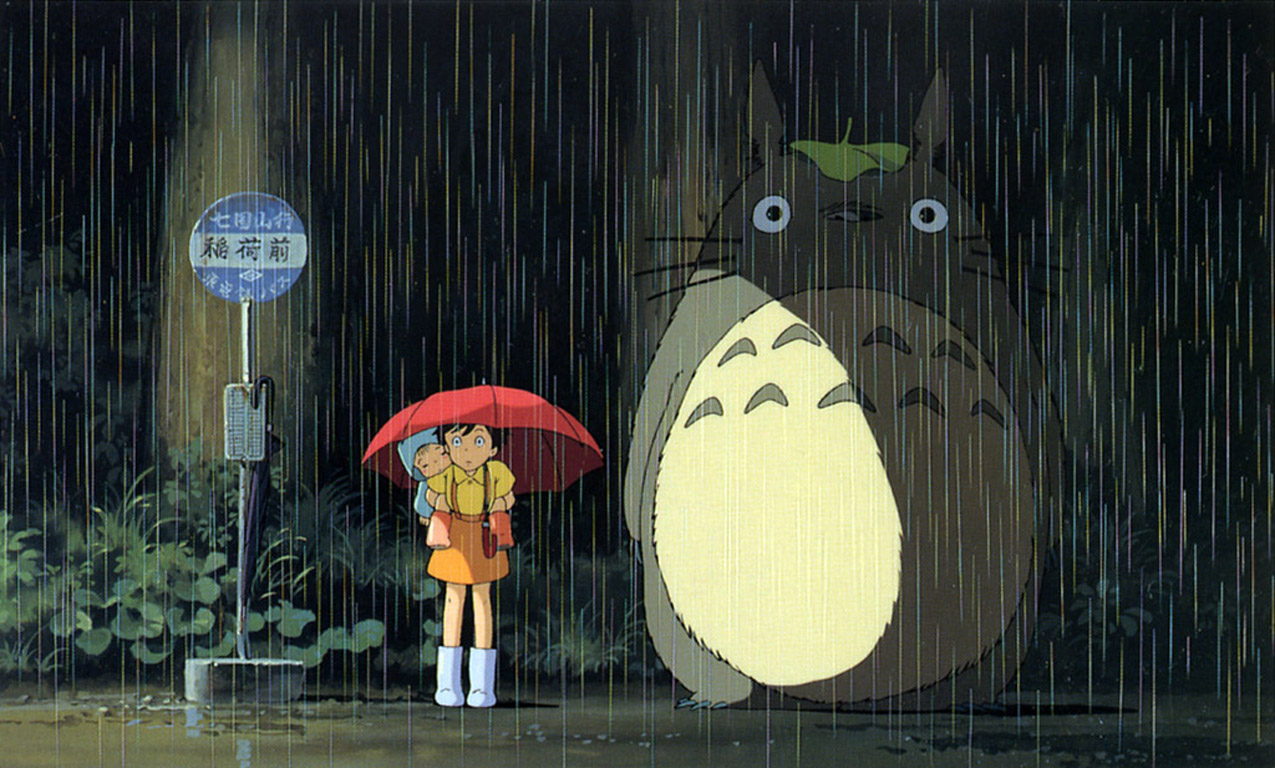
Notice the detail and wonderment in this scene where Totoro shows up to wait with the girls for their father who is late to arrive from work.
Notice the detail and wonderment in this scene where Totoro shows up to wait with the girls for their father who is late to arrive from work. Check out the scene, here.

Set in a period that is both modern and nostalgic, Totoro is a fable that captivates with little tension or plot twists, working against the mythology of the evil troll. Rather, forest spirits or trolls represent the bond that used to (and still could) exist between humans and spirits in a traditional village. In this way, Totoro is not just about conservation of the forest, but also of a certain way of living that is slowly disappearing due to urbanization. Few animated films have had the impact on me that Totoro has, other than Miyazaki’s phantasmagorical Spirited Away, and the haunting anti-war film, Grave of the Fireflies (a Studio Ghibli production that played with Totoro as a double feature). Set in Japan during World War II, Grave of the Fireflies, like Totoro, but for entirely different reasons, will challenge you to reconsider the possibilities of animation to convey a deep message.

Globally, the impact of Totoro has been enormous. For Japanese children Totoro is as famous as Winnie-the-Pooh is for children in North America. Like Winnie-the-Pooh, and a few select animated characters, Totoro reminds us of the human capacity to imagine a world that is more creative and loving. Sadly, Miyazaki announced on September 1, 2013 that The Wind Rises will be his final feature-length film. Totoro, along with his large catalogue of films, will continue to live on in the collective imagination.

Totoro, along with other Studio Ghibli films in various versions (dubbed, subtitled), is playing at TIFF until January 3rd.

My wife and Totoro-fan-to-be posing with Totoro cutout.

Tsotsi: The Transformative Power of Hope

The following is a throwback (slightly amended) review I wrote in 2006. This is nearly four years before I published anything in any format. I found it on my hard drive and felt it worth sharing, even if the language is simpler (perhaps more straightforward) than I often write reviews in these days. I have a couple more of these old reviews I might share at some point. Anyways, Tsotsi is a fantastic film, and one I need to certainly watch again soon.

1560Tsotsi_Cover

Life is a game of chance: we do not know whether we will be born into poverty or riches. At the same time, the decisions we make invariably influence the path we walk. The theme of chance is emphasized in the opening shots of Tsotsi as we watch Tsotsi’s gang roll dice, set in the monochromatic shades of a dark, dingy shack. Tsotsi, which literally means “thug,” is an effective and poignant film directed by Gavin Hood (adapted from an Athol Fugard novel) about a young man named Tsotsi who embarks on a transformative journey, set in motion by the helplessness of a baby. Tsotsi had no intention of kidnapping the baby, discovering it in the backseat of a car he stole after shooting its mother while she got out to ring the buzzer at her gate. The early contrast between the rich and poor communities depicts the austere differences between life in the broken-down shanty township of Soweto to which Tsotsi belongs, and the baby’s parents’ gated, luxurious home in the wealthy community of Joburg, illustrated with masterful cuts of cinematography. Fanon’s article “On Violence” provides an accurate description of what the shantytowns look like in the film: “It’s a world of no space, people are piled one on top of the other, the shacks squeezed tightly together” (4). Tsotsi is a killer, a fact brutally fleshed out earlier in the film by his senseless murder of man on a crowded train in order to steal his wallet. With this knowledge, it would seem that Tsotsi is unfit to take care of a baby, but for some intrinsic reason he takes on this task.

The acting from the almost all African cast is superb, and the young actor (Presley Chweneyagae) who plays Tsotsi has a magnificent amount of control over his emotions, ensuring his portrayal never crosses into melodramatic hamming. There is no sentimentalized view of poverty in this film, and we are not made to feel sympathetic towards Tsotsi. Rather, we journey alongside his transformative awakening on a thin line of hope: a hope that in the end he will do the right thing and give the baby back to its rightful guardians. Because the film is shot within close fields of vision, we are able to see what goes on inside Tsotsi’s head. Metaphorically, Tsotsi undergoes a medieval psychomachia of sorts—a battle for his soul, which the director carefully depicts vis-à-vis subtle shots of Tsotsi walking centre screen down a railway track. Tsotsi has become so dependant on wearing the mask of his public persona that intense feelings of his own innocence bleed into his private sphere where he has become protector of a baby he loves as if it was his own. The tragic comedy results from Tsotsi’s lack of knowing how to take care of a baby: he uses newspapers as diapers, and carries him around with him in a shopping bag. Fortunately Miriam, a nursing mother, provides a counterpoint to Tsotsi’s frustration and helps to gradually ignite a spark of love within Tsotsi’s psyche, deeply buried since his childhood.

Truly, the film is about hope and overcoming one’s odds against the shit cards life can sometimes deal. Tsotsi does not romanticize poverty, glamorize violence, or make us sympathetic towards a violent young man like Tsotsi; rather, it allows us to see the effects and suddenness of violence. Violence committed by the oppressor is passed onto the oppressed in a vicious cycle: the oppressed are left in poverty, while the rich get richer. Tsotsi represents the possibility that maybe the cycle can be broken: a hope for a post-apartheid South African black teenager, and a hope that Tsotsi can become a better person and ultimately do the right thing. In the context of the film, that’s giving the baby back and allowing reconciliation to take place within himself for his own troubled past—allegorical of the reconciliation process in South African. The film follows this progressive journey right up to its heavy ending, which we watch in a perpetual state of anticipation. The film does not try and prescriptively solve the enormous condition of poverty in South Africa; instead, the film traverses beyond the realm of violence, using the theme of forgiveness as a way to move forward and rebuild. The process of moving forward is an utterly frightening concept for Tsotsi, but there is a hopefulness that things can and should be better than they are, at least within his own world.

Check out the trailer:


Works Cited

Fanon, Frantz. “On Violence.” The Wretched of the Earth. New York: Grove Press, 2006. Print.

A Mushroom Trip Worth Taking: A Review of Ben Wheatley’s A Field in England

Ben Wheatley’s A Field in England (2013) is a British historical (although revisionist) thriller shot entirely in black-and-white and set during the mid-17th century English Civil War. The film is a gumbo concoction odyssey that breaks free of the historical thriller genre through the use of experimental film techniques: mixing humour, horror and hallucination, with a dissonant kaleidoscopic audio score—an homage to 60s psychedelia. Having seen Sightseers (2012) last year at TIFF, and Kill List (2011) before, seeing A Field in England at TIFF this year I was expecting Wheatley’s usual brand of gruesome violence through fairly straightforward storytelling.

To read more at Toronto Review of Books, click here.

A “Truthful Statement of Facts”: A Review of Steve McQueen’s 12 Years a Slave

I can speak of Slavery only so far as it came under my own observation—only so far as I have known and experienced it in my own person. My object is, to give a candid and truthful statement of facts: to repeat the story of my life, without exaggeration, leaving it for others to determine, whether even the pages of fiction present a picture of more cruel wrong or a severer bondage.
-Solomon Northup, 12 Years a Slave

So states Solomon Northup in the first page of his grueling autobiography 12 Years a Slave; 160 years later Northup’s words are visually echoed in perhaps the best portrayal of slavery on film. 12 Years a Slave is a fictionalized historical drama by British director Steve McQueen that adapts Northup’s 1853 autobiography of the same title. Given the palette of slavery, McQueen’s film is difficult to watch at times—as it should be—and I agree with critics who have called the film essential viewing. Having seen McQueen’s major theatrical releases, Hunger (2008, about the 1981 Irish Hunger Strike) and Shame (2011, about a struggling sex addict), I knew he wouldn’t shy away from starkly depicting the brutality of slavery, of which, believe it or not, the film could have shown even more.

African American scholar Henry Louis Gates, Jr., who served as a historical consultant on 12 Years a Slave, says the film actually minimizes the depiction of violence: “Slavery was a brutal, violent, sadistic institution. And I think that Steve McQueen showed remarkable restraint. It just hints at how violent slavery was… You can’t depict it and not show violence. That would be Gone with the Wind. But if you’re depicting it, there is a lot more violence in Solomon Northup’s slave narrative than there is in Steve McQueen’s film” (click here to read more from this article). Very true, and while the violence in 12 Years a Slave is visceral and unrelenting, it is fully necessary, much in the way that Schindler’s List needed to show the atrocities Jewish people faced in the concentration camps of Nazi Germany.

The unfortunate reality is that many suffer from a “collective amnesia” and fail to take into account that the Middle Passage—the capture of Africans and the brutal crossing of the sea into the New World—was a holocaust that ruptured, damaged, or destroyed the lives of over 20 million African people. 12 Years a Slave can’t tell the total story of slavery—the epigraph from Northup states the impossibility of this—but it is admirable for its heightened focus on the experiences Northup faced when he was captured, taken from his family, and sold into bondage. Given how realistic McQueen’s antebellum Southern opera feels, the film will set the bar for which other films about slavery will be compared.

McQueen’s early ventures into the art world are apparent, as many scenes are so horrifically beautiful (with very long and wide shots) that you feel as if you are watching a painting slowly combust before your eyes. Such as in the scene where Northup hangs from a tree—almost like a Tableau vivant—with his feet barely touching the muddy ground, which feels like an eternity on the screen. The beautiful southern landscape, along with the pious hypocrisy of the slave owners shows just how dehumanizing slavery was for all parties involved. And yet, despite this brutality the slaves found ways to make their lives meaningful, emphasized, for example, through the spirituals in the film. Recounting the emotive and philosophical power of slave songs, Frederick Douglass attests, “I have sometimes thought the mere hearing of those songs would do more to impress some minds with the horrible character of slavery, than the reading of whole volumes of philosophy on the subject could do” (Narrative 57). Douglass declares that the slave song is the final province of resistance to slavery.

Of course, none of the music, storytelling, or spectacular cinematography would be very affecting if the acting weren’t so phenomenal. As the lead, Chiwetel Ejiofor gave such a heart wrenching and brilliant performance that it would be a shame if he weren’t given an Oscar nomination. The rest of the star-studded cast also shine, or tarnish, as evil men and women who personify the malevolent machinations of slavery. Paul Dano is particularly vicious, that is until we encounter Michael Fassbender as Edwin Epps, a cruel plantation owner who is married to an equally cruel woman played by Sarah Paulson. However, the surprise standout performance, for me, was Lupita Nyong’o as Patsey, a slave on the Epps plantation who suffers the cruel brunt of the Epps’ guilt, jealousy, and perverted rage. Her performance will haunt me for some time to come, as will the film, which is the most painful, and lucid depiction of American slavery I’ve seen in cinema.

Watching a movie in Canada about American slavery, made by a black British director, reminded me of how global and transnational slavery was. And while Canada no longer practiced slavery at the time Northup was captured—he is aided by a Canadian carpenter in the film played by Brad Pitt—it is important to remember that slavery is “Canada’s best kept secret, locked within the National closet” (Afua Cooper, Untold Story 68). In Canada, slavery was not denounced until 1793, and was not formally abolished until 1834. I mention this because the last thing we should do as Canadians is congratulate ourselves for not participating in slavery—because we did—and our continued poor treatment of First Nations people (who were also once kept as slaves) is a reminder of the legacy of injustice that still effects this country.

On a less somber note, 12 Years a Slave is additionally a film about the will to overcome injustice, to find hope where only despair seems plausible, and to remain ardent in the search for greater freedom, fraternity, and equality for all people. Dedicated to Harriet Beecher Stowe (Uncle Tom’s Cabin), Northup’s book was published less than a year after his liberation. It became one of the best selling slave narratives of all time, and yet it remains unknown what happened to Solomon Northup. Regardless, Northup lives on in his book, and now his incredible story manifests in this gripping and powerful historical drama about the brutal inhumanities we as humans inflict upon one another. 12 Years a Slave offers no artificial Hollywood catharsis; rather, it presents an honest and harrowing parable of the evil of slavery as told through the real life experience of a man who was sent to hell and lived to tell about it.

Solomon Northup
Solomon Northup

Works Cited

Cooper, Afua. The Hanging of Angélique: The Untold Story of Canadian Slavery and the Burning of Old Montreal. Toronto: Harper Perennial, 2006. Print.

Douglass, Frederick. Narrative of the Life of Frederick Douglass, an American Slave. New York: Penguin, 1986. Print.

50 MUST SEE HORROR FILMS

d10fbde9-f4b8-4d73-bdb0-9d2d2a341564

My wife and I watch an intense thriller or horror film around once a month. We ramp it up every October to around 10 horror films to celebrate Hallowe’en. I admit there were a couple films on this list she couldn’t finish and I don’t blame her… although she did make it to the end of Martyrs, so who knows what qualifies as too much? And why do we enjoy scary films, anyway? Probably for the same reason we stop and gaze at a car accident: it is purgative and cathartic to live and survive someone else’s suffering. Catharsis is employed by Aristotle in the sixth chapter of his Tragedy as a defense of literature for its ability to release ourselves from the reception of our experience of shock and horror.

Even the Pasolini film, Salo: 120 days of Sodom, which is not a horror proper but is still included on this list, is a visual representation of the Sade novel: the film is full of abject horror, grotesque materiality and torture, and yet the violence in that film is infused with representation— symbolizing fascism, corruption and power. So horror films provide both abject representation and escape, and some—perhaps the Saw and Human Centipede franchises—might be simply what is often referred to as “torture porn.” Brazilian theatre director and pedagogue Augusto Boal argues against theatre as an Aristotelian construct because he saw it in this form as coercion to support the dominant ideology. And while Boal’s Theater of the Oppressed, which clearly states that the only liberating theatre is the kind that directly engages the spectator in action, hence allowing the people (spectators) the means to production in order to rehearse and potentially engage in revolution, I wonder if Boal somewhat misjudges the power of the directly uninvolved spectator, or at least his reading of spectators who, while they might not be able to control the production of a fixed text, they do, in fact, control its interpretation. And while theatre and film serve different yet similar purposes, I think it’s important to remember that horror and tragedy and its representations have a history that extends to the dawn of human time.

I’m not justifying our watching of horror films so much as stating that all humans experience fear and nightmare. We as a species will continue to find ways to represent those experiences. Despite our somewhat laid-back lifestyle, my wife and I tend to watch a lot of horrifying and disturbing films. Here’s a list of some of my favourites—although the list is hardly exhaustive—in time for All Hallows’ Eve. I’ve provided micro reviews of each film with horror haikus for the top 13! Enjoy these cinematic nightmares!

50. The Conjuring (2013): Well-crafted horror film that reminded me of classics like The Exorcist and The Amityville Horror.

49. 28 Days Later (2002): One of the best zombie movies out there; in addition, it has a fatal political bend to it.

48. The Descent (2005): Great performances from an all-female cast in this creepy and claustrophobic decent into nightmare.

47. Lost Highway (1997): I love Lynch and this is a bizarre drive worth taking.

46. Twin Peaks: Fire Walk with Me (1992): Not as good as the T.V. show, but it has many of the same themes that make this disturbing and vivid surrealist dream worth viewing.

45. Carrie (1976): Teen angst horror-prom blood fest at its best.

Rewatching Carrie a little while ago I noticed that Buck 65 samples the theme in his song, “The Centaur.

44. Oculus (2014): A recent film that blurs reality and perception, showing that freight can be more effective than gore.

43. An American Werewolf in London (1981): Pitch perfect genre-crossing horror-comedy.

42. Leprechaun (1993): I could write an essay on all the reasons I love this B horror film. Perhaps the highlight of Jennifer Aniston’s acting career?

41. The Fly (1986): Wow, horror films before all the special effects crap were so inventive. The Fly is a macabre romance with all the early fleshy Cronenberg trademarks. Oh, and Goldblum.

40. Halloween (1978): A Hallowe’en horror film list would feel inadequate without this film that set the bar for modern slasher films like Scream.

39. The Blair Witch Project (1999): Set the standard for all the mock-doc horror films that are now so popular.

38. Scream (1996): Nice homage to early slasher flicks—many of which were Craven’s own—and revival of the genre.

37. Salo: 120 days of Sodom (1975): The film updates Marquis de Sade’s most extreme novel to fascist Italy in the final days of WW II. I can’t actually recommend this film, as you probably won’t enjoy watching it, but it does a great job in showing how we are often complicit voyeurs of the world’s most disturbing and real horrors.

36. Videodrome (1983): Insanely awesome. Videodrome is a disorienting, wholly strange experience about technology and cybernetic flesh and lust that still resonates today.

35. High Tension (Switchblade Romance) (2005): One of the crazy bloodbath French slashers you need to see to believe. The ending could be a little stronger.

34. Funny Games (2007): Michael Haneke remakes his own film with a strong performance from Naomi Watts. Easier to watch than the crime drama Irreversible, but that isn’t saying much. Is this voyeuristic sadism? You decide.

33. Ringu (1998): I gotta go with the Japanese original. Elemental nightmares with a dose of technological anxiety create an unnerving mix.

32. The Cabin in the Woods (2012): Meta-horror flick that is funny, scary, weird and wonderful, often within the same scene.

31. The Innocents (1961): Atmospheric British classic based on Henry James’s The Turn of the Screw.

30. Se7en (1995): I was a little reluctant to include a mystery thriller because there are many I like even more than Se7en, but Se7en is unique for its disturbing exploration of the seven deadly sins, and does so in a more creative way than most horror films proper do.

29. The Red Riding Trilogy (2010): This British crime drama might not quite classify as horror, but it is an immersive and gritty neo-noir epic based on the Yorkshire Ripper.

28. The Wicker Man (1973): While the Cage remake would likely end up on a slew of worst lists, the original is a classic with a truly unforgettable ending.

27. Drag Me to Hell (2009): Horror veteran Sam Raimi delivers a modern campy thrill ride.

26. Los ojos de Julia/ Julia’s Eyes (2010): Full of Hitchcockian suspense. Your eyes will be glued to the screen.

25. Suspiria (1977): This abstract, glossy, and gory giallo horror is full of phantasmagoric style. The soundtrack is incredible.

Check out the original theme, and then listen to hip-hop producer RJD2’s use of the sample in his track “Weatherpeople”:

24. Let the Right One In (2008): Reenergizes the vampire genre. See Twilight if you want bad horror romance (I assume, I haven’t actually seen it), but watch Let the Right One In if you want an intelligent film with affecting storytelling.

23. Spoorloos/ The Vanishing (1988): The original, of course. I mean how many great foreign horror films has Hollywood unnecessarily remade? This film slowly unravels until we are presented with one of the most shocking endings in any film.

22. Mulholland Drive (2001): “Silencio.” In many ways this film parallels Lynch’s Blue Velvet as we gradually awaken into a living nightmare. Once Pandora’s box is opened the film enters into a mysterious realm that few, if any films, can travel, traverse, and transcend as beautifully and well as this film does.

21. Alien (1979)/ Aliens (1986): A poetic sci-fi horror tour de force. The more visceral Aliens is also fantastic and so I cheated and lumped it in with Alien. I also enjoyed Prometheus (2012).

20. The Texas Chainsaw Massacre (1974): Also host to a surfeit of bad remakes, the original is low-budget exploitation gore at its optimum. Is this where chainsaw nightmare are made?

19. Rosemary’s Baby (1968): Polanski’s iconic thriller is a spellbinding film that will turn expectant mothers to prayer for safe passage.

18. Red White & Blue (2010): Well-acted and taut thriller that is also a severely distressing revenge film with a surfeit of torture. Need I say more?

17. Repulsion (1965): Schizophrenic decent into psychosis. One of Polanski’s best.

16. Antichrist (2009): Shocking and controversial art house horror. Another film on this list that is not for the squeamish. Check out the trailer below:

15. [REC] (2007): My favourite zombie film and one of the best uses of POV found footage.

14. Kill List (2012): Slow burn crime-thriller that gradually becomes a corporal horror.

13. Audition (1999)

the girl of his dreams?
eyes open, kiri, kiri
nope: mistress slasher

12. American Psycho (2000)

classic Christian Bale
psycho psychomachia
elegant malice

11. Martyrs (2008)

witness grisly form
french do more than wine & cheese
take your filmy skin off

10. Eraserhead (1977)

surreal & bizarre
reptilian cries pierce night
parenthood is hard

9. Silence of the Lambs (1991)

psychological
thriller: cannibal killer
hear screams: then silence

8. Dead Ringers (1988)

gynecologists
a trifurcated cervix
twins: macabre game

7. Blue Velvet (1986)

she wore blue velvet
Hopper wore a bug-like mask
I read Lynch meditates

6. The Loved Ones (2012)

observe with bright eyes
lobotomize your hard skull
prom’s complicated

5. The Evil Dead (1981)

old woods . . .
the dead come in
evil’s sound

4. The Exorcist (1973)

Friedkin’s freaky film
fact, fiction, or fantasy?
exorcise some faith

3. A Clockwork Orange (1971)

Clockwork

viddy this brothers
blood oozes like eggiweg
on moloko world

2. Psycho (1960)

shower with lights on
psycho thriller that Hitchcock:
master of suspense

1. The Shining (1980)

blood: redrum, RƎⱭЯUM
what’s in room two-three-seven?
surprise: here’s Johnny!

Need a reprieve from all the scary carnage? Here’s The Shining à la Seinfeld with a laugh track.

On this year’s Hallowe’en horror films to watch list: A Tale of Two Sisters, Inside, Pulse, Thirst, Re-Animator, Peeping Tom, Don’t Look Now, The Thing (1982), In the Mouth of Madness, Prince of Darkness, Invasion of the Body Snatchers (1978), I Saw the Devil, and The Little Girl Who Lives Down the Lane. Maybe I’ll have to update my top 50 list next year after watching these. Happy—and spooky—Hallowe’en!

Also, here’s the imdb version.