BLOG: RIFFINGS

Mandela, Rest in Power

“For to be free is not merely to cast off one’s chains, but to live in a way that respects and enhances the freedom of others.”
-Nelson Mandela

On December 5th, 2013, the world lost one of its most principled heroes in the struggle against oppression. Nelson Mandela (18 July 1918 – 5 December 2013) was a South African politician, anti-apartheid revolutionary, and among many other things, a philanthropist who served as South Africa’s first fully representational and democratically elected President from 1994 to 1999. Mandela’s government focused on dealing with institutionalized racism, inequality of all strands, and fostered an environment where racial reconciliation was possible. Truly, this was affirmative and improvisational territory born out of Mandela’s love for justice. Politically an African Nationalist and a democratic socialist, Mandela spent 27 years in prison for his unrelenting and activist position towards the abolition of apartheid. In 1993 he won the Nobel Peace Prize. He is held in profound esteem around the world, and in South Africa he is often referred to as Tata (“Father”): “the father of the nation.”

Predictably, Canadian media coverage of Mandela’s death has been rather untrusthworthy, as it is important to remember that Mandela, while a man of peace,  also commenced a three-decade-long armed struggle after non-violent avenues had been shut down. Further, while many people living in Canada did resist apartheid,  the Canadian government only opposed the racist system rather late in the game.  The fact remains, as Cecil Foster argues, that the apartheid model in South Africa was largely based on Canada’s successful colonization of First Nations people with the Canadian constitution providing a model to control the undesirables (Race 41; 95).

Mandela importantly remains a force who taught the world about the power of resistance, redress, and reconciliation.

Have a listen to South African jazz artist, Abdullah Ibrahim’s moving composition, Mandela (1985)

Also, check out this very touching Mandela tribute, which came from a rather unexpected place:


Works Cited

Foster, Cecil. Where Race Does Not Matter: The New Spirit of Modernity. Toronto: Penguin, 2005. Print.

Call for Papers: “Cyphers: Hip Hop and Improvisation”

I am guest-editing a special collection of essays on Hip Hop and Improvisation. The Call for Papers is below.

splashtitle

Critical Studies in Improvisation / Études critiques en improvisation invites submissions for a special issue with the theme “Cyphers: Hip Hop and Improvisation,” guest-edited by Rebecca Caines and Paul Watkins. This special issue of CSI will draw together artists and academics to investigate the crucial role improvisation plays in the international field of Hip Hop, and in the related field of critical Hip Hop studies. We seek contributions from artist/practitioners and from scholars working across the disciplines.

Derek Bailey’s notion of improvisation as being the most practiced, yet the least understood, of all musical activities, is particularly pertinent to the immense and constantly burgeoning field of Hip Hop praxis from around the world. Although most scholars are aware of the integral nature of improvisatory practices in Hip Hop, few critically explore how improvisation is a viable form of analysis in Hip Hop, as well as a model for social change. Improvisation plays a central role in African-American, Hispanic, and Caribbean based Hip Hop practices in the US, and continues to be a core element in Hip Hop music, dance, and visual art across the globalized forms of this interdisciplinary art practice. We encourage contributors to pursue new conversations, interventions even, about how we think of improvisation vis-à-vis the larger milieu of Hip Hop. Critical academic essays are encouraged, and the editors also welcome for consideration artist statements, commentaries, reviews, interviews and experimental textual forms. We intend to showcase a variety of live artist performances and invited papers at a launch event for this Special Issue. CSI/ÉCI encourages the submission of audio and visual content to accompany texts. It is the responsibility of the author to ascertain copyright and gain permissions.

Potential topics include:

• How do Hip Hop artists combine idiomatic and non-idiomatic improvisation in their work?

• What artistic, social, and economic pressures face Hip Hop artists who foreground the improvisatory in their work?

• How does improvisation in Hip Hop reflect, develop, or contrast the social practices and pressing political issues of the communities in which it appears?

• What role does improvisation play in the creation of academic disciplinarities and “Hip Hop pedagogies” both inside and outside educational institutions? How might the ubiquity of improvised DJ performances inform knowledge formation, and provide critical tools for pedagogues?

• How does scholarship in Hip Hop studies respond to the improvisatory nature of the practice?

• What role does improvisation in Hip Hop play in the recontextualization of cultural and intercultural identity?

• How do Indigenous communities across the world improvise, translate, transform, and indigenize the US form of Hip Hop arts practice?

• Since Hip Hop has often traditionally been described as “noise” by many conservatives and academics who uncritically profile Hip Hop artists and fans of all genders, races, and classes, might dissonance compel us to think about how disruption can function as a model for critical practice?

• How are the five primary elements of Hip Hop—dance (notably breaking), urban inspired art (markedly graffiti), deejaying (turntablism), beatboxing and emceeing (rapping)—negotiated under improvisatory practices and amalgamations?

• In what ways are orality and textuality (what we might think of as recording) tied to Hip Hop and how might either form limit or broaden the art?

• Houston A. Baker Jr. argues, poetry, like rap, is intended to be a “disruptive performance […] as an audible or sounding space of opposition” (Rap 96). In what ways are Hip Hop and poetry related?

• What are the relationships between technology, accessibility, and Hip Hop culture?

• How do DJs improvisationally rework archival material that is often dormant, thus creating new repertoires from the past?

• While misogyny is bigger than Hip Hop, we welcome papers that explore how gender is improvised and performed in Hip Hop.

Submissions should be 4000-6000 words (shorter essays may also be considered at the discretion of the editors). Please submit completed essays to the journal website by April 16, 2014. Information on the submission process and examples of previously published work can be found at www.criticalimprov.com. Inquires can also be directly made to csi-eci@uoguelph.caCritical Studies in Improvisation/Études critiques en improvisation is an open-access, peer-reviewed, electronic, academic journal on improvisation, community, and social practice housed at the University of Guelph.

Cypher photo by AFP from here.

Improvisation as an Act of Faith

On December 6th, Improvisation, Community, and Social Practice (ICASP) presented a symposium (“Spirit(s) Improvise”) on improvisation and spirituality. “Spirit(s) Improvise” brought together distinguished scholars, musicians, and spiritual practitioners to explore the relationship between improvisation and spirituality. One of the primary questions asked was how can improvisation and spirituality, broadly defined as frameworks through which people imagine and enact alternative ways of being in the world, contribute to our understandings of imagination and creativity, community and space, and transcendence and hope?

Held at and co-sponsored by the Macdonald Stewart Art Centre, the well-attended event sparked animated conversations and debates about the relationship between improvisation and spirituality from a variety of perspectives: musical, political, social, and theological.

For speaker bios and abstracts, click here.

Below are some photos from the event.

DSC_1038
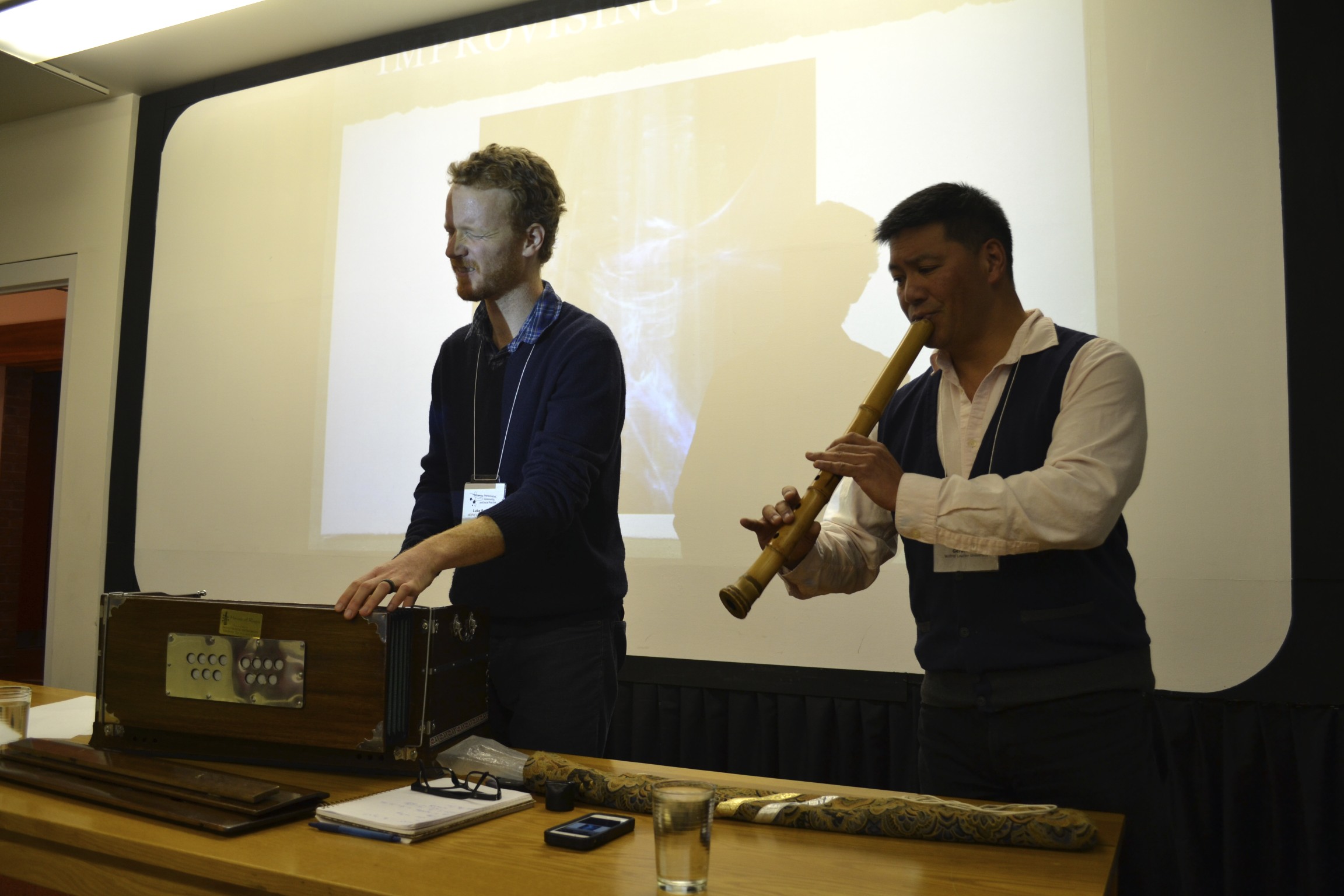
Gerard Yun (Music, University of Waterloo) and Luke Burton (Wilfrid Laurier Unviersity) “Beyond Traditions: Yogic Chant and Shakuhachi in Contemporary Improvisation.”
DSC_1045
Ajay Heble introduces the keynote speaker.
DSC_1048
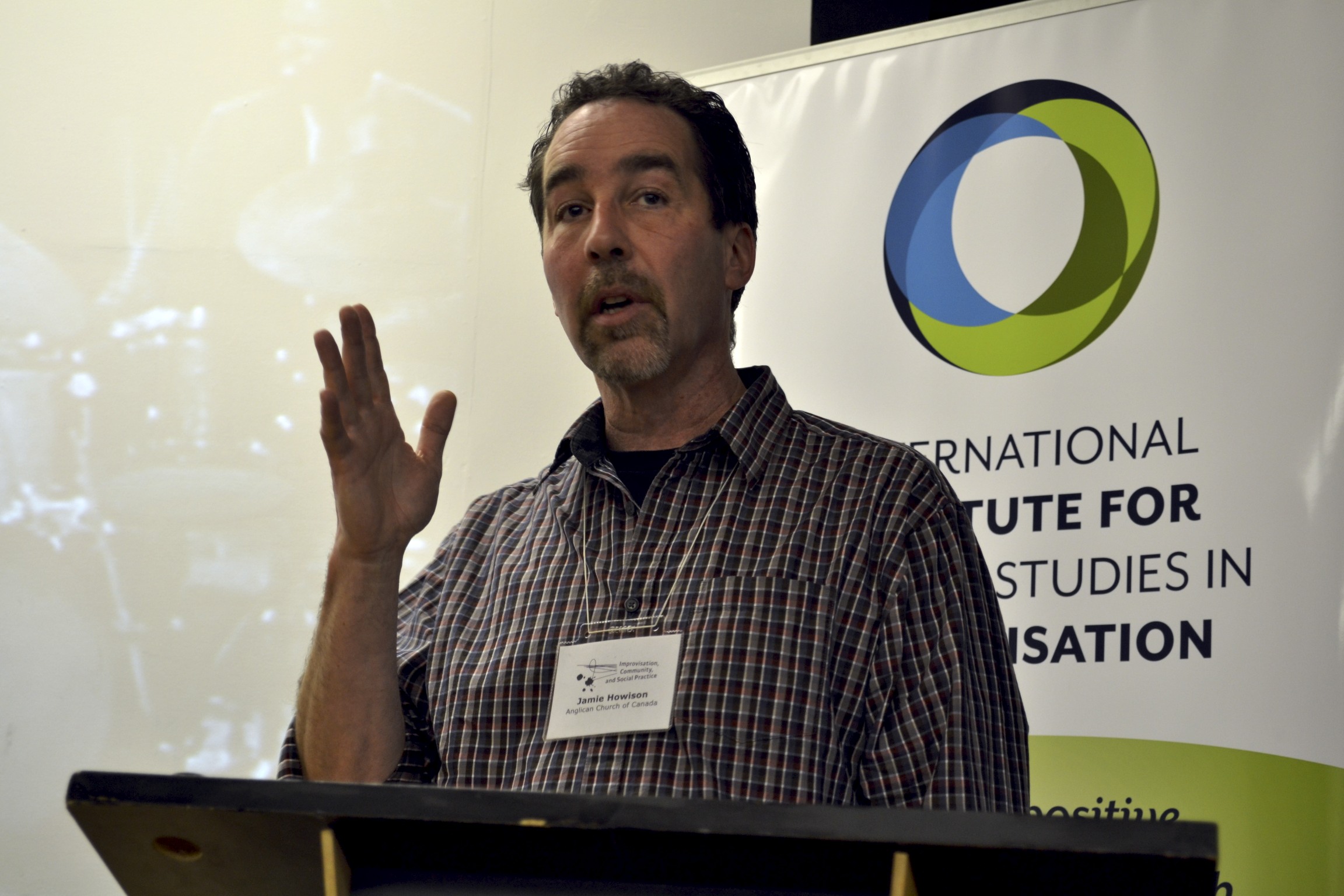
Anglican Priest, Jamie Howison, delivers a keynote entitled, “Improvisation as an Act of Faith.”
DSC_1049
There were lots of engaged questions from the audience.
DSC_1053
Lauren Levesque (Improvisation, Community, and Social Practice, University of Guelph), “Protest Music Performances as Methodological Frameworks for Re-envisioning Engaged Spirituality: Implications for Improvisation.”
DSC_1057
The event concluded with a fully improvised performance.
DSC_1058
David Lee.

DSC_1059  DSC_1063

Adapted from a write-up by  Lauren Levesque.
All Photos by Paul Watkins.

Sun Ra’s Bounce

So I leave the word space open, like space is supposed to be, when I say space music.
-Sun Ra

Dedications takes various phonogrooves (from jazz, hip-hop, and spoken word, to unusual recontextualized samples) and mélanges them together to create polyvalent dedications to a host of musicians and poets. One of those dedications is to the iconic jazz figure—from Saturn—Sun Ra. Below is a quick video photo mix I made in honour of Sun Ra’s alternative views and musical space. Such alternative listening spaces become for an artist like Sun Ra, an effort to relocate himself and escape the limits of earth.

DJ Techné, Dedications

I say, play your own way. Don’t play what the public wants. You play what you want and let the public pick up on what you’re doing, even if it does take them fifteen, twenty years.
-Thelonious Monk

Techne Banner

Lots going around on pauldbwatkins.com (Riffings) these days. You might have noticed the new look to my website. It’s still a work in progress, but take a look around. The other big news is that I’ve finally finished my DJ project, DedicationsDedications is an experimental jazzy hip-hop remix project born out of a love of listening to records. The album mixes, mashes, samples, spins, cuts, signifies, rhapsodizes, poetizes, layers, collages, remixes, breaks, distresses, archives, remakes, reshapes, and re-edits pieces of recorded history to create a sonic audio homage to a host of musicians and styles with a nod to the avant-garde. There is a lot of poetry on the album because, as a literary scholar, I have also always understood that poetry is musical, and that music is poetical.

Dedications takes various phonogrooves (from jazz, hip-hop, and spoken word, to unusual recontextualized samples) and mélanges them together to create polyvalent dedications to a host of musicians and poets. If you listen closely you will hear William Blake (with Archie Shepp), Sun Ra, Glenn Gould, Pharoah Sanders, Ravi Shankar, Inspectah Deck, Jack Kerouac, Ella Fitzgerald, The Last Poets, Gil Scott-Heron, Charlie “Bird” Parker (with Ontario songbirds), Sonny Rollins, John Coltrane (with Michael S. Harper), Louis Armstrong (with Gwendolyn Brooks), Fats Waller, Earl Birney, the poetry of The Four Horseman, Tom Waits, John G. Diefenbaker, Ginsberg reading Howl over Horace Parlan’s keys, A Japan Airlines record chopped up, Thelonious Monk accompanied by Amiri Baraka, MF Doom, and Mutabaruka dubbing over The Zombies, among a myriad of other sounds, samples, echoes, and cuts. At times I add a live-recorded layer of chant, singing bowl, or beatbox. I played almost all the drums on an MPC, and most of the samples are recorded live from vinyl. If I made a mistake in a recording, I usually embraced it as part of the process.

In short, I hope you enjoy the album. It is available for streaming below, or for free download (name your price), here.


Rutherford Chang’s The White Album

Front cover.
Front cover.
Back cover.
Back cover.

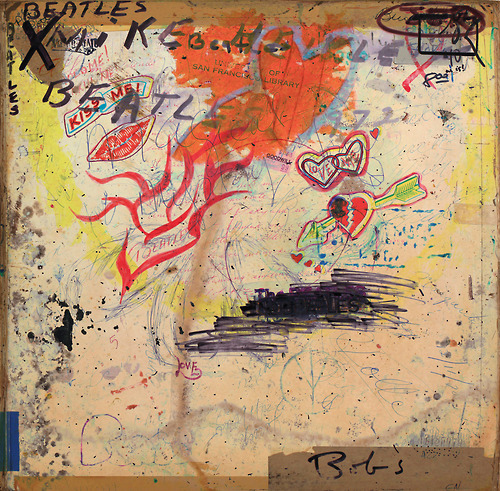
I own my share of peculiar records: The Psychedelic Experience: A Manual Based on The Tibetan Book of the Dead (read by Timothy Leary); Natural Childbirth (an early 1950s record that documents the live birth of a baby); a record that is only frog sounds; a yodeling record; and to my growing vinyl oddities, I can now add Rutherford Chang’s The White Album. Rutherford Chang has been getting a lot of press for his art project, “We Buy White Albums,” where he only purchases copies of The Beatles’ White Album, displayed at a gallery (set up like a record shop) that only carries the iconic double album. All of the albums are first-pressings and Rutherford Chang’s website now lists the total number of copies at 918. At some point during the exhibit (here’s an interview on the process), Rutherford thought, “I wonder what it sounds like if you play 100 copies of The White Album at once?” And that’s exactly what Chang’s The White Album does: 100 (45 year-old) first-pressings of The White Album are synced up in a bizarre sound collage that moves in and out of the familiar and into the choral and cacophonous. Each copy of the record is unique, and given the slight sound variations in pressings, and the natural and scratched wear of vinyl, the listening experience captures the distinct history of each record. We start off with a familiar, but muddier version of “Back in the U.S.S.R,” and then move into uncontrollably new territory as the records slowly coast out of sync over the course of each side. Chang even layered the gatefold cover and disc labels with the worn and hand-drawn originals to create a visual collage that reworks the featureless original and highlights the individual history of each copy.

Poster of the 100 albums.
The poster of the 100 albums.

Pressed in a very limited run—which sold out quick—I am happy to add Chang’s The White Album to my vinyl collection. Of course, some purists might disavow the album, while others will welcome this innovative project as being in line with the experimental spirit of late-period Beatles. Have a listen for yourself.

Tsotsi: The Transformative Power of Hope

The following is a throwback (slightly amended) review I wrote in 2006. This is nearly four years before I published anything in any format. I found it on my hard drive and felt it worth sharing, even if the language is simpler (perhaps more straightforward) than I often write reviews in these days. I have a couple more of these old reviews I might share at some point. Anyways, Tsotsi is a fantastic film, and one I need to certainly watch again soon.

1560Tsotsi_Cover

Life is a game of chance: we do not know whether we will be born into poverty or riches. At the same time, the decisions we make invariably influence the path we walk. The theme of chance is emphasized in the opening shots of Tsotsi as we watch Tsotsi’s gang roll dice, set in the monochromatic shades of a dark, dingy shack. Tsotsi, which literally means “thug,” is an effective and poignant film directed by Gavin Hood (adapted from an Athol Fugard novel) about a young man named Tsotsi who embarks on a transformative journey, set in motion by the helplessness of a baby. Tsotsi had no intention of kidnapping the baby, discovering it in the backseat of a car he stole after shooting its mother while she got out to ring the buzzer at her gate. The early contrast between the rich and poor communities depicts the austere differences between life in the broken-down shanty township of Soweto to which Tsotsi belongs, and the baby’s parents’ gated, luxurious home in the wealthy community of Joburg, illustrated with masterful cuts of cinematography. Fanon’s article “On Violence” provides an accurate description of what the shantytowns look like in the film: “It’s a world of no space, people are piled one on top of the other, the shacks squeezed tightly together” (4). Tsotsi is a killer, a fact brutally fleshed out earlier in the film by his senseless murder of man on a crowded train in order to steal his wallet. With this knowledge, it would seem that Tsotsi is unfit to take care of a baby, but for some intrinsic reason he takes on this task.

The acting from the almost all African cast is superb, and the young actor (Presley Chweneyagae) who plays Tsotsi has a magnificent amount of control over his emotions, ensuring his portrayal never crosses into melodramatic hamming. There is no sentimentalized view of poverty in this film, and we are not made to feel sympathetic towards Tsotsi. Rather, we journey alongside his transformative awakening on a thin line of hope: a hope that in the end he will do the right thing and give the baby back to its rightful guardians. Because the film is shot within close fields of vision, we are able to see what goes on inside Tsotsi’s head. Metaphorically, Tsotsi undergoes a medieval psychomachia of sorts—a battle for his soul, which the director carefully depicts vis-à-vis subtle shots of Tsotsi walking centre screen down a railway track. Tsotsi has become so dependant on wearing the mask of his public persona that intense feelings of his own innocence bleed into his private sphere where he has become protector of a baby he loves as if it was his own. The tragic comedy results from Tsotsi’s lack of knowing how to take care of a baby: he uses newspapers as diapers, and carries him around with him in a shopping bag. Fortunately Miriam, a nursing mother, provides a counterpoint to Tsotsi’s frustration and helps to gradually ignite a spark of love within Tsotsi’s psyche, deeply buried since his childhood.

Truly, the film is about hope and overcoming one’s odds against the shit cards life can sometimes deal. Tsotsi does not romanticize poverty, glamorize violence, or make us sympathetic towards a violent young man like Tsotsi; rather, it allows us to see the effects and suddenness of violence. Violence committed by the oppressor is passed onto the oppressed in a vicious cycle: the oppressed are left in poverty, while the rich get richer. Tsotsi represents the possibility that maybe the cycle can be broken: a hope for a post-apartheid South African black teenager, and a hope that Tsotsi can become a better person and ultimately do the right thing. In the context of the film, that’s giving the baby back and allowing reconciliation to take place within himself for his own troubled past—allegorical of the reconciliation process in South African. The film follows this progressive journey right up to its heavy ending, which we watch in a perpetual state of anticipation. The film does not try and prescriptively solve the enormous condition of poverty in South Africa; instead, the film traverses beyond the realm of violence, using the theme of forgiveness as a way to move forward and rebuild. The process of moving forward is an utterly frightening concept for Tsotsi, but there is a hopefulness that things can and should be better than they are, at least within his own world.

Check out the trailer:


Works Cited

Fanon, Frantz. “On Violence.” The Wretched of the Earth. New York: Grove Press, 2006. Print.

Wadada Leo Smith

Wadada Leo Smith is a trumpeter and mercurial composer working at the edges of avant-garde jazz and free improvisation. Perhaps the rightful heir to Miles Davis, Smith is known for his introverted style of playing and his incredible use of space. In the 1960s he gained experience performing in R&B groups, later playing in the military, and in 1967 he was a member of Chicago’s AACM, going on to form his own group, New Dalta Ahkri, playing with such free jazz luminaries as Henry Threadgill, Anthony Davis, Oliver Lake, and Anthony Braxton, among others. He was one of three finalists for the 2013 Pulitzer Prize for Music for the incredible American civil rights-era odyssey, Ten Freedom Summers (2012).

Smith's Golden Quartet at the Guelph Jazz Festival.
Smith’s Golden Quartet at the Guelph Jazz Festival.
William Parker introduced Smith and his quartet. The two jazz luminaries share an embrace.

At 273 minutes the four-disc box set, Ten Freedom Summers, is an epic free jazz/classical/astral work that rightfully belongs in the jazz lexicon alongside Max Roach’s Freedom Now Suite, or Ellington’s Black, Brown, and Beige. Ten Freedom Summers evokes the civil rights movement through a series of freedom motifs and dedications, including a piece dedicated to Emmett Till, the Dred Scott case, the black church, Rosa Parks, and moves forwards (or backwards) to September 11th. Smith can shift the focus on an entire improvising ensemble at the sudden sound of a single note. While Ten Freedom Summers is meticulously composed, Smith wrote improvised elements into his masterwork, which could be heard by Smith and his Golden Quartet during their performance at this year’s 20th Anniversary Guelph Jazz Festival (GJF) in moments of atomized energy. Sections of Ten Freedom Summers were performed at the GJF with Smith’s Golden Quartet of Anthony Davis on piano, John Lindberg on double bass, and Anthony Brown on drums.

Wadada Leo Smith and Pharoah Sanders.

Have a listen to “Martin Luther King, Jr.” by Wadada Leo Smith from Ten Freedom Summers:

Also, check out the Golden Quartet’s “Rosa Parks” (excerpt), from the album Tabligh:

All Photos by Paul Watkins.

the multiplicity of everyday life (poem, draft)

starbucks-trash-can
Image from here.

before you finish eating breakfast in the morning, you’ve depended on more than half of the world.
-Martin Luther King Jr.

polyphonic murmurings
the city speaks
even while it sleeps.
we are more than ourselves
the sum of our parts
is the larger part of something.
the whole world is allegorical.

our coffee is a miracle of globalization:
a seed is planted,
years later little nimble fingers harvest the cherries:
roasted, processed, it arrives across oceans, hot java,
we sip its velvety elixir & go about our day.

wearing bluejeans, crafted from swaths of denim in a factory
somewhere on a map in a county we’ve never been to.
we transport bodies in oiled machines that run on the commerce of drilling,
& eat our lunches in the break rooms of silent killings.

a solitary pig travels from farmactory to the killing fields.
we eat the animal we never could never know,
walk our dogs after, pet our cats, & yet,
all our bellies buzz with bellowing hunger.

we are all hungry for love, for comfort, for the workings of everyday niceties.
there is no human that is not a part—however apart—of the cacophonous pulling of all things.

the exploding of ourselves is like the imploding stars we’ve inherited.
we share in the cry of babies & the undulation of the ocean.
even if you can’t see or hear the howl of a starving child, we still play part to its cosmic tragedy.
miracles don’t end at the bottom of a coffee cup thrown casually into a recycling receptacle.

they end cause life gets in the way.

Still Bringing the Ruckus: Wu-Tang Clan’s 36 Chambers turns 20

My original copy of Enter the Wu-Tang: 36 Chambers.

From the slums of Shaolin, Wu-Tang Clan strikes again

The RZA, the GZA, Ol’ Dirty Bastard, Inspectah Deck, Raekwon the Chef, U-God, Ghostface Killer and the Method Man.

My grade nine girlfriend (who I’ll call Mable after the Goldfinger song we both listened to) introduced me to the Wu-Tang Clan. It was right around the time the Clan dropped their second classic album, Wu-Tang Forever. That album, and even more so, 36 Chambers, forever changed the way I listened to music and got me back into Hip Hop. At the time I was listening to a lot of alternative and punk music, and Wu-Tang synthesized the hard anti-assimilative sound of punk and alternative I admired, and fused it with incredibly verbose, funny, and cerebral lyrics. Heck, there was even a whole mythos around the group and their incorporation of the Shaolin Kung fu theme.

The distinctive sound of Enter the Wu-Tang (36 Chambers) created a blueprint for hardcore Hip Hop during the 1990s. Its idiosyncratic sound also became hugely influential in modern Hip Hop production, while the group members’ explicit, humorous, free-associative lyrics have served as a template for many Hip Hop artists. The caustic and bizarre humour, theatrical personalities, cerebral storytelling, and the variety of lyrical technicians contribute to crafting an album that is full of play: martial arts metaphors, an unlimited supply of pop culture references, and a hyperbolic approach to lyrical violence are negotiated as different emcees trade off verses. Much of the sonic improvisation on 36 Chambers is the result of phonetic dialogism between sounds that mesh surprisingly well. RZA describes that he would start “sampling one note and playing it on different notes of the keyboard [. . .] chopping things down to notes and chords, not knowing which chords they were but knowing them as sounds” (Manual 197). It is this free rhythm and free style that help define the musical/linguistic aspect of Wu-Tang, influenced by African oral traditions of rhythmic talk-singing (signifying), recalling similar musical lines while also absorbing the entire gamut of popular culture.

The group’s de facto leader RZA, produced the album with heavy, eerie beats and a sound largely based on martial-arts movie clips and soul music samples, ensuring that the samples dialogically speak to one another. RZA describes the process of creating the sound on the album as belonging to a tradition pioneered by jazz pianists such as Monk and Bill Evans. He says:

I know that a sound I became known for at the beginning was that detuned acoustic piano zither—those creepy notes that quiver in the air. It’s the kind of sound you hear in ‘7th Chamber,’ ‘Da Mystery of Chessboxin,’ and a bunch of other joints. It’s funny when people ask me the inspiration for it, because, to be honest, it was jazz pianists—mostly Bill Evans and Thelonious Monk—but the fact is I played most of it myself. (Manual 191)

To read more about the jazz influences on 36 Chambers, particularly Wu-Tang’s sampling and recontextualization of Monk’s “Black and Tan Fantasy” in their song, “Shame on a Nigga,” check out my article, “Disruptive Dialogics: Improvised Dissonance in Thelonious Monk and Wu-Tang Clan’s 36 Chambers.” The complexity of the music, the unique sound, and the absolute fun of 36 Chambers keep it on constant circulation on my iPod, or spinning on my turntable. I am a devotee of 36 Chambers, and over the years I’ve memorized lines and verses, vocal inflections, and still find the album refreshing after not listening to it for a while. Every track is a standout cut, but “Bring the Rukus,” “Shame on a Nigga,” “Protect Your Neck,” and “Da Mystery of Chessboxin'” display the power and synchronicity of the Clan, and really get me hyped.

While I bought the first four Wu albums on CD, before I got big into wax, I’ve managed to acquire various Wu-Tang albums on vinyl over the years: the “Triumph” single, the deluxe Chess box version of Gza’s Liquid Swords, the original “C.R.E.A.M” and “Da Mystery of Chessboxin’” single, an original copy of 36 Chambers, and my most prized piece of Wu-Tang wax, a copy of “Protect Your Neck”/ “After the Laughter Comes Tears” circa 1992 on Wu-Tang Records pressed in RZA’s basement (limited to 500 copies). As Rza explains: “We pressed five hundred copies and sold it directly to record stores and Djs. This was before the Internet and the whole direct-to-buyer explosion” (Manual 75). Initially Wu-Tang was part of the Tommy Boy roster, but the label made the decision to sign the all-white group, House of Pain instead. RZA describes that when his group was dropped he felt bamboozled, since they “‘chose a bunch of whiteboy shit over me’” (73). Not long after on November 9th, 1993, 36 Chambers was released on Loud Records.

My very rare copy of the first pressing of "Protect Your Neck" pressed on Wu-Tang Records.
My very rare copy of the first pressing of “Protect Ya Neck,” pressed on Wu-Tang Records.
Chess box edition of Gza's Liquid Swords (limited to 750 copies, Record Store Day find).
Chess box edition of Gza’s Liquid Swords (limited to 750 copies, Record Store Day find).

In 2010 at the Rock the Bells festival in San Francisco, I had the privilege of listening to 36 Chambers live in its entirety with all remaining members present (with Boy Jones, ODB’s first-born son, filling in for his father). It was, of course, absolutely fantastic. The album is rightfully included in RollingStone’s Top 500 albums (sitting at 387), although it should be higher up, and currently the Wu are touring in honour of the 20th Anniversary of 36 Chambers. A seminal record in the Hip Hop lexicon, 36 Chambers is to Hip Hop what the Beatles’ St. Pepper is to rock. Long live Hip Hop’s original dynasty.

images-4images-4images-4images-4images-4(5 spins out of 5, classic)


Works Cited

RZA. The Wu-Tang Manual. New York: Penguin, 2005. Print.

This post was partially adapted from my article, “Disruptive Dialogics: Improvised Dissonance in Thelonious Monk and Wu-Tang Clan’s 36 Chambers.”