From the Stage to the Site: Wayde Compton Interview and Soundin’ Canaan Updates

The website for my book is nearly complete — the final piece, a “create your own remix” section, is on its way.

Recently, I added audio and photos from the Victoria Book Launch on March 13. A huge shoutout to Susan Sanford Blades for organizing the event as part of the Wild Prose reading series (https://www.susansanfordblades.com/wild-prose-reading-series). 

After a remixed reading of my book, I sat down for an on-stage interview with Wayde Compton. This was an incredible full circle moment, and audio (as well as a transcript) are now available as well.

I’ve also added a new remix to the Remix section: “Kind of Blue in Green (for GEC),” which reimagines Miles Davis’s “Blue in Green” and offers a poetic riff/reading of George Elliott Clarke’s “Bluing Green.”

Head over to www.soundincanaan.com to explore this new material and more from the book. If you don’t have a copy yet, you can grab one here — and save 20% all April with the code POETRY2025.

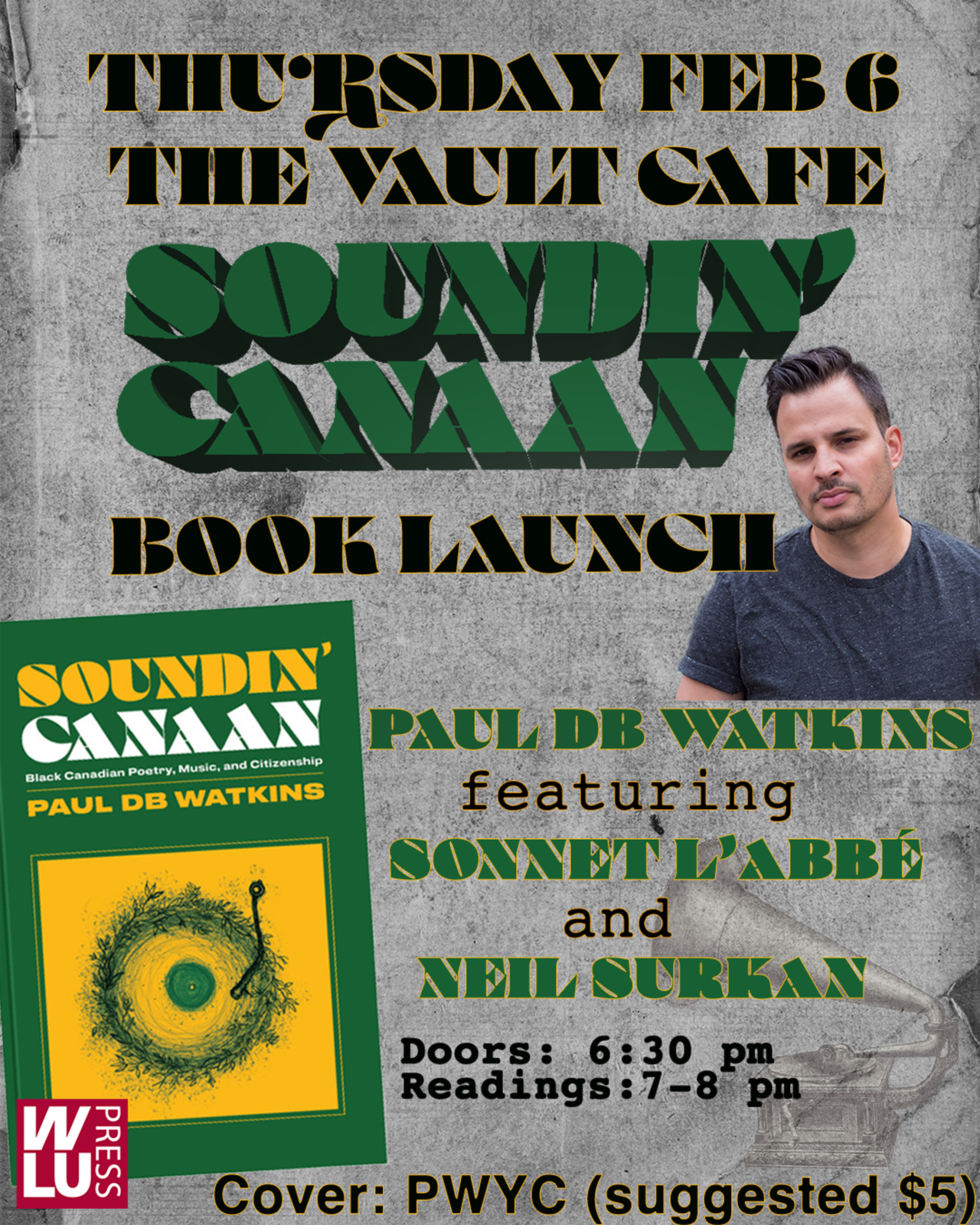
Soundin’ Canaan Book Launches!

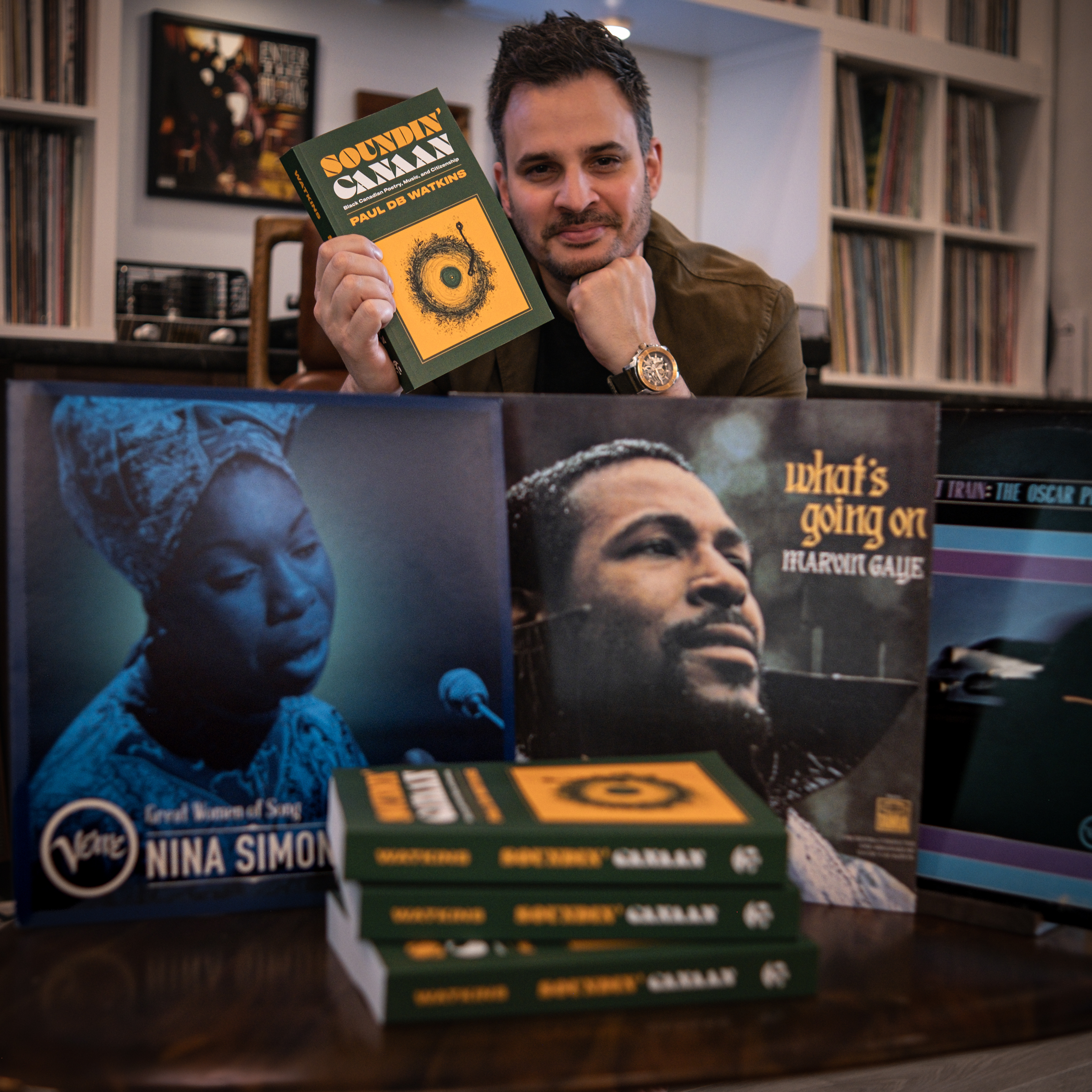
𝕊𝕠𝕦𝕟𝕕𝕚𝕟’ ℂ𝕒𝕟𝕒𝕒𝕟: 𝔹𝕝𝕒𝕔𝕜 ℂ𝕒𝕟𝕒𝕕𝕚𝕒𝕟 ℙ𝕠𝕖𝕥𝕣𝕪, 𝕄𝕦𝕤𝕚𝕔, 𝕒𝕟𝕕 ℂ𝕚𝕥𝕚𝕫𝕖𝕟𝕤𝕙𝕚𝕡 is officially out! Seeing it in physical form is truly special. Music weaves through the book, and just in the Prelude, I reference Marvin Gaye’s “What’s Going On,” Nina Simone’s “Mississippi G**dam,” and Oscar Peterson’s “Hymn to Freedom.” Get your copy today!

The first launch will take place on February 6th at The Vault Café (499 Wallace St) and will feature poet and musician Sonnet L’Abbé (Sonnet’s Shakespeare) and Nanaimo Poet Laureate Neil Surkan (Unbecoming). I’ll also be performing remixed versions of sections from the book. Doors open at 6:30 p.m., and the readings will run from 7:00 to 8:00 p.m. Come by and grab a signed copy!

A second launch will happen in Victoria on March 13th at Paul Phillips Hall (1928 Fernwood Road). This event will feature poet Wayde Compton (Performance Bond, The Outer Harbour, Toward an Anti-Racist Poetics). Doors open at 6:30 p.m., with an open mic at 7:00 p.m. Featured readings and an interview will start at 7:30 p.m.

Local folks: I hope to see you at one of the events! Also, for any local Nanaimo folk, you can grab a copy of the book from @windowseatbooks.

Warmly,
Paul

Harmonious Dissonance: in Conversation with George Elliott Clarke

To provide Malahat readers with a context in which to read and more deeply appreciate George Elliott Clarke’s “Othello: By Donation Alphonse François, Marquis de Sade,” a bravura long poem appearing in the magazine’s Summer 2016 issue, I explore with the poet his ambitions and the intent he enacts in the writing of such a profoundly engaging and provocative work. Last year I also recorded George reading a few poems when he visited Vancouver Island University last year, and The Malahat Review has published one of these recordings, “The Testament of Ulysses X.” You may read the full text of this poem or listen to George’s performance of it, recorded while he was the 2015 Ralph Gustafson Distinguished Poet at Vancouver Island University in Nanaimo.

George Elliott Clarke is currently  Canadian Parliamentary Poet Laureate. Towards the end of the interview I asked him, why does the world need poetry? To which he responded:

Hal David and Burt Bacharach: “What the World Needs Now is Love, Sweet Love”? That song comes to mind in thinking about why the world should need poetry. But I will also reiterate my sentiments in the Shad/Q interview: poetry exists in the rhythm of pulse and breath; it is “mind-forged” (Blake) language given vocal (originally) expression in tune with the pace of breath and the beat of the heart. The cadences are related to the sounds conjured by the arrangements of tongue, teeth, lips, and lungs. Poetry is organic technology, a physical art—as much as is dance, save that its calisthenics are performed by abstract characters or organically by the movement of the mouth.  In any event, it is the cheapest art and thus the most portable, for it can be memorized and taught to others. It is the first civilizing art, for it is the basis of scripture, whether inscribed or chanted. It conjoins imagination and emotion; so, for so long as human beings dream, recall, and/or have feelings, they/we will always invent poems.

Read the full interview, here.

In addition,

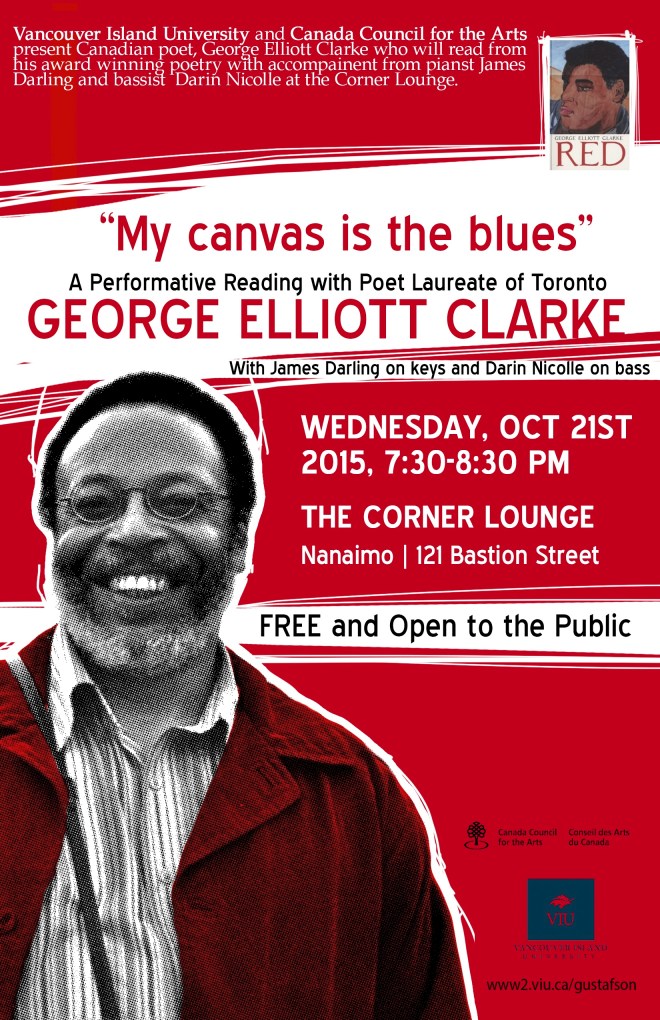
PRESS RELEASE: Celebrated ‘Africadian’ Poet George Elliott Clarke Reads at VIU Oct. 22

Toronto Poet Laureate, playwright, and literary critic George Elliott Clarke, VIU’s 2015 Gustafson Distinguished Poet, will deliver a free public lecture, On Entering the Echo Chamber of Epic: My “Canticles” Vs Pound’s Cantos, Thursday Oct. 22nd at 7pm in building 355 on the Nanaimo campus.  Clarke introduces his epic poem, “Canticles,” in response to Ezra Pound’s contentious Cantos, a 20th-century post/modern epic both vilified for its integration of fascist propaganda and heralded for its haunting lyricism. Pound, a classicist, nodded to T. S. Eliot’s “The Waste Land” and Stephen Vincent Benet’s “John Brown’s Body,” both of which skirted racist material yet refused to be contained, or restrained, by formalism.

Clarke will recite excerpts from his work-in-progress “Canticles,” which echoes slave and imperialist debates from Cleopatra to Celan. Clarke will also invoke contemporary poets Derek Walcott and NourbeSe Philip who invite harmonious, multiple, and multicultural voices in their revisions of Pound’s controversial masterpiece. Clarke champions writers of African descent and coined the term, “Africadian” to identify the Black culture of Atlantic Canada, a term he says is both “literal and liberal—I canonize songs and sonnets, histories and homilies.”

Clarke traces his own inspiration to “poet-politicos: jazz trumpeter Miles Davis, troubadour-bard Bob Dylan, libertine lyricist Irving Layton, guerrilla leader and poet Mao Zedong, reactionary modernist Ezra Pound, Black Power orator Malcolm X, and the Right Honourable Pierre Elliott Trudeau.” Clarke finds their “blunt talk, suave styles, acerbic independence, raunchy macho, feisty lyricism, singing heroic and a scarf-and-beret chivalry quite, well, liberating.”

Clarke’s colleague and VIU English professor Paul Watkins says, “For George, poetry is not only a printed form, but also an oral art. His boisterous readings present the listener with a gumbo-concoction of jazz rhythms, blues-infused gospel vernacular, and plenty of play upon the standards of the larger literary tradition. This is poetry presented with the ‘lightning of prophecy’.”

Clarke has published: a 13 works of poetry including Whylah Falls (2002 Canada Reads contender), Execution Poems, winner of the Governor General’s Award for Poetry, and his latest Traverse; 4 plays, screenplays, or libretti One Heart Broken Into SongBeatrice ChancyQuébécité, Trudeau; the novel George and Rue; and 4 anthologies of African-Canadian writing including Directions Home: Approaches to African-Canadian Literature. He has been the E.J. Pratt Professor of Canadian Literature at the University of Toronto for the last 12 years and holds 8 honorary doctorates from Royal Military College and Dalhousie, New Brunswick, Alberta, Waterloo, Windsor, Acadia, Saint Mary’s universities. He received the Martin Luther King Jr. Achievement Award, the Pierre Elliott Trudeau Fellows Prize, and Order of Nova Scotia and the Order of Canada.

After Clarke’s lecture, a catered reception, cash bar, and book signing will follow in Bldg 300’s Royal Arbutus Room. Several of Clarke’s books will be sold at the VIU Bookstore. Courtesy parking is available in Lot N, in front of building 355. Clarke will also perform with musician James Darling at the Corner Lounge Wednesday October 21st 7:30-8:30. These events are sponsored by VIU’s Faculty of Arts & Humanities, Writers on Campus, and the Canada Council for the Arts.

The Gustafson Distinguished Poetry Lecture was established in 1998 from the estate of the late, pre-eminent Canadian poet Ralph Gustafson and his wife, Betty. The Chair has been held by celebrated poets Don Domanski, Dionne Brand, Tom Wayman, Daphne Marlatt, Robert Bringhurst, Don MacKay, Jan Zwicky, Dennis Lee, Michael Crummey, and Katherena Vermette among others, most of whom have had their lectures published as chapbooks. An interview will also appear in Portal2016, VIU’s full-colour literary magazine, on stands in April.

For more info contact Chair of the Gustafson Committee Toni Smith at Toni.Smith@viu.ca or to buy a chapbook contact the series’ publisher Joy Gugeler at joy.gugeler@viu.ca. For more information about the lecturers visit http://www.mediastudies.viu.ca/gustafson/

See more at: http://www.mediastudies.viu.ca/gustafson/#sthash.Y6hAy6n0.dpuf

RED REVISED Gustafson Poet Poster PRINT[3]

clarke Poster-final copy

Oral Histories Project

Since January 2012 I’ve curated an Oral Histories Special Project for the Improvisation, Community, and Social Practice Project.  The ICASP project plays a leading role in defining a new field of interdisciplinary inquiry in Improvisation Studies. The project’s core hypothesis is that musical improvisation is a crucial model for political, cultural, and ethical dialogue and action.

Oral Histories is a showcase of interviews, performances, and articles by and about improvising musicians, artists, writers, and scholars. This monthly feature offers an intimate look inside the minds and practices of some of the many dynamic, innovative people whose energy and ideas make improvisation studies such a vibrant field of inquiry. The Oral Histories project provides a space for improvising artists to be heard in their own words, often in dialogue with other improvisers, scholars, and practitioners. Back in 2012, I wrote a short reflective piece on the idea behind the project, musing on the relationship between orality and improvised musical practices. That short reflection can be found here.

The project has also been useful for my PhD thesis, Soundin’ Canaan: Music, Resistance, and Citizenship in African Canadian Poetry, since the thesis contains audio/visual interviews (many archived under the Oral Histories project) with several poets explored in the thesis (including M. NourbeSe Philip, George Elliott Clarke, Cecil Foster, d’bi.young, Wayde Compton, and others). Future Oral Histories will include the legendary South African pianist Abdullah Ibrahim, the late Amiri Baraka in conversation with William Parker, and more!

View Past Oral Histories below:

2014

 2013

 2012

Featured photo of Paul Watkins in conversation with d’bi.young.