Call for Papers: “Cyphers: Hip Hop and Improvisation”

I am guest-editing a special collection of essays on Hip Hop and Improvisation. The Call for Papers is below.

splashtitle

Critical Studies in Improvisation / Études critiques en improvisation invites submissions for a special issue with the theme “Cyphers: Hip Hop and Improvisation,” guest-edited by Rebecca Caines and Paul Watkins. This special issue of CSI will draw together artists and academics to investigate the crucial role improvisation plays in the international field of Hip Hop, and in the related field of critical Hip Hop studies. We seek contributions from artist/practitioners and from scholars working across the disciplines.

Derek Bailey’s notion of improvisation as being the most practiced, yet the least understood, of all musical activities, is particularly pertinent to the immense and constantly burgeoning field of Hip Hop praxis from around the world. Although most scholars are aware of the integral nature of improvisatory practices in Hip Hop, few critically explore how improvisation is a viable form of analysis in Hip Hop, as well as a model for social change. Improvisation plays a central role in African-American, Hispanic, and Caribbean based Hip Hop practices in the US, and continues to be a core element in Hip Hop music, dance, and visual art across the globalized forms of this interdisciplinary art practice. We encourage contributors to pursue new conversations, interventions even, about how we think of improvisation vis-à-vis the larger milieu of Hip Hop. Critical academic essays are encouraged, and the editors also welcome for consideration artist statements, commentaries, reviews, interviews and experimental textual forms. We intend to showcase a variety of live artist performances and invited papers at a launch event for this Special Issue. CSI/ÉCI encourages the submission of audio and visual content to accompany texts. It is the responsibility of the author to ascertain copyright and gain permissions.

Potential topics include:

• How do Hip Hop artists combine idiomatic and non-idiomatic improvisation in their work?

• What artistic, social, and economic pressures face Hip Hop artists who foreground the improvisatory in their work?

• How does improvisation in Hip Hop reflect, develop, or contrast the social practices and pressing political issues of the communities in which it appears?

• What role does improvisation play in the creation of academic disciplinarities and “Hip Hop pedagogies” both inside and outside educational institutions? How might the ubiquity of improvised DJ performances inform knowledge formation, and provide critical tools for pedagogues?

• How does scholarship in Hip Hop studies respond to the improvisatory nature of the practice?

• What role does improvisation in Hip Hop play in the recontextualization of cultural and intercultural identity?

• How do Indigenous communities across the world improvise, translate, transform, and indigenize the US form of Hip Hop arts practice?

• Since Hip Hop has often traditionally been described as “noise” by many conservatives and academics who uncritically profile Hip Hop artists and fans of all genders, races, and classes, might dissonance compel us to think about how disruption can function as a model for critical practice?

• How are the five primary elements of Hip Hop—dance (notably breaking), urban inspired art (markedly graffiti), deejaying (turntablism), beatboxing and emceeing (rapping)—negotiated under improvisatory practices and amalgamations?

• In what ways are orality and textuality (what we might think of as recording) tied to Hip Hop and how might either form limit or broaden the art?

• Houston A. Baker Jr. argues, poetry, like rap, is intended to be a “disruptive performance […] as an audible or sounding space of opposition” (Rap 96). In what ways are Hip Hop and poetry related?

• What are the relationships between technology, accessibility, and Hip Hop culture?

• How do DJs improvisationally rework archival material that is often dormant, thus creating new repertoires from the past?

• While misogyny is bigger than Hip Hop, we welcome papers that explore how gender is improvised and performed in Hip Hop.

Submissions should be 4000-6000 words (shorter essays may also be considered at the discretion of the editors). Please submit completed essays to the journal website by April 16, 2014. Information on the submission process and examples of previously published work can be found at www.criticalimprov.com. Inquires can also be directly made to csi-eci@uoguelph.caCritical Studies in Improvisation/Études critiques en improvisation is an open-access, peer-reviewed, electronic, academic journal on improvisation, community, and social practice housed at the University of Guelph.

Cypher photo by AFP from here.
Improvisation as an Act of Faith

On December 6th, Improvisation, Community, and Social Practice (ICASP) presented a symposium (“Spirit(s) Improvise”) on improvisation and spirituality. “Spirit(s) Improvise” brought together distinguished scholars, musicians, and spiritual practitioners to explore the relationship between improvisation and spirituality. One of the primary questions asked was how can improvisation and spirituality, broadly defined as frameworks through which people imagine and enact alternative ways of being in the world, contribute to our understandings of imagination and creativity, community and space, and transcendence and hope?

Held at and co-sponsored by the Macdonald Stewart Art Centre, the well-attended event sparked animated conversations and debates about the relationship between improvisation and spirituality from a variety of perspectives: musical, political, social, and theological.

For speaker bios and abstracts, click here.

Below are some photos from the event.

DSC_1038
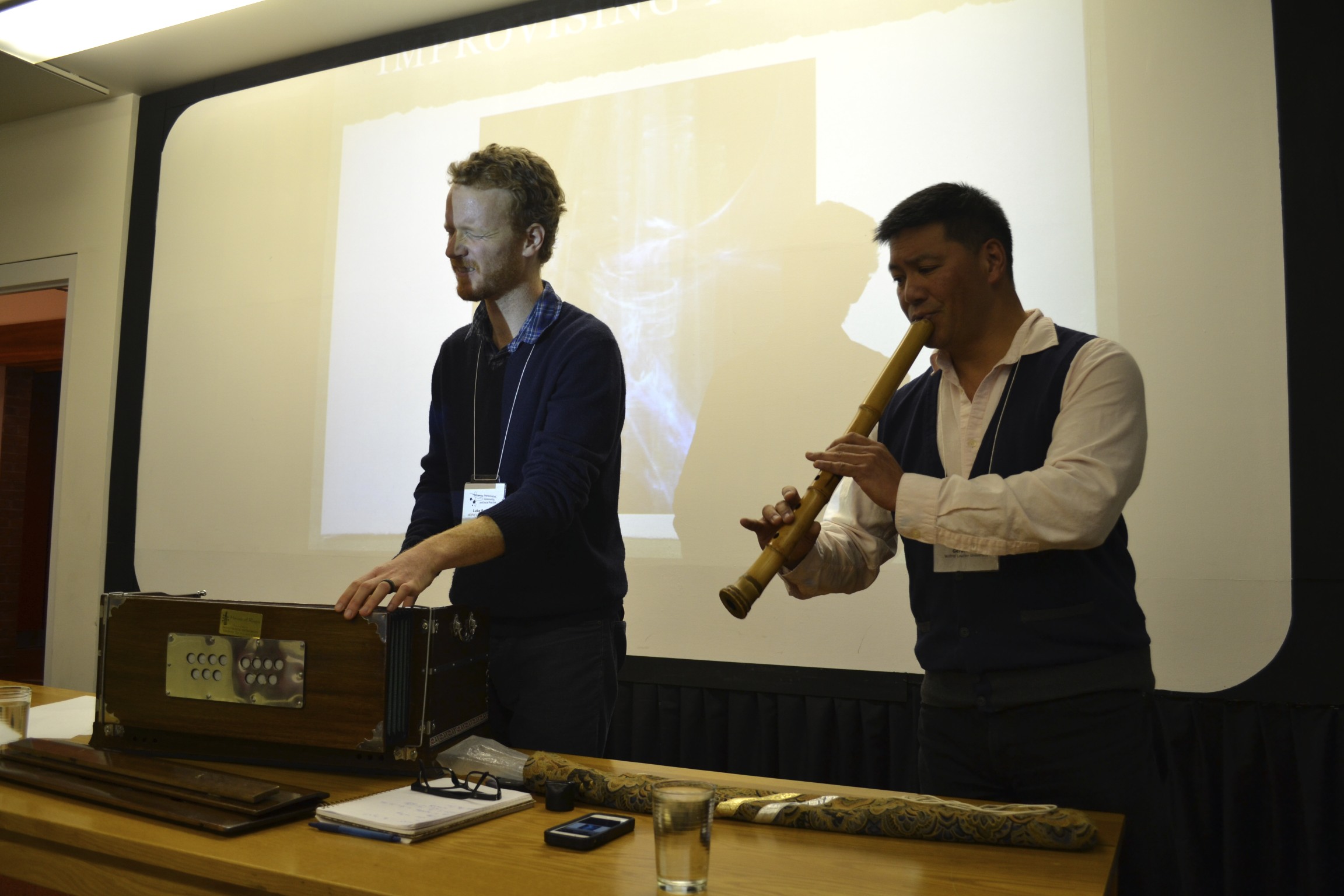
Gerard Yun (Music, University of Waterloo) and Luke Burton (Wilfrid Laurier Unviersity) “Beyond Traditions: Yogic Chant and Shakuhachi in Contemporary Improvisation.”
DSC_1045
Ajay Heble introduces the keynote speaker.
DSC_1048
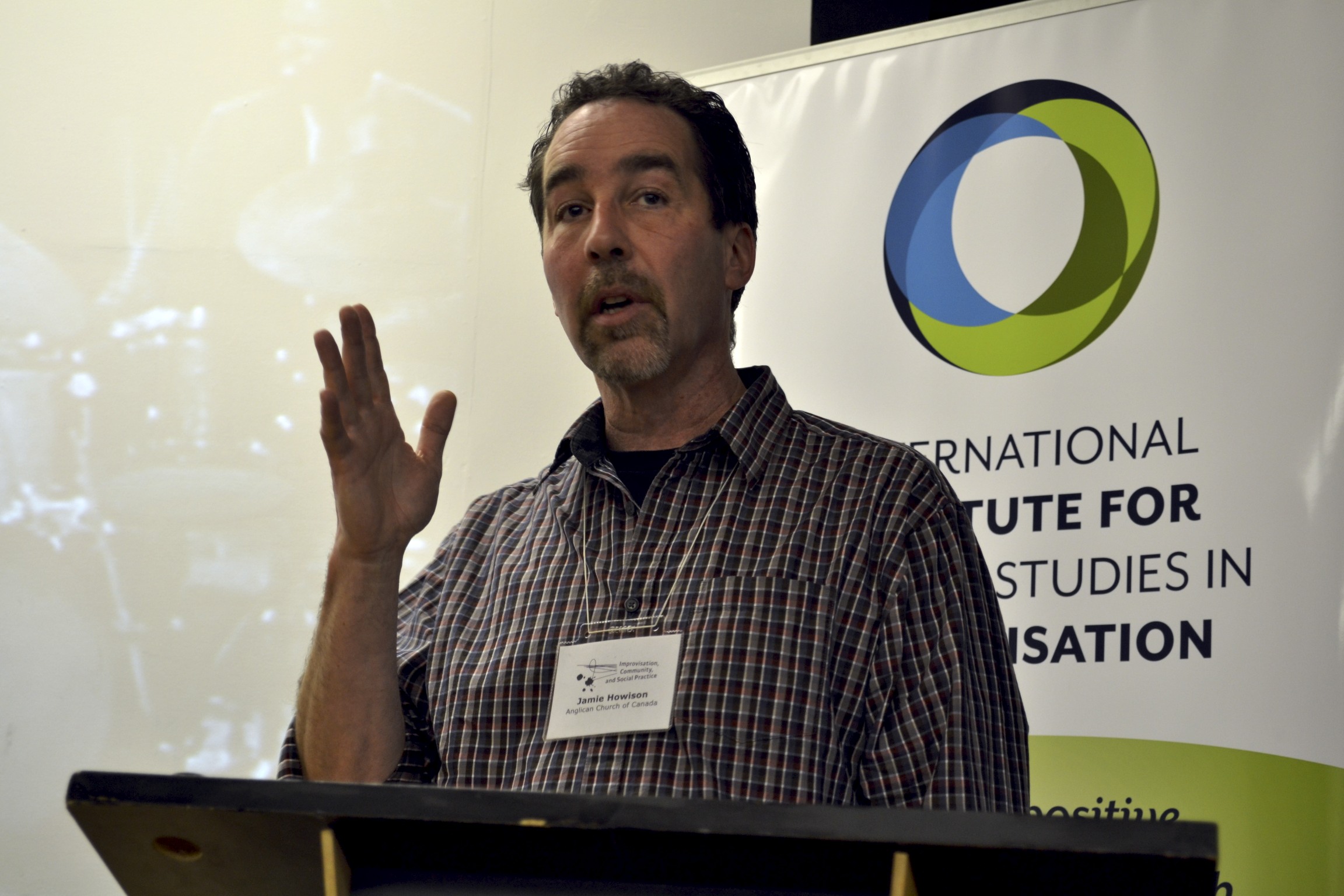
Anglican Priest, Jamie Howison, delivers a keynote entitled, “Improvisation as an Act of Faith.”
DSC_1049
There were lots of engaged questions from the audience.
DSC_1053
Lauren Levesque (Improvisation, Community, and Social Practice, University of Guelph), “Protest Music Performances as Methodological Frameworks for Re-envisioning Engaged Spirituality: Implications for Improvisation.”
DSC_1057
The event concluded with a fully improvised performance.
DSC_1058
David Lee.

DSC_1059  DSC_1063

Adapted from a write-up by  Lauren Levesque.
All Photos by Paul Watkins.

Tomomi Adachi

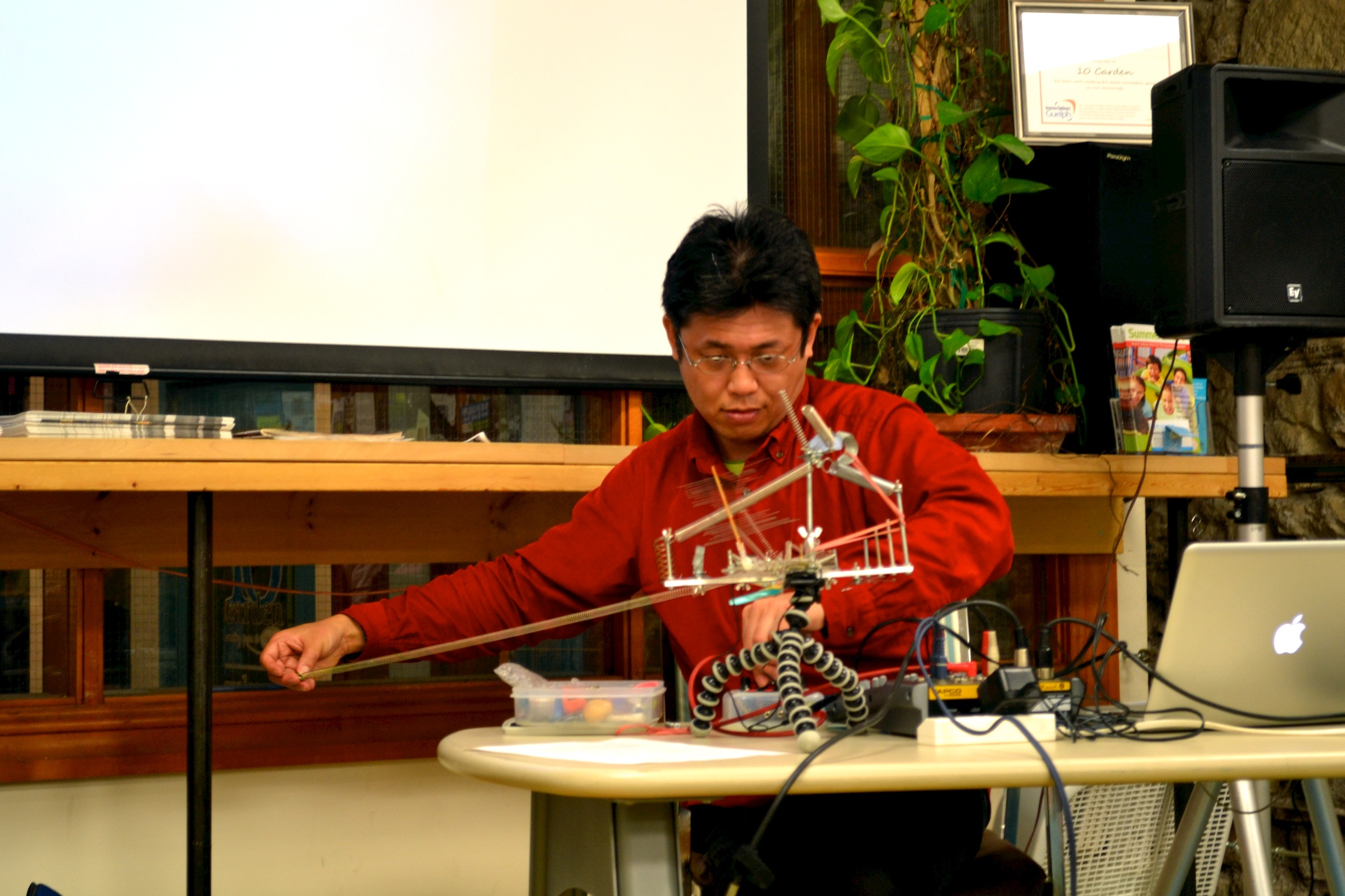
Adachi  performs on a self-made instrument.
Tomomi Adachi performs on a self-made instrument.


Tomomi Adachi (足立 智美) is a Japanese vocal and electronics performer, improviser, composer, instrument builder, installation artist, theatre director, and sound poet. He is the only performer of sound poetry in Japan and performed Kurt Schwitters’ “Ursonate” for the first time in Japan. He has performed with numerous musicians, dancers, and filmmakers, and along with his incredible vocal improvisations, he is known for his unique improvisations on his self-made instruments, many of which are made from Tupperware: a material that is both affordable and portable. Adachi describes his creations as an extension of his improvisatory practice: “I began to build instruments by myself in 1994, it was almost the same period with starting my activity as an improviser.” Last month in Guelph, Ontario we were treated to a performance by Adachi on one of his self-made instruments, as well as a vocal performance, followed by a self-reflexive talk about his artistic praxis.

The event took place at the inaugural Thinking Spaces Reading Group in Guelph. After the performance, Adachi discussed his work as an improviser with a focus on his own approach to self-made instruments, as well as his newest project PUTIF (People’s United Telepathic Improvisation Front), a collaboration with Jennifer Walshe. In PUTIF, Walshe and Adachi improvise together at a specified time in two separate locations, listening to one another at distances beyond the reach of the human ear. These improvisations are recorded and later combined and compared. They also encourage others to listen telepathically to their improvisation and send in descriptions of what they hear. At the Reading Group, Adachi discussed how telepathy functions as a conceptual framework for musical improvisation, demonstrating how others can be present in their absence. He also discussed how improvisation can be a tool for being together despite physical distance, as well as posing questions about the advantages of telematic technology in an age where it is becoming increasingly common.

If you get a chance you should check out Adachi’s fantastically creative work. For now, here is a video of Adachi performing on a self-made instrument, similar to the one he performed with in Guelph:

And, here are a couple photos of Tomomi Adachi’s performance and visit to Guelph.

DSC_0874

DSC_0880
All photos of Tomomi Adachi by Paul Watkins.

Photo Recap: Guelph Jazz Festival Continues to Inspire at 20

Photos by Paul Watkins

DSC_0736
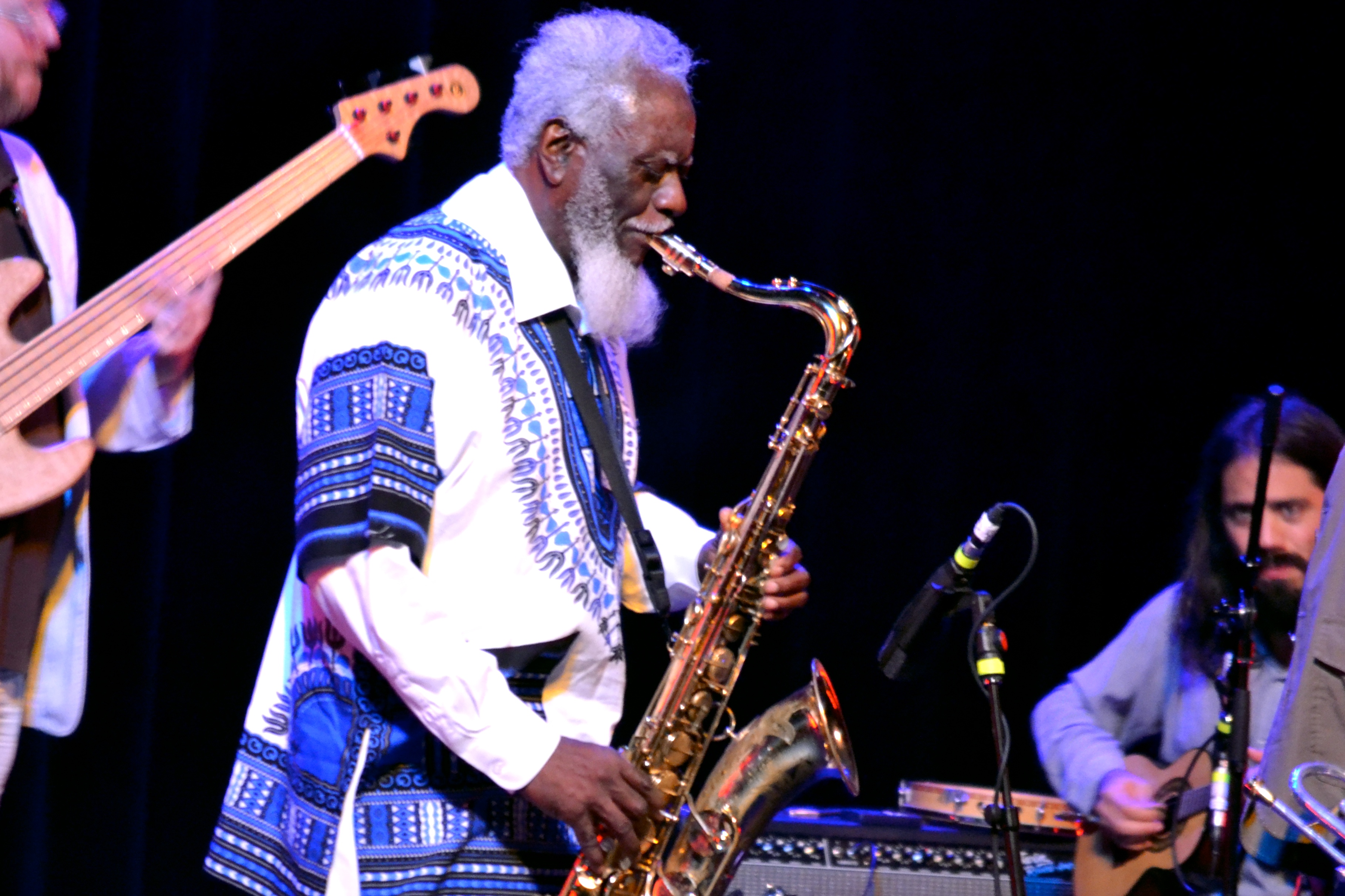
Headliner Pharoah Sanders

The 20th Anniversary of the Guelph Jazz Festival and Colloquium was another resounding success. Over the last twenty years the Festival has burgeoned from what Artistic Director Ajay Heble describes as “very modest origins into a vital social-purpose enterprise.” It has become an inclusive meeting place where enthusiasts of creative, innovative jazz and improvised music gather once a year to be inspired, engaged, even healed, while participating in one of the planet’s most diverse listening communities. The festival is a reminder of how you can create something from little more than a good idea and a love for the music. This year’s festival and colloquium was no exception, boasting sold out shows, packed colloquium talks, world premieres, enchanting Nuit Blanche performances, and a constellation of musical styles, with musicians and listeners in dialogue with the music in the space of the now.

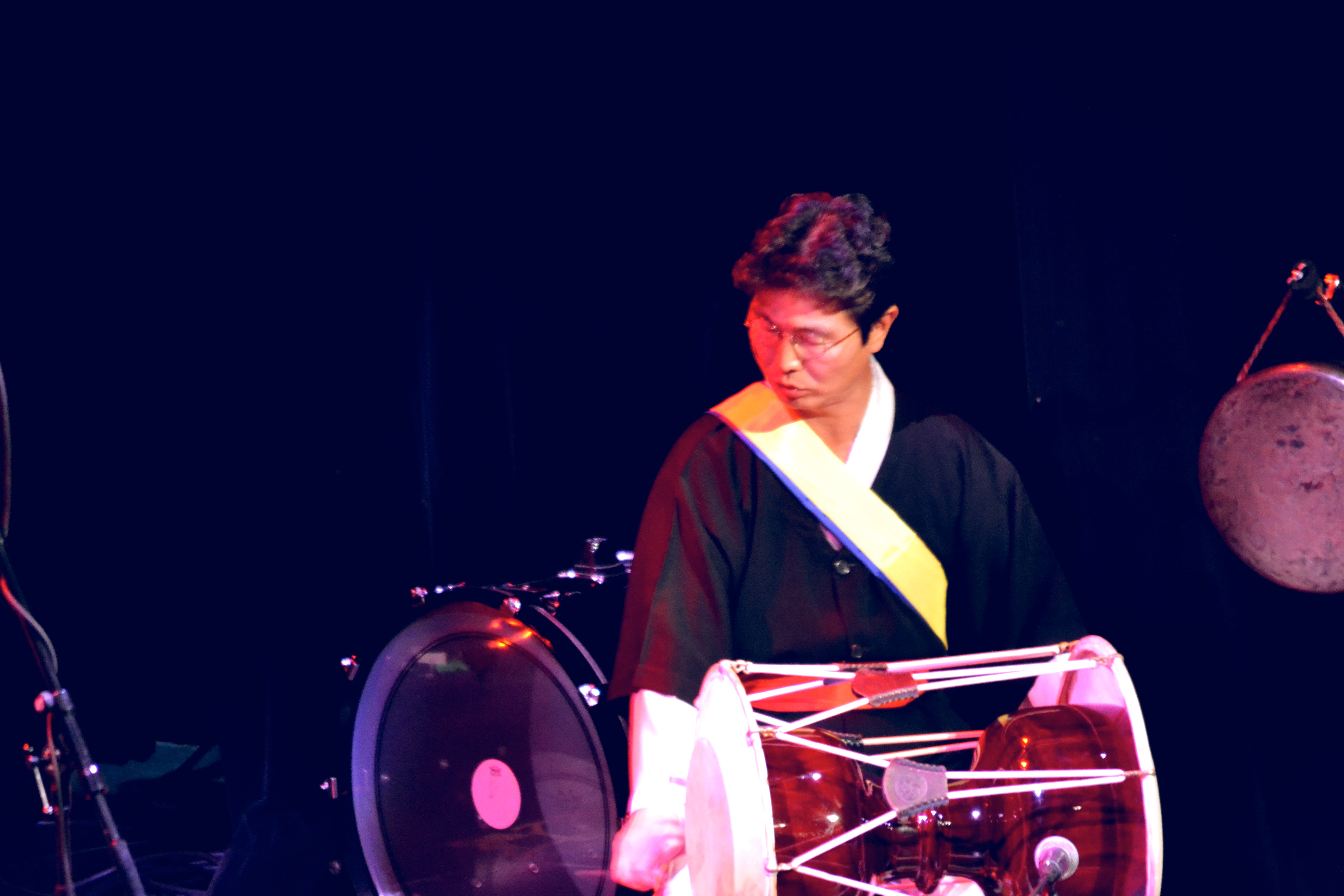
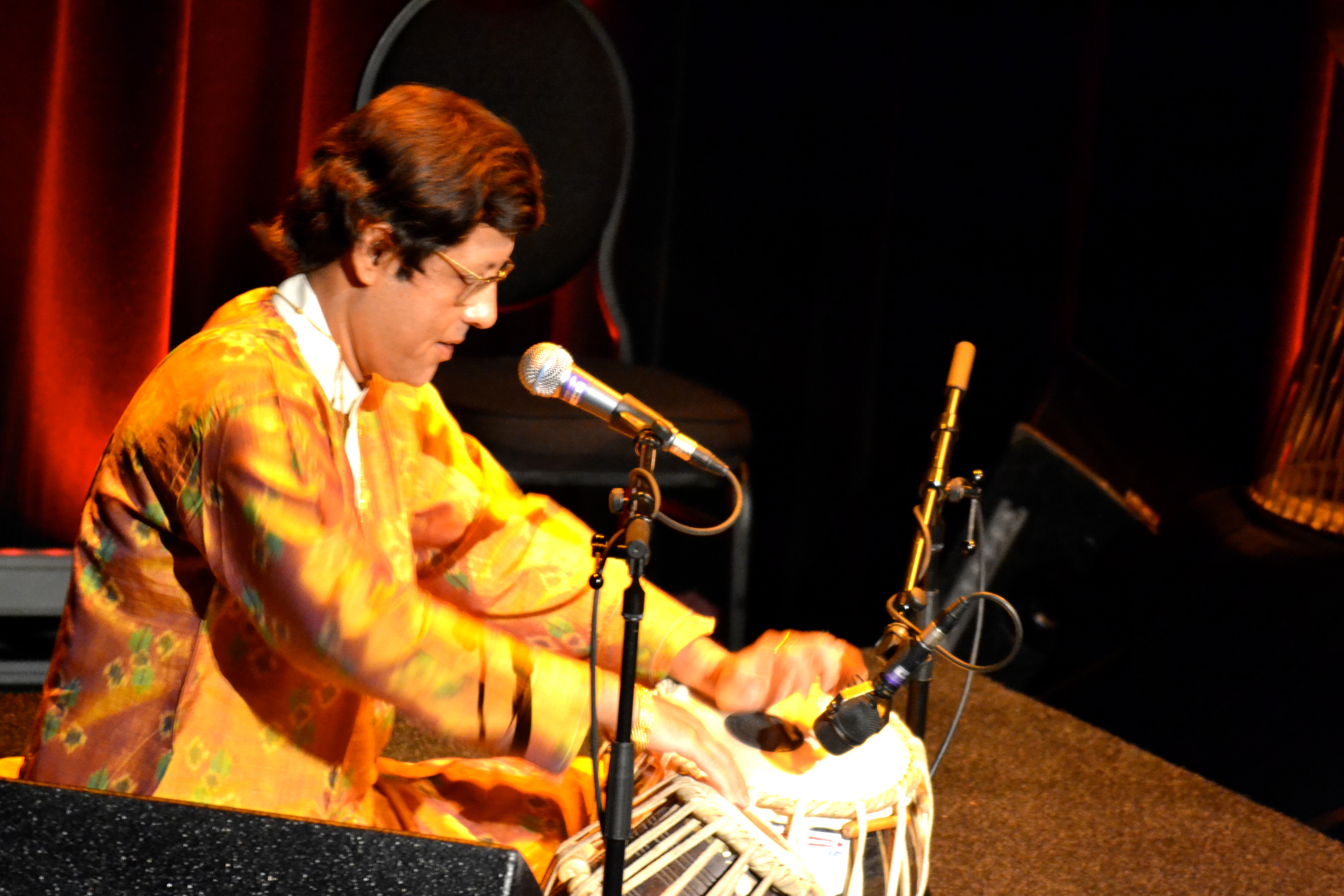
In honour of the 20th Anniversary, the festival was extended by an extra day to launch a new-partnered research institute, the International Institute for Critical Studies in Improvisation. The launch of the institute culminated in a symphony of drums with the World Percussion Summit. The improvising percussion quartet featured master drummers Jesse Stewart (Ontario), Hamid Drake (USA), Dong-Won Kim (South Korea), and Pandit Anindo Chatterjee (India).

DSC_0495
Don-Won Kim
Pandit Anindo Chatterjee.
Jesse Stewart and Pandit Anindo Chatterjee.
Jeff Schlanger, musicWitness-in-Residence, captures it all.

As usual, the Colloquium (co-presented between ICASP and the Guelph Jazz Festival) was top-notch and remains one of the few events in North America to combine scholarly activity with a music festival. The talks and music performances at the Colloquium were full of academic fervor while remaining generally accessible to the larger Guelph community with a stimulating mix of panels, keynote addresses, assorted workshops, and concerts and interviews that featured festival artists.

George Lipsitz keynote.
William Parker keynote.
Wadada and Pharoah after their interview.

The Colloquium was held at the Macdonald Stewart Art Centre, which was adorned with the jazz photography of Thomas King. King is a master storyteller who also possesses an incredible ability to tell the story of the Guelph Jazz Festival through the chronicle of his photography. King also collaborated with Guelph visual artist Nick Craine to create this year’s festival poster and logo.

Festival Logo.
Festival Logo.

The 20th Anniversary was full of amazing performances, which included Toronto based jazz upstarts BadBadNotGood, Matt Brubeck, Atomic, free shows by DRUMHAND, Jane Bunnett, Friendly Rich’s Scheherazade,Marianne Trudel, as well as the amazing double bill featuring Wadada Leo Smith’s Golden Quartet alongside Pharoah Sanders and The Underground. The festival continues to affirm that there is something special happening in Guelph. There is much more that could be said about the music, but I’ll leave that for other critics, although I do have a review of the trio Dawn of Midi coming soon. After all, in jazz there is no final chord. We can only dream what the next 20 years of the festival will manifest. For now, here are some additional pictures from this year’s anniversary celebration.