My article, “Listening to a Listening: The Disruptive Jazz Poetics of Dionne Brand’s Ossuaries (a call towards freedom)” is now out in MaComère’s most recent issue, Volume 14 Numbers 1 & 2 (2013-‐2014), titled Critical Perspectives on Dionne Brand.
MaComère is the first journal to publish an issue dedicated to providing sustained, critical focus on Brand’s works. For over thirty years, Dionne Brand has been testing the capacity of language to address ethical questions of global consequence. Her work spans a wide range of genres, including poetry, prose (novels and short stories), the essay and documentary film. Poet Laureate for the City of Toronto from 2009 to 2012, Brand has won many awards for her writing, including the prestigious Griffin Poetry Prize in 2011 for her narrative poem Ossuaries.
The Toronto Review of Bookshas just published my interview with the renowned poet, M. NourbeSe Philip. In the interview we focus on her work Zong!, and touch on music, improvisation, slavery (including the film 12 Years a Slave), the haunting of modernity, and more!
I wrote this poem after listening to my baby’s heartbeat on the Doppler fetal monitor. Below the poem is audio of the heartbeat mixed vis-à-vis my music production, voice, and lyrics.
we’re new h/ear
i heard your heartbeat today, baby.
a fast 180bpm slowed to a steady 160
as you listened to us listening to you
nestled in your echo chamber.
i play buddy holly’s “everyday”
headphones wrapped round mommy’s round belly,
you kick a little more, {your little foot} everyday it’s a-gettin’ closer.
i wonder what you look like?
can you feel my warm, loving, yet anxious hand
against the walls of your mini-universe, come what may.
on the news: another war, another shooting, more corruption,
pollution. I question bringing you here.
but then I hear your mommy singing, gently touching her belly
& feel the world—at least ours—is perfect.
Amiri Baraka, a poet and playwright of incendiary rage and collective insight, who went from Beat poet to Black Nationalist and finally Marxist-Leninist, died today in Newark. He was 79. Among his most known works are the poetry collections The Dead Lecturer and Transbluesency: The Selected Poetry of Amiri Baraka/LeRoi Jones (1961-1965), his plays Dutchmen and A Black Mass, and his various works on Black music, such as Blues People and Black Music. Along with Ezra Pound, Amiri Baraka remains one of the most controversial and least understood American poets. As M.L. Rosenthal wrote, “No American poet since Pound has come closer to making poetry and politics reciprocal forms of action” (qtd. in Baraka Reader xxi). For Baraka, art was a weapon of revolution. Further, Baraka wrote some of the most insightful works on African American music,appropriately referring to the music as American classical music. His poetry was always musical, for as he states in Blues People, the poem must “swing—from verb to noun.” The “changing same” was his designation of the interplay between tradition and the individual talent in Afro-American music.
His creative writing shows how poetry can move through blues and jazz to black chant and graphic sound. His poem, “In the Tradition,” dedicated to alto saxophonist Arthur Blyth, opens with a slick alliterative line, followed by a quick twist that recalls music as a resistive province to slavery: “Blues walk weeps ragtime / Painting slavery” (Transbluesency 199). “In the Tradition” is an epic poem concerning historical events; like much of Baraka’s work it carefully wields together traditions to assert poetic agency. Baraka’s poem “Black Art” charges forth like a gorilla and provides an Umwalzung—that is, a revolution—through a complete overturn of prior poetic systems, enacting one of the most ferocious black chants ever to appear on the page. Anti-Semitism aside, which the poem sadly has in abundance, “Black Art” is an improvisatory chant in the form of a free jazz poem. Baraka’s poetic violence disavows lyric voice in favour of a gruffer, more militant poetics: “Poems are bullshit unless they are / teeth or tress or lemons piled / on a step […] Fuck poems […] We want ‘poems that kill.’ / Assassin poems” (Transbluesency 142). While I can’t condone much of the poem’s content, its form, along with Baraka’s opus, altered the course of African American literary culture. It didn’t merely blacken the canon: it blew it into a million pieces.
Baraka is one of the most important poets and music critics of the twentieth century: full stop. The controversy and backlash over his public reading of his poem “Somebody Blew Up America,” as well as some of the homophobic, anti-Semitic, and misogyny of his middle period poems, often overshadow the incredible firebrand prowess and construction of Baraka’s cerebral and polemical thinking. Baraka lived a very tumultuous life and his poetry and social activism reflect that. He showed many young poets—across cultures and generations—that poetry could be a call to arms, as well as a tool to adequately express lived experience. His uncompromising, engaging, and, at times, problematic voice will be missed.
Check out this 2004 piece on why Amiri Baraka matters by poet Saul Williams in Fader.
Check out Baraka reading from “Why’s/Wise”:
Works Cited
Baraka, Amiri. Amiri Baraka/LeRoi Jones Reader. Ed. W.J. Harris. New York: Thunder’s Mouth Press, 1991. Print.
—. Transbluesency: The Selected Poems of Amiri Baraka/ LeRoi Jones (1961-1995). Ed. Paul Vangelisti. New York: Marsilio Publishers, 1995. Print.
I say, play your own way. Don’t play what the public wants. You play what you want and let the public pick up on what you’re doing, even if it does take them fifteen, twenty years.
-Thelonious Monk
Lots going around on pauldbwatkins.com (Riffings) these days. You might have noticed the new look to my website. It’s still a work in progress, but take a look around. The other big news is that I’ve finally finished my DJ project, Dedications. Dedications is an experimental jazzy hip-hop remix project born out of a love of listening to records. The album mixes, mashes, samples, spins, cuts, signifies, rhapsodizes, poetizes, layers, collages, remixes, breaks, distresses, archives, remakes, reshapes, and re-edits pieces of recorded history to create a sonic audio homage to a host of musicians and styles with a nod to the avant-garde. There is a lot of poetry on the album because, as a literary scholar, I have also always understood that poetry is musical, and that music is poetical.
Dedications takes various phonogrooves (from jazz, hip-hop, and spoken word, to unusual recontextualized samples) and mélanges them together to create polyvalent dedications to a host of musicians and poets. If you listen closely you will hear William Blake (with Archie Shepp), Sun Ra, Glenn Gould, Pharoah Sanders, Ravi Shankar, Inspectah Deck, Jack Kerouac, Ella Fitzgerald, The Last Poets, Gil Scott-Heron, Charlie “Bird” Parker (with Ontario songbirds), Sonny Rollins, John Coltrane (with Michael S. Harper), Louis Armstrong (with Gwendolyn Brooks), Fats Waller, Earl Birney, the poetry of The Four Horseman, Tom Waits, John G. Diefenbaker, Ginsberg reading Howl over Horace Parlan’s keys, A Japan Airlines record chopped up, Thelonious Monk accompanied by Amiri Baraka, MF Doom, and Mutabaruka dubbing over The Zombies, among a myriad of other sounds, samples, echoes, and cuts. At times I add a live-recorded layer of chant, singing bowl, or beatbox. I played almost all the drums on an MPC, and most of the samples are recorded live from vinyl. If I made a mistake in a recording, I usually embraced it as part of the process.
In short, I hope you enjoy the album. It is available for streaming below, or for free download (name your price), here.
before you finish eating breakfast in the morning, you’ve depended on more than half of the world.
-Martin Luther King Jr.
polyphonic murmurings
the city speaks
even while it sleeps.
we are more than ourselves
the sum of our parts
is the larger part of something.
the whole world is allegorical.
our coffee is a miracle of globalization:
a seed is planted,
years later little nimble fingers harvest the cherries:
roasted, processed, it arrives across oceans, hot java,
we sip its velvety elixir & go about our day.
wearing bluejeans, crafted from swaths of denim in a factory somewhere on a map in a county we’ve never been to.
we transport bodies in oiled machines that run on the commerce of drilling,
& eat our lunches in the break rooms of silent killings.
a solitary pig travels from farmactory to the killing fields.
we eat the animal we never could never know,
walk our dogs after, pet our cats, & yet,
all our bellies buzz with bellowing hunger.
we are all hungry for love, for comfort, for the workings of everyday niceties.
there is no human that is not a part—however apart—of the cacophonous pulling of all things.
the exploding of ourselves is like the imploding stars we’ve inherited.
we share in the cry of babies & the undulation of the ocean.
even if you can’t see or hear the howl of a starving child, we still play part to its cosmic tragedy.
miracles don’t end at the bottom of a coffee cup thrown casually into a recycling receptacle.
LEMON HOUND has evolved from the single-author blog of Sina Queyras, to a multi-authored blog, with the aim to be a dynamic bi-monthly Literary Journal. I’ve published a review with Lemon Houndbefore, and I’m proud to share my latest review in Volume 6 of the journal.
My review, “A Poetics of “Meditaysyun” covers new texts by Cecilia Vicuña and bill bissett. Vicuña’s Spit Temple and bissett’s hungree throat are two new poetic works significant not for what they edit out, but for what they edit in. Vicuña and bissett employ an “editing in” that allows for constellations of dialogue within and outside the texts. Edited in are improvised performances, incantatory phrases, chanting, signing, stories, meditations, webs and threads, languages and sounds, mediations, polyphonies, rhythms, silences, and listenings. To read more, click here.
~
I also contribute reviews on an ongoing basis to Toronto Review of Books’s blog, Chirograph. My latest review (“Forgive Us Our Trespasses”) is of Quebeçois auteur Denis Villeneuve’s film Prisoners, which I viewed at TIFF. I have another TIFF review coming soon on Ben Wheatley’s A Field in England.
Happy weekend reading (whatever that may be), watching (whatever you may watch, I’ll be watching Breaking Bad‘s tense conclusion on Sunday), and venturing (wherever you may go).
I was sad to learn that Seamus Heaney, Irish poet & Nobel Laureate, died this morning. I first encountered the work of Heaney some six years ago in an undergrad English class entitled, “British Poetry, Lately.” The class examined recent developments in contemporary British and Irish Poetry. In the class we engaged with poets such as Eavan Boland, Kathleen Jamie, Ted Hughes, Carol Ann Duffy, Tom Raworth, and, of course, Heaney—all masters of tone, language, subject matter, working with/against the long British devotion to rhyme and meter.
Poetry in the twentieth century has largely been about defamiliarization (ostranenie (остранение)), the artistic technique of persuading the audience to see familiar things in an unfamiliar or strange way, often using metaphor to help depict the mechanics of the world we inhabit. Heaney was a master of using incredibly rich and dense metaphors. He was also a master of listening. Ever the attentive poet, Seamus Heaney made use of melopoeia (charging words beyond their normal meaning, like the cadences of music) as a part of his fluidity to create his dense rhythms. In Glanmore Sonnets he stands and listens to the mysterious corporeal sensualities that surround him to cultivate words: “Words entering almost the sense of touch / Ferreting themselves out of the dark hutch — / ‘These things are not secrets but mysteries’” (II).
Yet, it was in “Digging,” a poem full of onomatopoeia and poetic excavation, and the first poem from his very first collection, The Death of a Naturalist (1966), where Heaney first displayed his poetic method:
The cold smell of potato mold, the squelch and slap
Of soggy peat, the curt cuts of an edge
Through living roots awaken in my head.
But I’ve no spade to follow men like them.
Between my finger and my thumb
The squat pen rests.
I’ll dig with it.
It’s been a number of years since I’ve read Heaney, and it’s unfortunate that it took his death for me to reread a couple of his well known poems, which I still remember so well from that undergrad class. He was a poet of the highest order and will be missed. His poetic cultivations and living roots charge on.
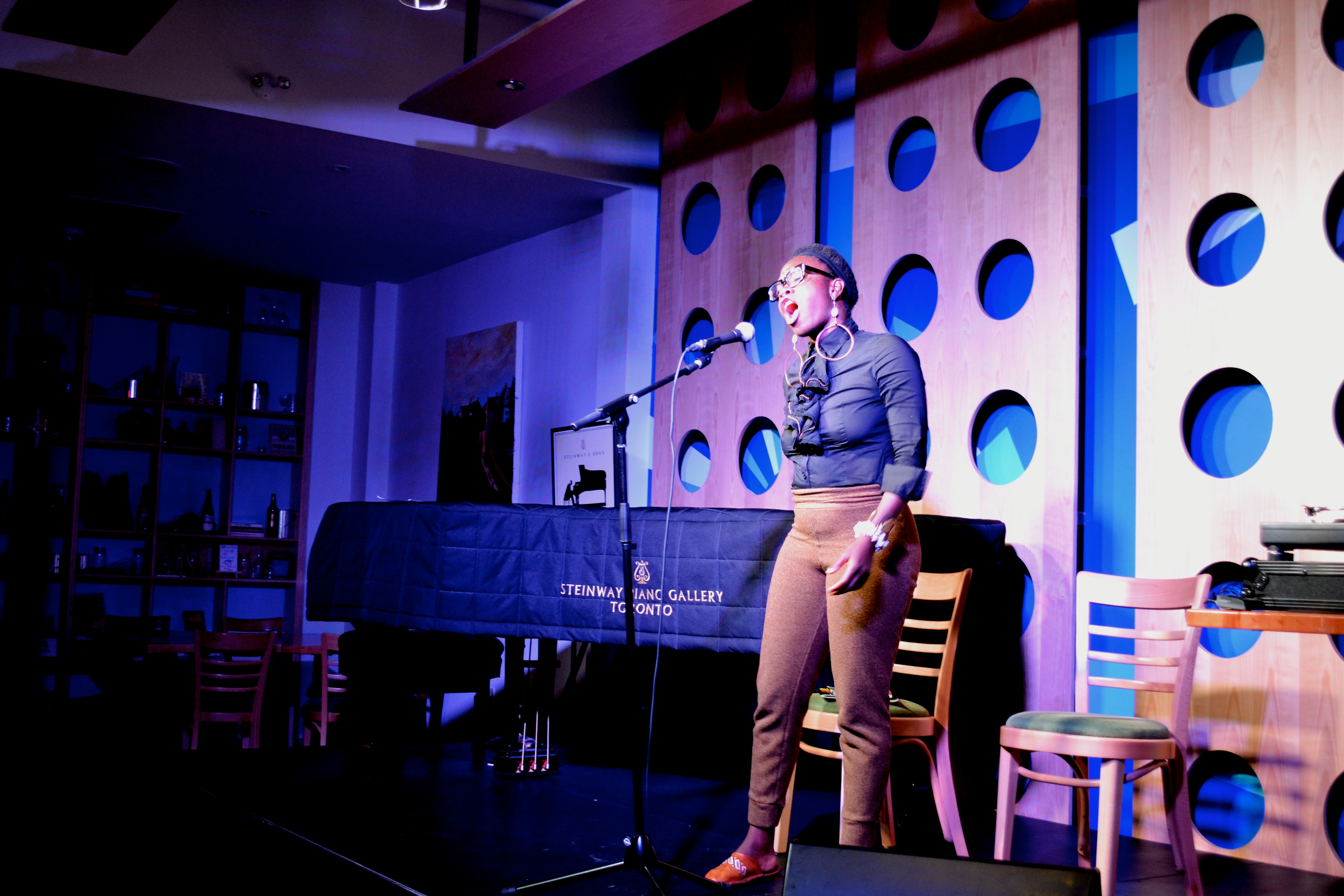
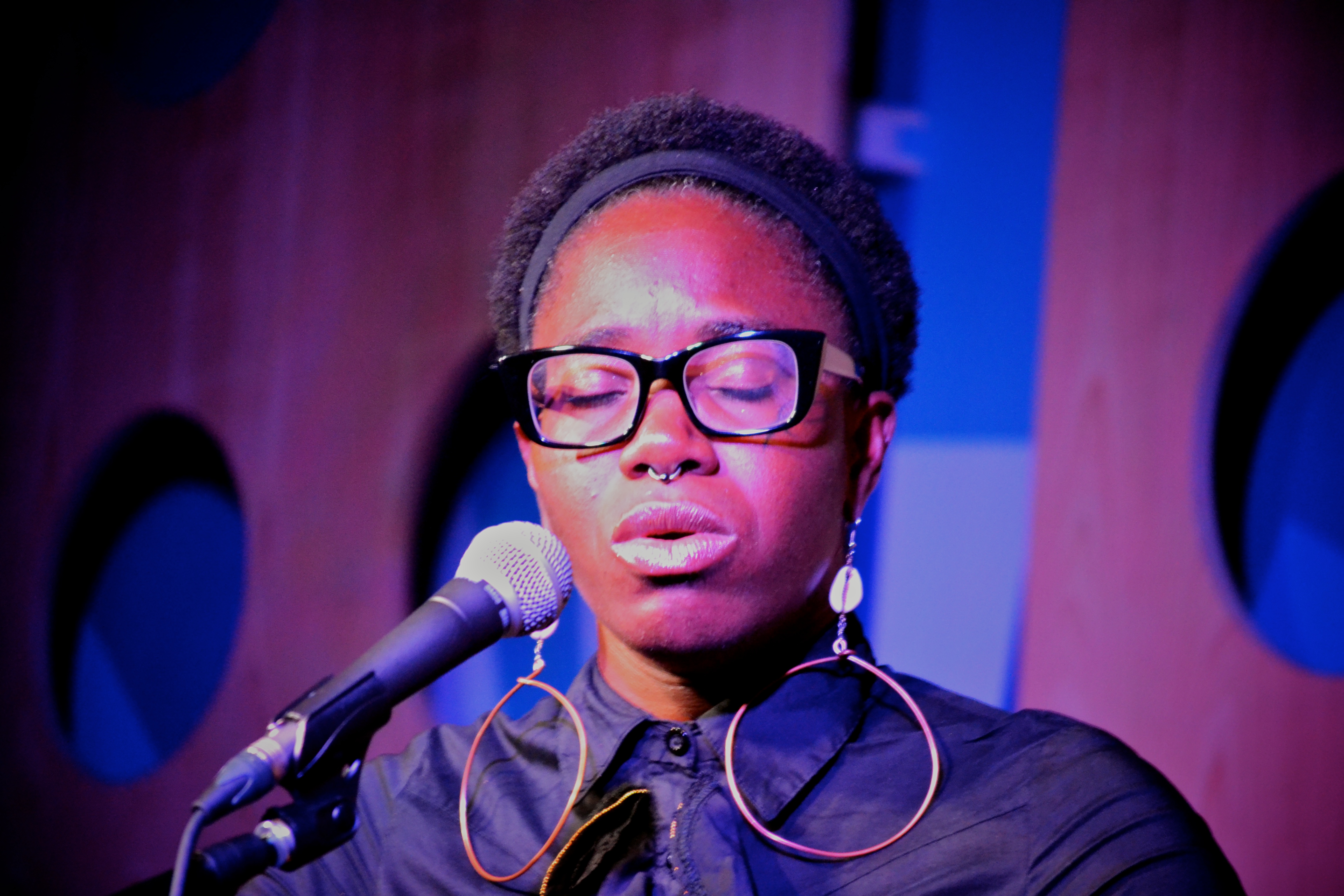
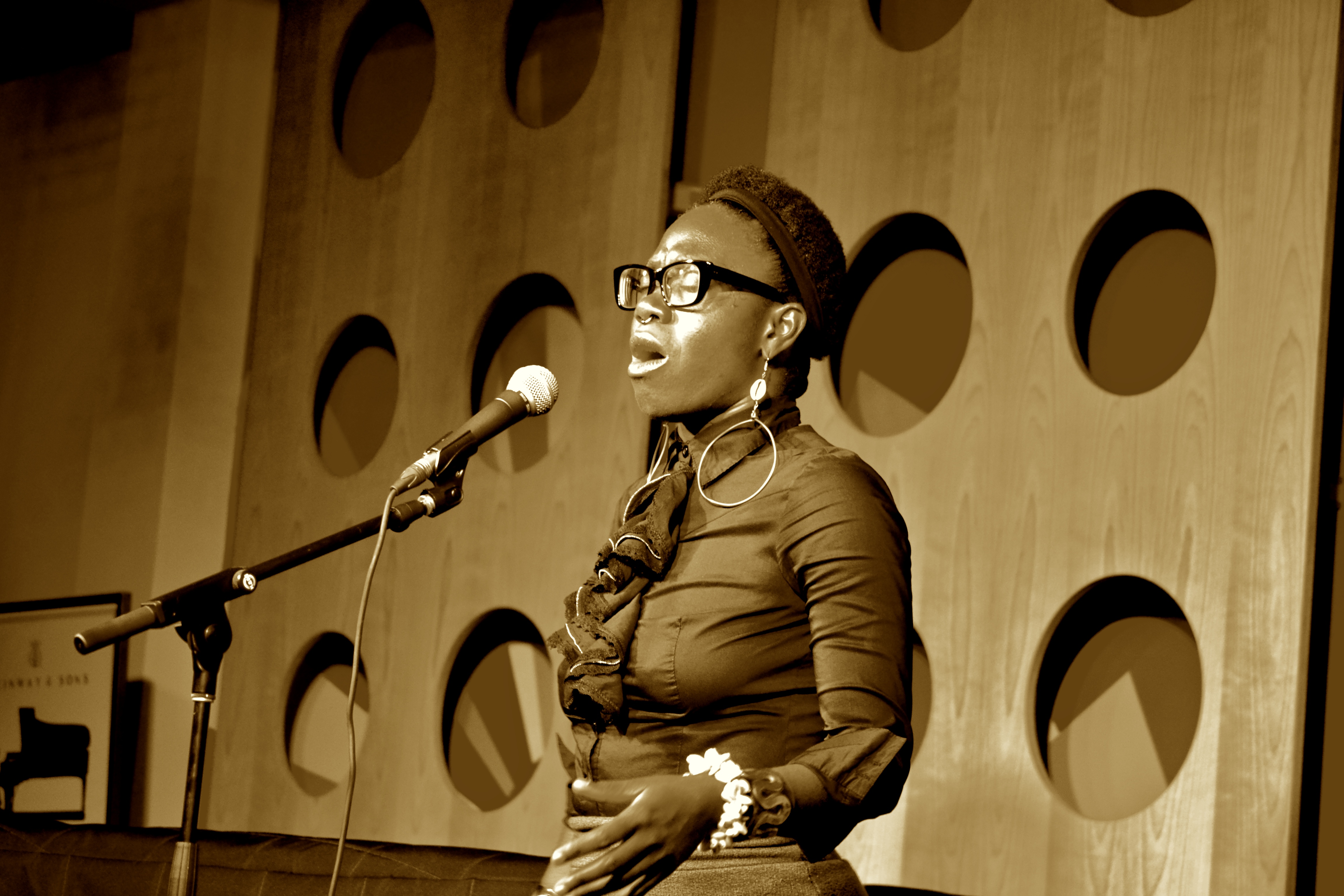
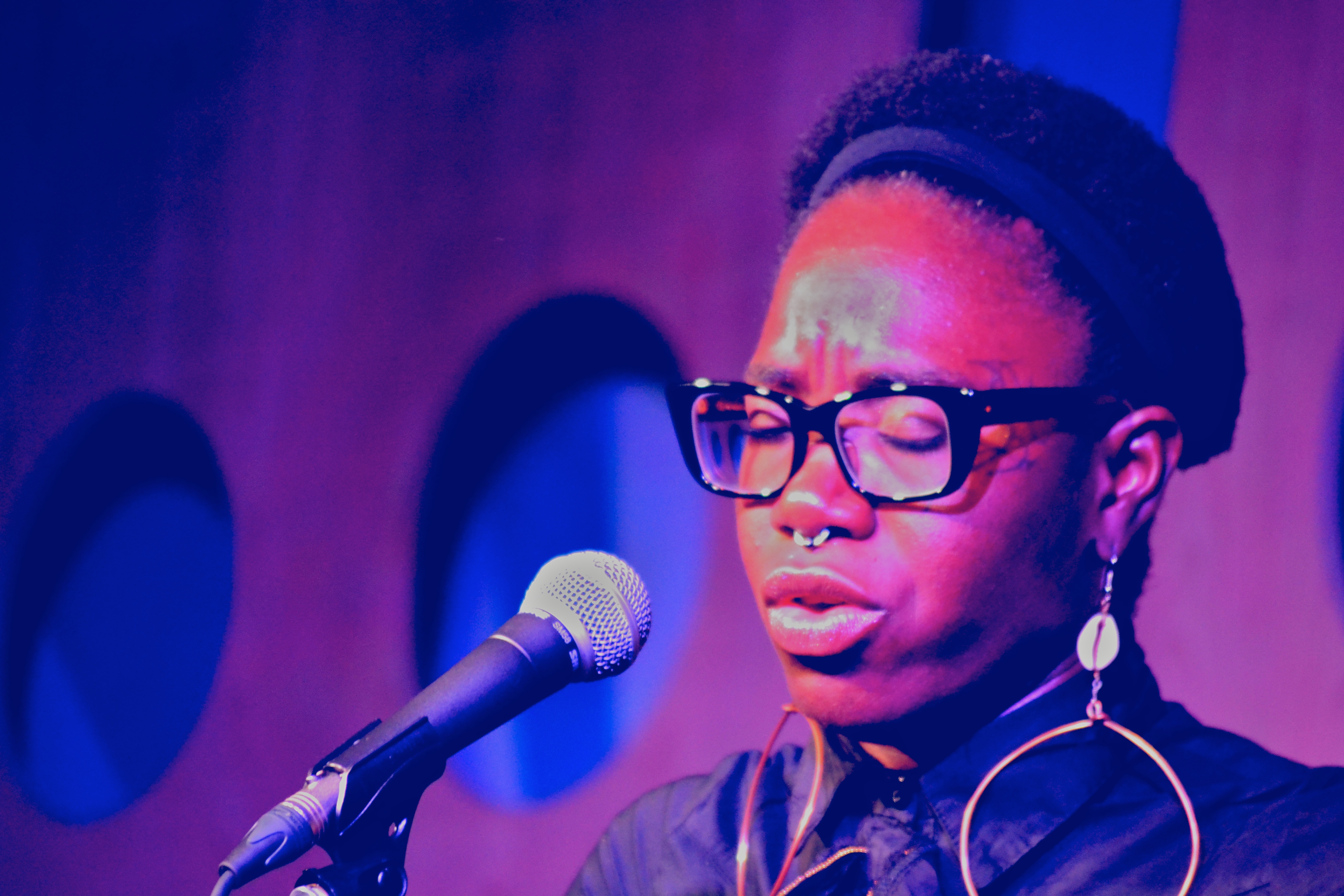
“we tellin’ stories yo”: A Performance and Interview with renowned dub poet d’bi.young with an opening DJ Set by DJ Techné. Thursday, August 8th, 2013 (7-9 pm) @ Paintbox Bistro.
Photos of d’bi by Paul Watkins.
Photos of Paul Watkins and d’bi together by Meg Watkins.
Edits by Paul Watkins.
“This poet is a griot in search of a village.”
-Kwame Dawes, “Holy Dub,” Midland 18.
Dub poetry is a form of performance poetry with a West Indian aesthetic and origin. It evolved out of dub music comprised of spoken word pieces over reggae rhythms and Nyabinghi traditions[i] in Jamaica beginning in the 1970s. Rather than the Jamaican form of “toasting” (a significant stylistic influence on hip-hop), which also featured (often improvised) spoken word, sometimes as chant, to the music of the dancehall DJ, a dub poet’s performance is usually pre-written and prepared. Spoken or chanted with the background of reggae rhythms, or a capella or ital, and using Jamaican Creole/Patois, dub poetry effectively blends African and Caribbean oral and griot traditions with more standard approaches to poetry and performance. Basically, dub performances were created by removing vocals from side A of a record with a dub machine to create a B side containing a rhythm/instrumental track, often amplifying the bass and drums. Traditionally dub poets are closely aligned with DJs—yes DJing is both traditional and tradition—as they reanimate and (re)sound the past in the present through a musico-poetic performance atop a tentative original.
Conventionally, “Jamaican Creole is the natural language of dub poetry” (Afua Cooper, Utterances 1) and while dub poets often privilege reggae music, nearly all forms of African American and Afro-diasporic musics, and others, can be used in the performance of a dub poem as the mode continues to evade a single homogenizing definition or approach. Nevertheless, dub “began as, and remains, rebel poetry” (2). This is not to say that dub poetry eludes the possibility of definition. d’bi.young.antifrika—one of Canada’s most renowned dub poets and dub monodramatists—thinks through dub vis-à-vis her own mother’s manuscript on dub, which identifies the four major elements of the then emerging form: music, language, politics, and performance (“r/evolution” 27). Dub as such bridges the personal and the political, and as d’bi developed her own understanding of dub she added four more elements for a total of eight principles to form the acronym s.o.r.p.l.u.s.i: “urgency, sacredness, integrity, and self-knowledge. I then renamed the earlier elements of music, politics, and performance to rhythm, political content and context, and orality” (27).
In the following video d’bi outlines how these eight principles can empower artists, particularly African artists across the diaspora.
For d’bi, the principles of dub poetry—consisting of self-knowledge, orality, rhythm, political content and context, language, urgency, sacredness, and integrity—combine to comprise “a comprehensive eco-system of accountability and responsibility between my audiences and me. each principle in the methodology challenges me to not only be self-invested but to (re)position to the centre of my micro and macro communities, being both accountable and responsible (able to account for and respond to these communities)” (“r/evolution” 27). As such, dub poetry has the power to connect disparate communities together through lines of solidarity. Two days from now, on August 8th, I will have the privilege of interviewing d’bi.young about her practice as a pioneer in the art of dub poetry and theatre. I hope to see you there for what promises to be an exciting and engaging evening of “Word! / Sound! / Powah!”
Here’s the poster for the event, d’bi’s personal page and youtube page, as well as the facebook event page.
Cooper, Afua (Ed.). Utterance and Incantations: Women, Poetry and Dub. Toronto: Sister Vision, 1999. Print.
[i] The Nyahbinghi Order is the oldest of all the Rastafari mansions and the term translates as “black victory” (niya = black, binghi = victory). The Niyabinghi resistance inspired a number of Jamaican Rastafarians, who incorporated niyabinghi chants into their celebrations (Wikipedia). The rhythms of these chants—full of improvised syncopation— greatly influenced popular ska, rocksteady and reggae music.






 PAUL db WATKINS
