Professor Paul Watkins
Class: Tuesdays 1:00 pm – 4:00 pm
English 390 will investigate intersections between word and image in an emergent genre loosely defined as “graphic memoir,” or what others have called “autographics” (Gillian Whitlock), “graphic narrative” (Hilary Chute), “Graphic-Novel-Memoir” (David Itzcoff), or “comics journalism” (Joe Sacco). Along the way, we will explore how graphic texts push the boundaries of literature and memoir. We will also delve into the intricate relationship between popular culture, politics, and art. The final text will be chosen from two options through a class vote. Additionally, a creative intervention project will be part of the course.
See the course outline on VIULearn for course policies and a detailed breakdown of assignments.
Required Texts:
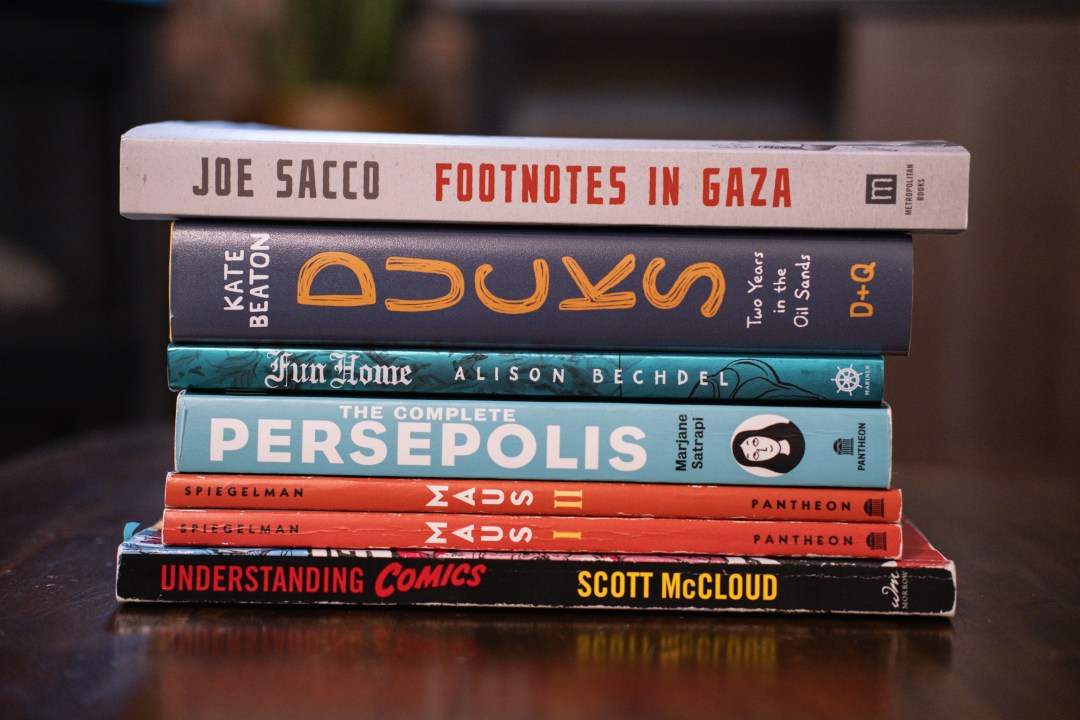
- Understanding Comics by Scott McCloud
- Maus by Art Spiegelman
- Persepolis by Marjane Satrapi
- Fun Home by Alison Bechdel
- Ducks by Kate Beaton
- TBA (class vote)
Schedule:
Please note that this schedule is subject to change as the term progresses.
I. Intro to Comics
Sept 15, Course Intro and Understanding Comics
- Introduction: course outline; standards and expectations; final text options
- Reading: Scott McCloud, Understanding Comics (chapter 1-3)
Sept 22, Understanding Comics
- Reading: Scott McCloud, Understanding Comics (chapters 4-9)
- Show and Tell [short presentation and submission due before class]
- Discussion of Creative Interventions and Discussion Questions
- VOTE FOR FINAL TEXT: due before class
Additional Readings and Media for Understanding Comics
- Rolling Stone, The 50 Best Non-Superhero Graphic Novels
- Doctoral dissertation in graphic novel form
- “Alan Moore attacks Frank Miller in comic book war of words”
- “Margaret Atwood is working on her first graphic novel series”
- Scott McCloud’s homepage
- TED Talk by McCloud on “The Visual Magic of Comics“
- 2000 interview with Scott McCloud.
- 2003 Interview with Scott McCloud
- 2007 Interview with Scott McCloud
- Blog post by Aaron Muszalski on McCloud’s Understanding Comics
- “Talking Comics with Scott McCloud”
- “On the Problem of Form” by Kandinsky
- Read “Inventing Comics” by Dylan Horrocks
- On Osamu Tezuka
- Doctor Who on Time.
- Comic for Blind People
III. History and Graphic Memoir
Sept 29, Maus (I: My Father Bleeds History)
- Reading: Art Spiegelman, Maus (I) [full text]
Oct 6, Maus (II: And Here My Trouble Began)
- Reading: Spiegelman, Maus (II) [full text]
- Additional VIULearn Readings: Jonathan Kincade, “Art Spiegelman’s Maus;” Rosemary V. Hathaway, “Reading Art Spiegelman’s Maus as Postmodern Ethnography”
- Discussion Question 1 due
Additional Readings and Media for Maus
- Audio: Of ‘Maus’ and Spiegelman
- Why Mice?
- “Life After Maus“
- “Art Spiegelman Breaks His Silence on Israel“
- “Legendary Cartoonist Robert Crumb on the Massacre in Paris“
- “‘Cartoonist Lives Matter’: Art Spiegelman Responds to Charlie Hebdo Attack, Power of Cartoons”
- “Art Spiegelman: Je Suis Charlie“
- “An Open Letter to Art Spiegelman by Kim O’Connor”
- “Charlie Hebdo Is Heroic and Racist“
- Why Maus was Banned (2022)
- Art Spiegelman Reflects on Maus (2022, NYT)
Oct 13, no class, replaced by classes scheduled on a Monday. READ Persepolis.
Oct 20, Persepolis
- Reading: Marjane Satrapi, Persepolis (pages 1-275)
- Start Persepolis film
Oct 27, Persepolis
- Reading: Marjane Satrapi, Persepolis (276-341)
- Additional VIULearn Readings: Chute, “The Texture of Retracing in Marjane Satrapi’s Persepolis”; Darda, “Graphic Ethics: Theorizing the Face in Marjane Satrapi’s Persepolis”
- Finish Persepolis film
- Discussion Question 2 due
- Close Reading Due by 11:59 pm on VIULearn
Additional Readings and Media for Persepolis
- The little girl in Persepolis has grown up’: Marjane Satrapi on life after her hit graphic novel – and her radical new work
- “Marjane Satrapi: On Artistic Freedom, Fame & Finishing No Matter What”
- 2004 interview with Marjane Satrapi
- 2008 interview with Satrapi
- “Marjane Satrapi: Princess of darkness“
- Salome MC, Price of Freedom
- A Girl Walks Home Alone at Night (Trailer)
- How Iran’s history is fuelling the Mahsa Amini protests
- On the Death of the Author
III. Feminist and Queer Perspectives in Graphic Memoir
Nov 3, Fun Home
- Reading: Alison Bechdel, Fun Home (full text)
- Additional VIULearn Readings (choose two): Watson, “Autographic Disclosures and Genealogies of Desire in Alison Bechdel’s Fun Home;” Abram, “Beyond the Front, Specificity is Abandoned: Illustrating Backgrounds in Alison Bechdel’s Fun Home“; Tison, “Loss, Revision, Translation”
- Discussion Question 3 due
Nov 9-13, STUDY DAYS (no class). Read Ducks.
Nov 17, Ducks
- Reading: Kate Beaton, Ducks (pages 1-250)
- Discussion of final paper
- Discussion Question 4 due
Nov 24, Ducks
- Reading: Kate Beaton, Ducks (250-end)
- Additional VIULearn Reading: “The Liminal World of The Oil Sands in Kate Beaton’s Ducks” and “The Messiness of Humanity” (CBC, Kate Beaton Interview); [note: might be one more]
- Creative Interventions Due and Sharing
Additional Readings and Media for Fun Home and Ducks
- Alison Bechdel on turning a tragic childhood into a hit musical
- Ducks review on Good Ok Bad
- Another reivew of Ducks
- This is Not a Review of Ducks
IV. Present Pasts: History, Memory, and Comics
Dec 1, TBA: Either Footnotes in Gaza or March
- Reading: TBA
- Discussion Question 5 due
Dec 8, TBA: Either Footnotes in Gaza or March
- Additional VIULearn Readings TBA on VIULearn
- Exam Prep
- Research paper due on Dec 8 by 11:59 pm on VIULearn (Dec. 11 if your essay focuses on the final text)

