Occasionally, I perform under the DJ Techné moniker. My latest track, “I am Om,” is about finding inner peace in a world that often feels disconnected and sick. The vocal clips are from Alice Coltrane, Pharoah Sanders (from Coltrane’s Om), the Dalai Lama, Louis Armstrong, and MLK. It is available for free download, here, or have a listen below:
BLOG: RIFFINGS
A Healing and Honest Path: In Conversation with Louise Bernice Halfe
I talk with Louise Bernice Halfe about her contribution of four poems to the Malahat’s Indigenous Perspectives issue: “Finding Bone,” “God of nightmares,” “it was a pure,” and “Skeletons and Cannibals.”
Click here to read the full interview.
“The Gathering of Nations” Anthem
I was fortunate to take part in recording and mixing the audio portion of Marlene Rice’s (Hwiem’) “The Gathering of Nations” Anthem at VIU’s Cowichan campus. The video work is done by my colleague Jay Ruzesky in the Creative Writing department. It is a song that welcomes students to learn and it is performed in the Hul’qumi’num language. As Marlene Rice puts it:
This song teaches us respect for our family and our friends. It says “speak your mind, and keep your mind strong.” Our communities want to bring our generations together. We need to always think about the elders of the past and the teachings they provide and bring to the present day that will give strength to our youth. We can take a look at our young people and look at the elders of the past and form a vision of bringing them together so they can survive in this world.
Feel free to share.
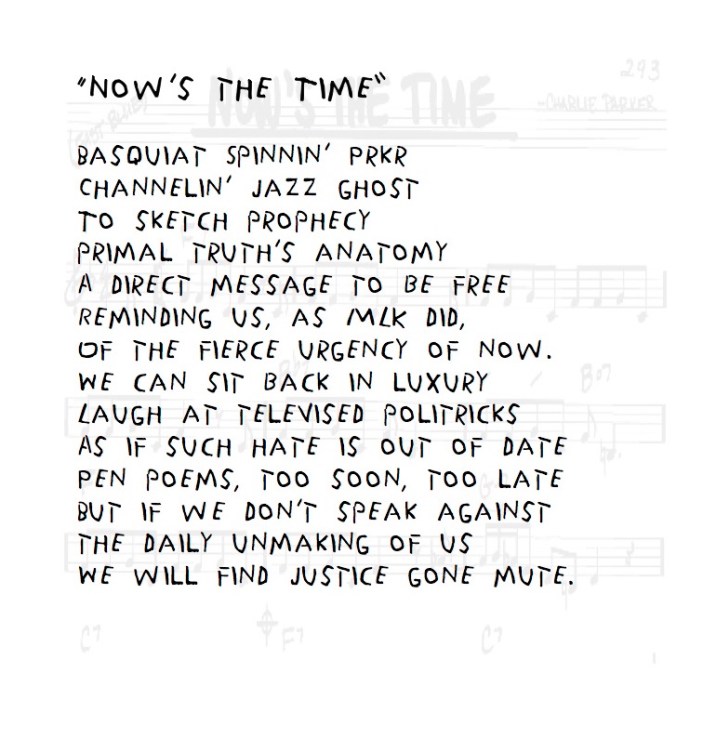
Hogan’s Alley Remixed: Learning through Wayde Compton’s Poetics
Tomorrow, Friday, November 25, you are invited to step into Hogan’s Alley, Vancouver’s historic neighbourhood and a focal point of Black culture prior to its destruction in the late 1960s. I will be delivering the final Arts and Humanities Colloquium for the term, entitled Hogan’s Alley Remixed: Learning through Wayde Compton’s Poetics.
My talk will look at the work of Vancouver-born poet, essayist, DJ, and historian Wayde Compton, whose collection, Performance Bond, explores the destruction of Hogan’s Alley. Compton incorporates hip-hop and turntable poetics in his piece to recover the past and effectively blend such histories into the present.
The presentation will mix images, sound, and text. VIU student and bassist Darin Nicolle will provide some bass accompaniment during the presentation and there will be an opening performance piece on mashup culture.
The presentation is from 10-11:30 a.m. at Malaspina Theatre (on the Nanaimo VIU campus). The sessions are free to attend. Please join us at 9:30 am for coffee, tea, cookies, and conversation in the theatre lobby.
Press:
Nanaimo Bulletin: Vancouver Island University lecture examines poet Wayde Compton’s work
The Navigator: Exploring historic Vancouver’s Hogan’s Alley through Wayde Compton’s eyes
Image Credit: RACHEL STERN / The News Bulletin
When Voices Intertwine (Book Review)
Robert Bringhurst is often described as a modern-day renaissance man. Few writers could navigate fields as diverse as poetry, translation, typography, cultural history, and philosophy as interwoven vocations. Through an adherence to polyphony as a mode of deep ecological thinking, Bringhurst works to make accessible the wisdom of poets and thinkers past, from Sophocles to Haida mythtellers Ghandl and Skaay.
As Bringhurst puts it, “when two voices intertwine, the space they occupy gets larger, and the mind gets larger with it”; no wonder poet Denis Lee calls him “a man of massive simple-mindedness.” Bringhurst has a way of chiselling complex thinking down to that part of being that ineluctably binds all living matter together. Bringhurst’s ontological approach is more aligned with ancient Greece than the modern academy, which is why editors Brent Wood and Mark Dickinson make clear that he doesn’t neatly fit within the “twenty-first century university’s rubric of knowledge production and transmission.” As such, Bringhurst is most comfortable in the role of an independent public thinker, bound by neither institution nor strict cultural protocol, which has irked some of his critics.
Click here to read my full review at Canadian Literature.
New English Courses at VIU Explore Diverse Ethnic and Cultural Perspectives
Courses are open to the community through the University’s Love of Learning program
VIU’s English Department is pleased to present three new courses next semester that examine literature from a variety of non-traditional perspectives and mediums. From reconciliation, to post-colonial Caribbean lifestyles and cultures, to the quest for unforgettable journeys, these new courses incorporate a diverse range of perspectives and writing styles, and question people’s assumptions about literature and art.
In a rare and unique opportunity for students and community members, English 332: Topics in Indigenous Literatures will include class visits and public readings from some of the authors studied in class, including Eden Robinson, whose novel Monkey Beach won the BC Book Prize’s Ethel Wilson Fiction Prize. While many of the stories deal with the lasting effects of Canada’s colonial past, they are also about healing, reconciliation and hope. Dr. Paul Watkins will explore these stories through several mediums, including fiction, poetry, art, comics, film and music, and students will participate in a creative intervention project.
“The hope is to open up spaces that challenge the colonization that affects us all, whether we are aware of it or not,” says Watkins.
As students read, watch and listen, they will also Tweet with the hashtag #ENGL332. The readings are sponsored by VIU’s Faculty of Arts and Humanities, the First Nations Studies Program, the Office of Aboriginal Education and Engagement, and the Canada Council for the Arts.
If you’re itching for a little taste of the Caribbean then maybe English 333: Topics in Post-colonial Literature is your course. From Rihanna and Bob Marley, to the dub poetry of Jean ‘Binta’ Breeze and the magical realism of Junot Diaz, English 333 delves into anti-colonial, post-colonial, feminist and queer perspectives expressed through various mediums, including literature, art, music, film and literary theory.
“The Caribbean is on the move, and it moves me,” says Dr. Melissa Stephens. “I see it as a shape-shifting constellation of people and places, politics and art, feeling and intellect. This course will help you grasp the enduring impact of colonial violence, but also, and most importantly, the work of resistance and liberation.”
Finally, adventure seekers will want to check out English 222: Travels in World Literature, during which Dr. Jeannie Martin examines a range of provoking historical travel writing along with popular contemporary works that highlight journeys in search of the romantic, the pastoral and the picturesque.
“Books about travel and tourism are wildly popular these days, but often unwittingly extend the enterprise of imperialism,” says Martin. “This course raises questions about the ethics of presenting the truth of another place and another culture. In this age of globalization, we passport-carrying privileged, viewing the world through the limited lens of our own cultures and experiences, are not the only travellers. Raising questions about who travels, why we travel, and why we write about our travels encourages us to form more complex relationships with other peoples, places and cultures.”
These courses are open to the general public via VIU’s Love of Learning program, which allows community members to take an academic course without the stress of exams or assignments at a discounted rate of only $99 per 3-credit course plus ancillary fees. Pre-requisites will be waived for Love of Learning students.
To learn more, visit the VIU English Department news page.
-30-
MEDIA CONTACT:
Jenn McGarrigle, Communications Officer, Vancouver Island University
P: 250.740.6559 | C: 250.619.6860 | E: jenn.mcgarrigle@viu.ca | T: @VIUNews
Wednesday, November 9, 2016 – 1:45pm
Harmonious Dissonance: in Conversation with George Elliott Clarke
To provide Malahat readers with a context in which to read and more deeply appreciate George Elliott Clarke’s “Othello: By Donation Alphonse François, Marquis de Sade,” a bravura long poem appearing in the magazine’s Summer 2016 issue, I explore with the poet his ambitions and the intent he enacts in the writing of such a profoundly engaging and provocative work. Last year I also recorded George reading a few poems when he visited Vancouver Island University last year, and The Malahat Review has published one of these recordings, “The Testament of Ulysses X.” You may read the full text of this poem or listen to George’s performance of it, recorded while he was the 2015 Ralph Gustafson Distinguished Poet at Vancouver Island University in Nanaimo.
George Elliott Clarke is currently Canadian Parliamentary Poet Laureate. Towards the end of the interview I asked him, why does the world need poetry? To which he responded:
Hal David and Burt Bacharach: “What the World Needs Now is Love, Sweet Love”? That song comes to mind in thinking about why the world should need poetry. But I will also reiterate my sentiments in the Shad/Q interview: poetry exists in the rhythm of pulse and breath; it is “mind-forged” (Blake) language given vocal (originally) expression in tune with the pace of breath and the beat of the heart. The cadences are related to the sounds conjured by the arrangements of tongue, teeth, lips, and lungs. Poetry is organic technology, a physical art—as much as is dance, save that its calisthenics are performed by abstract characters or organically by the movement of the mouth. In any event, it is the cheapest art and thus the most portable, for it can be memorized and taught to others. It is the first civilizing art, for it is the basis of scripture, whether inscribed or chanted. It conjoins imagination and emotion; so, for so long as human beings dream, recall, and/or have feelings, they/we will always invent poems.
Read the full interview, here.
In addition,
Some Notes Towards the (im)Possible: 3D Printing a Turntable
3D printing, which is also known as additive manufacturing (AM), uses successive layers of material under computer control to create 3D objects. The technological sphere of 3D printing is a space that excites futurists, scientists, engineers, inventors, pragmatists, and digital humanists. Given the relative infancy of this technology, it remains a truly improvisatory space where ample play (and a fair dosage of frustration) unfold in the process of creating and printing 3D objects.
Improvisation is the force by which we maintain the human, and yet it also foreshadows where the technocratic future will take us as we head further onto the ledge of the possible, or as jazz artist and creative icon Sun Ra writes, the impossible: “The possible has been tried and failed; now I want to try the impossible” (qtd. in Szwed 192). It is in imagining the impossible that we can create futures that at one time seemed only imaginable. There are concerns that 3D printing—which futurologist Jeremy Rifkin refers to as a third industrial revolution, following the production line—could replace the work of people, among a list of other concerns, such as unhealthy air emissions, a reliance on plastics, gun control loopholes, and 3D printed drugs. While these concerns need to be taken seriously, what I find particularly exciting about 3D printing is its relative accessibility, affordability, and the potential to inspire users to view themselves as creators and innovators.
In terms of pedagogy, 3D printing has enormous potential, and by introducing the technology into schools we can shift the paradigm of how young people view innovation and manufacturing. That is, we can get young people to see themselves as innovators, scientists, and futurists from an early age. The DJ in me sees a continuous loop of remixed potential, as users can control their own manufacturing as they see fit, printing household goods and responding to the enormous crisis of climate change by making conscious decisions to use biodegradable PLA plastic filament in printers like the MakerBot.
At the Innovation lab at the VIU Cowichan campus, we’ve printed a number of 3D printed prosthetic hands, which speaks to the massive potential of the emergent technology of 3D printing. Organizations like the Open Hand Project and Enabling the Future are reminders that technology can greatly improve the lives of those who are missing hands and arms and it can do so at a fraction of the cost. While 3D printers are not cheap (starting at around $1000), the material (filament) to print objects is incredibly inexpensive, which can lead to thousands in savings in terms of prosthetics or other printed objects such as instruments.
Case in point: Schools could print 3D ukuleles for less than half the cost of a traditional ukulele and have students assemble them, simultaneously learning two crafts. Working with the 3D printers at the Innovation lab at Vancouver Island University’s Cowichan campus presented an opportunity to print a hand-cranked turntable using an existing template—an appropriate meeting of the old world dialoging with the new. During the process, working alongside my work-op student Sam, who is truly an equal collaborator (and the creator of the video below), we utilized two 3D printers: MakerBot 3D and Lulzbot TAZ. You learn as you go, as there were challenging moments where printing suddenly stopped midpoint, or where we hadn’t heated the bed properly, or where we chose the wrong filament for printing. Through trial and error, and by making slight modifications along the way, we successfully printed a hand cranked 3D vinyl player.
Below is a video showcasing the process that eventually led to the finished and functional model. The fact that the completed player contains different colours than in the time lapse video speaks to the challenges of correctly printing a larger and multipart 3D object (especially when you are learning the technology). The video also puts a number of objects into juxtaposed conversation. For example, in the second part of the video we’ve chosen the backdrop of a pond with moving water to contrast the mechanical movements in the first part. You might also notice other objects that function as visual metaphor, such as a biography on inventor Alexander Graham Bell, or Pierre Bourdieu’s The Field of Cultural Production.
The choice of the Billie Holiday record was twofold: one, the record was already scratched up and so the further damage our sewing needle stylus would inflict would be fine; and two, its initial pre-digital recording and iconic sound provides a useful reflective space to think about how recording technologies and musical performance borrow from the past while suggesting new ways forward. That is: the past and the present are constantly speaking to one another. In addition, the music in the video, which I composed under my DJ Techné alias, is mixed, cut, scratched, distressed, mashed, and recontextualized largely from fragments of different Louis Armstrong recordings (taken from vinyl in real time), and functions like the Poundian maxim to “make it new.”
While these juxtapositions create some cognitive dissonance, they suggest that experimentation is about finding new ways to understand the social contexts of cultural practice and production in relation to new technologies. At its best, 3D printing and other forms of digital engagement can help us understand technologically based learning, and provide critical tools for pedagogues both within and outside the walls of academia. While the final result is a 3D turntable that looks far better than it sounds, it is important to remember that it sounds at all. It sounds a kind of way forward, which for us, involves an echoing back as we decide where we want to go next. We hope you enjoy the video.
Works Cited
Szwed, John. Space is the Place: The Lives and Times of Sun Ra. New York: Pantheon, 1997.
Print.
Special thanks to George Farris and Sally Carpentier for their technical support and encouragement through the process.
Beyoncé in X “Formation”
I’m currently teaching the Autobiography of Malcolm X in a few formats, including the original text, the Spike Lee Joint, and a graphic biography rendition. It’s great to see his notions of “Black is Beautiful” (à la Steve Biko) and “By any means necessary” reach millions vis-à-vis Beyoncé’s charged Super Bowl performance. The performance, which featured dancers dressed as Black Panthers getting into the “Formation” of an X (an icon of identity, resistance, and the human right for self-identification), was a fervid Black Power anthem and a call to arms. The video for the song, “Formation,” is itself a resonant intervention into the popular imagination concerning the #BlackLivesMatter movement, and it unapologetically celebrates roots and history while disavowing white supremacy’s desire to control Black cultural narratives. It’s remarkable to see the intersection of aesthetics and politics taking place in popular music, as a nascent canon of new Black radical thinkers, activists, writers, and musicians provide the soundtrack for the current zeitgeist. Hopefully, people are listening. I leave you with a few words from X’s influential “The Ballot or the Bullet”:
“Now in speaking like this, it doesn’t mean that we’re anti-white, but it does mean we’re anti-exploitation, we’re anti-degradation, we’re anti-oppression. And if the white man doesn’t want us to be anti-him, let him stop oppressing and exploiting and degrading us. Whether we are Christians or Muslims or nationalists or agnostics or atheists, we must first learn to forget our differences. If we have differences, let us differ in the closet; when we come out in front, let us not have anything to argue about until we get finished arguing with the man.”
Check out the video for “Formation” below:
P.s. I’ve kept this post brief, largely because there are women of colour far more equipped to discuss why this video is so important. Here’s a list of “Six Beyoncé Pieces By Women of Color That You Should Read Right Now”: http://ww2.kqed.org/pop/2016/02/08/six-beyonce-pieces-by-women-of-color-that-you-should-read-right-now/
 PAUL db WATKINS
