So I leave the word space open, like space is supposed to be, when I say space music.
-Sun Ra
Dedications takes various phonogrooves (from jazz, hip-hop, and spoken word, to unusual recontextualized samples) and mélanges them together to create polyvalent dedications to a host of musicians and poets. One of those dedications is to the iconic jazz figure—from Saturn—Sun Ra. Below is a quick video photo mix I made in honour of Sun Ra’s alternative views and musical space. Such alternative listening spaces become for an artist like Sun Ra, an effort to relocate himself and escape the limits of earth.
Wadada Leo Smith is a trumpeter and mercurial composer working at the edges of avant-garde jazz and free improvisation. Perhaps the rightful heir to Miles Davis, Smith is known for his introverted style of playing and his incredible use of space. In the 1960s he gained experience performing in R&B groups, later playing in the military, and in 1967 he was a member of Chicago’s AACM, going on to form his own group, New Dalta Ahkri, playing with such free jazz luminaries as Henry Threadgill, Anthony Davis, Oliver Lake, and Anthony Braxton, among others. He was one of three finalists for the 2013 Pulitzer Prize for Music for the incredible American civil rights-era odyssey, Ten Freedom Summers (2012).
Smith’s Golden Quartet at the Guelph Jazz Festival.William Parker introduced Smith and his quartet. The two jazz luminaries share an embrace.
At 273 minutes the four-disc box set, Ten Freedom Summers, is an epic free jazz/classical/astral work that rightfully belongs in the jazz lexicon alongside Max Roach’s Freedom Now Suite, or Ellington’s Black, Brown, and Beige. Ten Freedom Summers evokes the civil rights movement through a series of freedom motifs and dedications, including a piece dedicated to Emmett Till, the Dred Scott case, the black church, Rosa Parks, and moves forwards (or backwards) to September 11th. Smith can shift the focus on an entire improvising ensemble at the sudden sound of a single note. While Ten Freedom Summers is meticulously composed, Smith wrote improvised elements into his masterwork, which could be heard by Smith and his Golden Quartet during their performance at this year’s 20th Anniversary Guelph Jazz Festival (GJF) in moments of atomized energy. Sections of Ten Freedom Summers were performed at the GJF with Smith’s Golden Quartet of Anthony Davis on piano, John Lindberg on double bass, and Anthony Brown on drums.
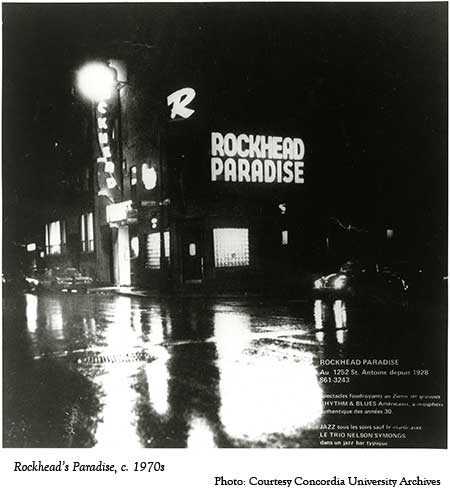
I’ve drafted a writeup of the historically renowned Rockhead’s Paradise in wikipedia style. I actually intend to make a wikipedia page for Rockhead’s, since there surprisingly isn’t one for Rufus or his legendary club.
Rockhead’s Paradise—along with other jazz clubs in Montreal, such as The Nemderoloc Club [colored men spelled backwards], The Boston Café, and The Terminal Club—helped established Montreal’s reputation as “Harlem of the North” (See Gilmore, Swinging in Paradise; Winks, The Blacks in Canada 332-35; Williams, Road to Now 44; Israel, “Montreal Negro Community” 189-95.) Of all the jazz clubs in Montreal throughout the twentieth century Rockhead’s Paradise, located at 1254 St. Antoine Street, was the most popular until it closed its doors permanently in 1980 when it was sold and then shortly thereafter demolished, followed by the creation of the Ville Marie Expressway overhead which solidified the club’s demise (Brownstein). During it’s fifty year tenure numerous renowned jazz players were drawn to Rockhead’s Paradise, including Duke Ellington, Louis Armstrong, Fats Waller, Cab Calloway, Billie Holiday, Ella Fitzgerald, Leadbelly, Nina Simone, Dizzy Gillespie and Sammy Davis Jr., among countless others.
The three-story club was founded in 1928 by Rufus Rockhead, a Jamaican-born railway porter who was able to draw some of the biggest names in blues and jazz during Montreal’s Sin City heyday from the 1930s to the 1950s (Brownstein). Rufus Rockhead opened the club with the income he earned on the rails as a porter, and then later as a bootlegger, allegedly running booze for Al Capone (Mathieu, North 71; 201; 240). Initially Rufus Rockhead opened the operation at the Mountain Tavern on St. Antoine and Mountain St. with hotel rooms on the top floor; eventually, he converted the second and third floors into a cabaret (Miller 172). Even though African Canadians were unable to get liquor licenses, Rufus used what sway he had among friends to help him get the license. After three years of running the Mountain Tavern, Rufus parlayed the tavern into the jazz club Rockhead’s Paradise (Gazette).The club was located in Little Burgundy, an area known for producing talented jazz musicians, most notably Oscar Peterson and Oliver Jones. While the club was particularly popular—given its long tenure and the caliber of jazz musicians who played there—many white Canadians felt that jazz and the crowd it attracted, “jeopardized white Canadians’ morality and white womanhood in particular” (6), as Sarah-Jane Mathieu contends through historical documentation in her book, North of the Color Line: Migration and Black Resistance in Canada, 1870-1955.
Norman Marshall Villeneuve – Rockhead’s Paradise 1963 – Jam (with pictures of the club)
During its last years of operation, the club was the home of Rising Sun (Soleil Levant), which was a jazz, blues, and reggae club (Miller, 170; 173). In 2012, 32 years after Rockhead’s Paradise was demolished, pianist Billy Georgette organized “Rockhead’s Last Jam” to honour the now legendary iconic jazz figure and club along with some of Montreal’s luminary jazz musicians and stalwarts who got their start at the Little Burgundy jazz club, including: Oliver Jones, Billy Georgette, Norman Marshall Villeneuve, Leroy Mason, Glenn Bradley and Richard Parris, among other notables, for what was perhaps their last collective jam (Brownstein). As Georgette recalls: “It was quite the place. I believe it was the first club owned by a black in Montreal and maybe in all of Canada. And the tavern was reputed to have the longest bar in the city at 75 feet. There was so much going on at the time. Not just the music. I remember the hookers, who were almost motherly to us. There was so much excitement there. But then modern construction just wiped it all off the map. It’s such a pity” (Brownstein).
I can’t wait to see the documentary, Burgundy Jazz, about jazz in Montreal, and which will likely feature Rockhead’s Paradise.
Works Cited
Brownstein, Bill. The Gazette. June 28, 2012.
Gilmore, Swinging in Paradise: The Story of Jazz in Montreal. Quebec: Vehicule Press (Dossier Quebec Series), 1988. Print.
Mathieu, Sarah-Jane. North of the Color Line: Migration and Black Resistance in Canada, 1870-1955. USA: North Carolina UP, 2010. Print. 71; 201; 240.
Miller, Mark. The Miller Companion to Jazz in Canada and Canadians in Jazz. Canada: The Mercury Press. Print. 172.
The Gazette. Montreal, Sat., Jan. 20, 1979.
Williams, Dorothy. The Road to Now: A History of Blacks in Montreal. Quebec: Vehicule Press (Dossier Quebec Series), 1997. Print. 44.
Winks, Robin. The Blacks in Canada: A History. 2nd Ed. Montreal: McGill-Queen’s UP, 2000. Print. 332-35.


 PAUL db WATKINS