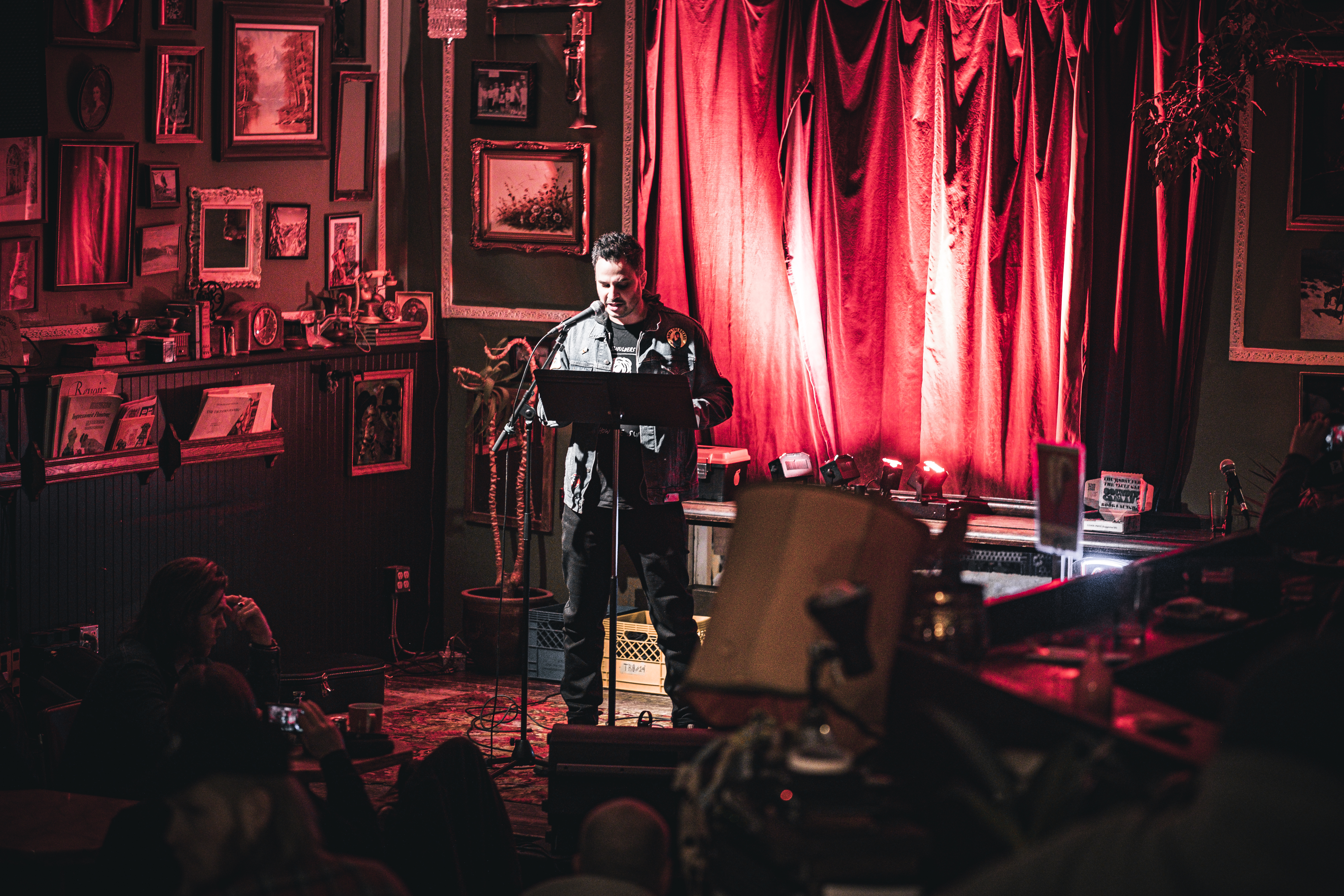
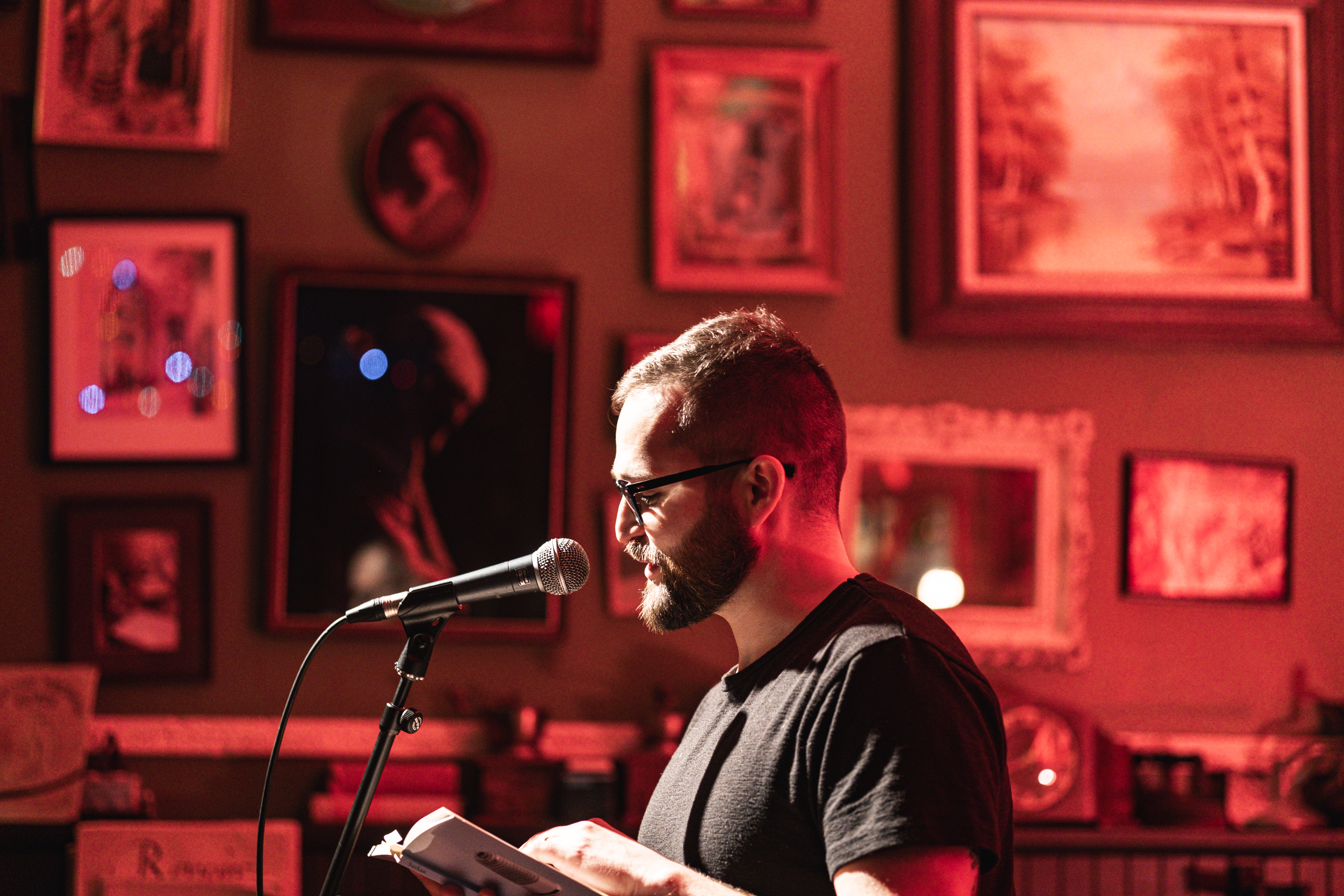
Event at Victoria Festival of Authors

Hey Victoria and Island folk,

You are invited to join me, along with d’bi.young anitafrika, Wayde Compton, and Sonnet L’Abbé, for performances and conversation that embody and expand on the wide-ranging power of human sound to make, unmake, and remake the ways in which we feel, engage with, and know ourselves, others, and the world around us.

Visit victoriafestivalofauthors.ca for more information and tickets, as well as an interview by yours truly: Q&A with Paul db Watkins.

Event Details
📅 Friday, October 17 · 2:00 PM PDT
📍 Langham Court Theatre
805 Langham Court, Victoria, BC V8V 4J3

Scenes from My Nanaimo Book Launch

Thanks to everyone who came out to my book launch on Feb. 6 at The Vault! We packed the house, and I sold my entire box of books. It was a night to celebrate my book, Soundin’ Canaan, but it was also a night of poetry and music—a night of community. It was a night of sonic solidarity in honour of Black History Month. I’m very grateful to both Neil Surkan and Sonnet L’Abbé for sharing the power of their words. The night left me feeling a little more hopeful about the state of things.

On March 7, from 10–11:30 a.m., I’ll be giving the final colloquium talk at VIU in the Malaspina Theatre. The talk will combine sound (including a live DJ mix), images, material from a new website to support the book, and text.

A second book launch will take place in Victoria on March 13 at Paul Phillips Hall (1928 Fernwood Road). This event will feature poet Wayde Compton (Performance Bond, The Outer Harbour, Toward an Anti-Racist Poetics). Doors open at 6:30 p.m.

Vertigo: Cinematic Influence, Pure Cinema, Voyeurism, and the Male Gaze

In this video essay I discuss Alfred Hitchcock’s Vertigo (and its ongoing influence) and his use of pure cinema, as well as voyeurism and the male gaze. I also look at David Lynch’s Mulholland Drive in relation to Vertigo. The end of the video features a remix of the prelude from Vertigo.

Warning: the video features spoilers for both films.

This video is for educational purposes.

A Multi-Generational Mixtape: A Review of Ian Williams’s Reproduction

Reproduction—the debut novel from Ian Williams—is an inventive multi-generational saga that pushes the limits of narrative and language. The novel explores the ways families are bonded, whether by blood, story, or choice. Its size, encyclopedic knowledge, Biblical intertextuality, and peregrination through the complicated genealogy of family (from the cycle of birth, life, and death) recall Steinbeck’s East of Eden, but in language and style it is closer to the work of Zadie Smith and the late David Foster Wallace. Fitting the cyclical nature of life and the seasons, the novel is told in four sections (with an interlude between them titled “The Sex Talk”), moving from Toronto in the late seventies to the mid-nineties, and finally to the present. Before the narrative proper, we encounter an upwards-moving genealogy that begins with “before” and then seven epigraphs. The genealogy—devoid of names, with representative sex chromosomes in their place—and the epigraphs, ranging from Margaret Atwood to Genesis, speak to Williams’ awareness that both he, as author, and his characters are part of an inherited chain of stories.

Click here to read my full review at Canadian Literature.

When Voices Intertwine (Book Review)

Robert Bringhurst is often described as a modern-day renaissance man. Few writers could navigate fields as diverse as poetry, translation, typography, cultural history, and philosophy as interwoven vocations. Through an adherence to polyphony as a mode of deep ecological thinking, Bringhurst works to make accessible the wisdom of poets and thinkers past, from Sophocles to Haida mythtellers Ghandl and Skaay.

As Bringhurst puts it, “when two voices intertwine, the space they occupy gets larger, and the mind gets larger with it”; no wonder poet Denis Lee calls him “a man of massive simple-mindedness.” Bringhurst has a way of chiselling complex thinking down to that part of being that ineluctably binds all living matter together. Bringhurst’s ontological approach is more aligned with ancient Greece than the modern academy, which is why editors Brent Wood and Mark Dickinson make clear that he doesn’t neatly fit within the “twenty-first century university’s rubric of knowledge production and transmission.” As such, Bringhurst is most comfortable in the role of an independent public thinker, bound by neither institution nor strict cultural protocol, which has irked some of his critics.

Click here to read my full review at Canadian Literature.

New English Courses at VIU Explore Diverse Ethnic and Cultural Perspectives

Courses are open to the community through the University’s Love of Learning program

VIU’s English Department is pleased to present three new courses next semester that examine literature from a variety of non-traditional perspectives and mediums. From reconciliation, to post-colonial Caribbean lifestyles and cultures, to the quest for unforgettable journeys, these new courses incorporate a diverse range of perspectives and writing styles, and question people’s assumptions about literature and art.

In a rare and unique opportunity for students and community members, English 332: Topics in Indigenous Literatures will include class visits and public readings from some of the authors studied in class, including Eden Robinson, whose novel Monkey Beach won the BC Book Prize’s Ethel Wilson Fiction Prize. While many of the stories deal with the lasting effects of Canada’s colonial past, they are also about healing, reconciliation and hope. Dr. Paul Watkins will explore these stories through several mediums, including fiction, poetry, art, comics, film and music, and students will participate in a creative intervention project.

“The hope is to open up spaces that challenge the colonization that affects us all, whether we are aware of it or not,” says Watkins.

As students read, watch and listen, they will also Tweet with the hashtag #ENGL332. The readings are sponsored by VIU’s Faculty of Arts and Humanities, the First Nations Studies Program, the Office of Aboriginal Education and Engagement, and the Canada Council for the Arts.

If you’re itching for a little taste of the Caribbean then maybe English 333: Topics in Post-colonial Literature is your course. From Rihanna and Bob Marley, to the dub poetry of Jean ‘Binta’ Breeze and the magical realism of Junot Diaz, English 333 delves into anti-colonial, post-colonial, feminist and queer perspectives expressed through various mediums, including literature, art, music, film and literary theory.

“The Caribbean is on the move, and it moves me,” says Dr. Melissa Stephens. “I see it as a shape-shifting constellation of people and places, politics and art, feeling and intellect. This course will help you grasp the enduring impact of colonial violence, but also, and most importantly, the work of resistance and liberation.”

Finally, adventure seekers will want to check out English 222: Travels in World Literature, during which Dr. Jeannie Martin examines a range of provoking historical travel writing along with popular contemporary works that highlight journeys in search of the romantic, the pastoral and the picturesque.

“Books about travel and tourism are wildly popular these days, but often unwittingly extend the enterprise of imperialism,” says Martin. “This course raises questions about the ethics of presenting the truth of another place and another culture. In this age of globalization, we passport-carrying privileged, viewing the world through the limited lens of our own cultures and experiences, are not the only travellers. Raising questions about who travels, why we travel, and why we write about our travels encourages us to form more complex relationships with other peoples, places and cultures.”

These courses are open to the general public via VIU’s Love of Learning program, which allows community members to take an academic course without the stress of exams or assignments at a discounted rate of only $99 per 3-credit course plus ancillary fees. Pre-requisites will be waived for Love of Learning students.

To learn more, visit the VIU English Department news page.

-30-

MEDIA CONTACT:

Jenn McGarrigle, Communications Officer, Vancouver Island University

P: 250.740.6559 | C: 250.619.6860 | E: jenn.mcgarrigle@viu.ca | T: @VIUNews
Wednesday, November 9, 2016 – 1:45pm

Harmonious Dissonance: in Conversation with George Elliott Clarke

To provide Malahat readers with a context in which to read and more deeply appreciate George Elliott Clarke’s “Othello: By Donation Alphonse François, Marquis de Sade,” a bravura long poem appearing in the magazine’s Summer 2016 issue, I explore with the poet his ambitions and the intent he enacts in the writing of such a profoundly engaging and provocative work. Last year I also recorded George reading a few poems when he visited Vancouver Island University last year, and The Malahat Review has published one of these recordings, “The Testament of Ulysses X.” You may read the full text of this poem or listen to George’s performance of it, recorded while he was the 2015 Ralph Gustafson Distinguished Poet at Vancouver Island University in Nanaimo.

George Elliott Clarke is currently  Canadian Parliamentary Poet Laureate. Towards the end of the interview I asked him, why does the world need poetry? To which he responded:

Hal David and Burt Bacharach: “What the World Needs Now is Love, Sweet Love”? That song comes to mind in thinking about why the world should need poetry. But I will also reiterate my sentiments in the Shad/Q interview: poetry exists in the rhythm of pulse and breath; it is “mind-forged” (Blake) language given vocal (originally) expression in tune with the pace of breath and the beat of the heart. The cadences are related to the sounds conjured by the arrangements of tongue, teeth, lips, and lungs. Poetry is organic technology, a physical art—as much as is dance, save that its calisthenics are performed by abstract characters or organically by the movement of the mouth.  In any event, it is the cheapest art and thus the most portable, for it can be memorized and taught to others. It is the first civilizing art, for it is the basis of scripture, whether inscribed or chanted. It conjoins imagination and emotion; so, for so long as human beings dream, recall, and/or have feelings, they/we will always invent poems.

Read the full interview, here.

In addition,

Improvisation and the Syrian Refugee Crisis

At the end of the summer the conversation around the Syrian refugee crisis changed when shocking images of a drowned Syrian boy went viral. Since then numerous videos have appeared that humanize the millions of displaced and dispossessed refugees. The conversation drastically shifted to one around security after the Paris attacks, and has changed again in Canada after Justin Trudeau gave a welcoming response to Syrian refugees.

I’ve published a short paper about the crisis where I suggest that improvisation might be one way we can frame a meaningful response to the crisis. The current Syrian refugee crisis—the civil war and the displaced peoples that resulted from it, but also the crisis with respect to how Western countries have responded to it—affirms a renewed need to learn to deal with social dissonance. In this piece, I discuss the ways in which social and musical improvisation (particularly when immersed in the ethics of “cocreation”) can teach us about the merits of creative risk-taking in relation to the current Syrian refugee crisis, a form of social dissonance. Learning to improvise imbues citizens with the important notion that creative risk-taking makes for more exciting and, while unpredictable to a degree, egalitarian societies. Ultimately, I insist that we can fight the insular mechanics of an improvisation of fear with an improvisation of hope that challenges the anxiety that refugees destroy borders and culture, as if these things are pure, static, given, unchanging, and authentic.

See the full article, here.

Featured image from here.

The Presence of the Past

Winfried Siemerling’s The Black Atlantic Reconsidered and Austin Clarke’s In Your Crib prioritize transatlantic Black perspectives from within national paradigms to explore Black Canadian identity, belonging, and the presence of the past. The two works are quite different: Clarke’s text is an introspective long poem that channels the radical spirits and rhythms of the civil rights movement, and Siemerling’s text is a considerable historical undertaking that reconsiders Canada’s place in the Black Atlantic. However, both texts deepen our understanding of Black writing and radical thinking within a Canadian space that belongs to a larger historic transatlantic nexus.

Click here to read my full review at Canadian Literature.