From the Stage to the Site: Wayde Compton Interview and Soundin’ Canaan Updates

The website for my book is nearly complete — the final piece, a “create your own remix” section, is on its way.

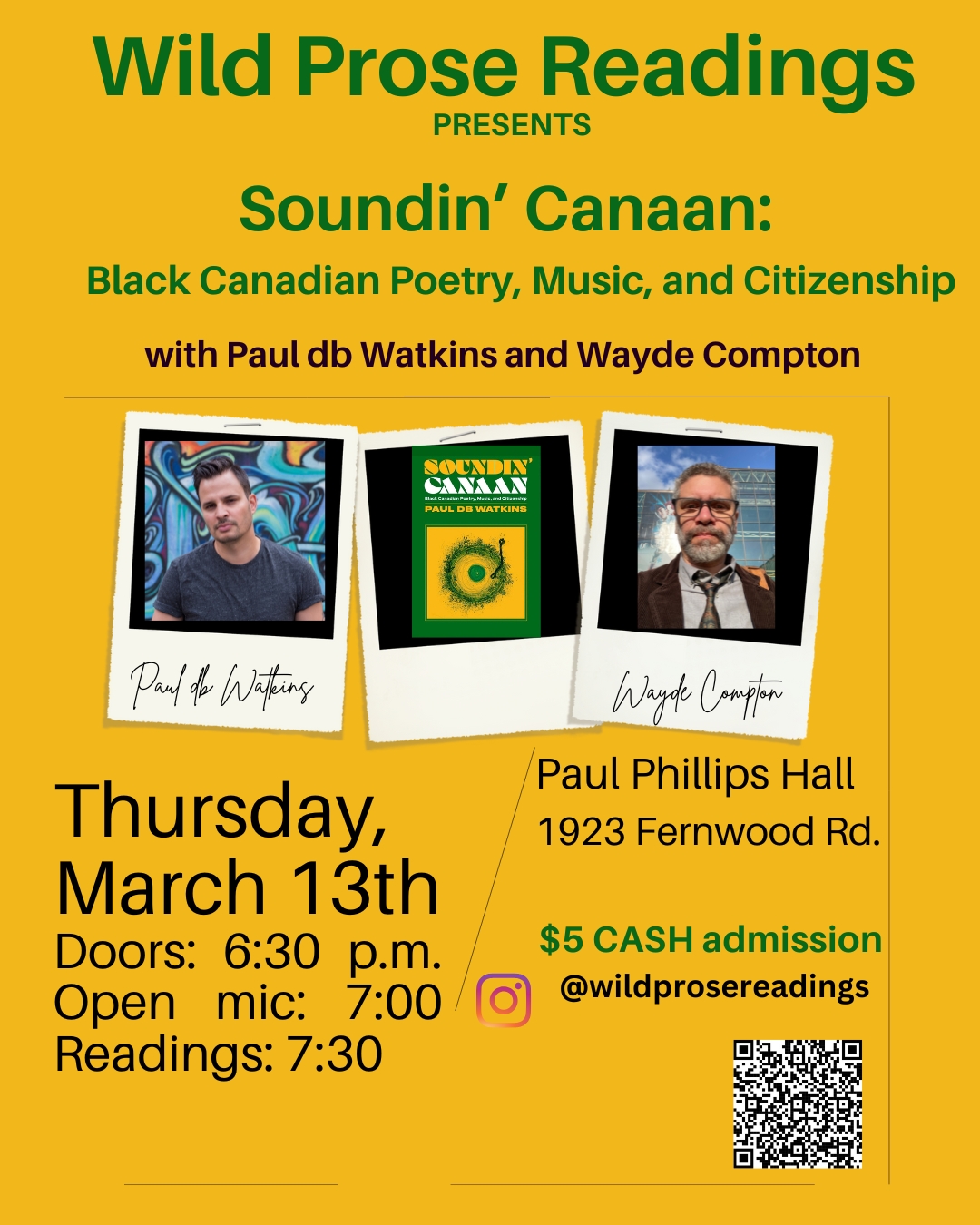
Recently, I added audio and photos from the Victoria Book Launch on March 13. A huge shoutout to Susan Sanford Blades for organizing the event as part of the Wild Prose reading series (https://www.susansanfordblades.com/wild-prose-reading-series). 

After a remixed reading of my book, I sat down for an on-stage interview with Wayde Compton. This was an incredible full circle moment, and audio (as well as a transcript) are now available as well.

I’ve also added a new remix to the Remix section: “Kind of Blue in Green (for GEC),” which reimagines Miles Davis’s “Blue in Green” and offers a poetic riff/reading of George Elliott Clarke’s “Bluing Green.”

Head over to www.soundincanaan.com to explore this new material and more from the book. If you don’t have a copy yet, you can grab one here — and save 20% all April with the code POETRY2025.

Exciting Soundin’ Canaan Updates: Website, Talk, & Book Launch

Hi Friends,

There are three things I wanted to let you know about.

I’m pleased to announce a new website to support my book, Soundin’ Canaan: Black Canadian Poetry, Music, and Citizenship. Created for readers, listeners, courses, and research and discussion groups, the companion site soundincanaan.com is designed to benefit both readers of the book and anyone interested in Black Canadian poetry, culture, and Black music. The site features audio and transcripts of interviews with poets from the book, as well as resources mentioned in the book—including newly added materials of interest. You’ll also find playlists from the book (available on both Spotify and YouTube), a section of remixed audio, and additional media and news. An Open Access chapter is already available to read there.


On Friday, March 7, from 10–11:30 a.m., I’ll be giving a performance/talk at Malaspina Theatre (located on VIU’s Nanaimo campus). In my colloquium talk, I will combine sound (including a live DJ mix), images, material from the website, and text. Adopting a self-reflexive creative approach and cueing samples from interviews with the poets featured in my book, this presentation promises a captivating journey through the dynamic world of Black creativity in Canada.


Finally, I want to encourage you to come out to the Victoria book launch, which will take place on March 13 at Paul Phillips Hall (1928 Fernwood Road). This event will feature one of my all-time favourite writers—and a major influence on the ideas in the book—poet Wayde Compton (Performance Bond, The Outer Harbour, Toward an Anti-Racist Poetics). Doors open at 6:30 p.m.

As always, thanks for the support. I hope you read the book and, especially, seek out the work of the fantastic poets featured in it.

Warmly!
Paul

Preorder Soundin’ Canaan at 50% Off Today!

Hi friends,

I’m thrilled to announce that my debut academic book, published by Wilfrid Laurier University Press, will be released on January 21, 2025! The Press is currently celebrating its 50th Anniversary with a sale, so you can preorder the book at 50% off until December 15 using the code WLUP50. (Canada and US only).

Using a DJ Methodology, I blend close readings of poetry, music, cultural and literary history, along with interviews with the poets featured in the book. It also includes an accompanying soundtrack of playlists to enhance your reading experience, and a website is forthcoming.

You can learn more and preorder the book here: https://www.wlupress.wlu.ca/Books/S/Soundin-Canaan

All my best,
Paul db Watkins

Reviews

Soundin’ Canaan is an imaginative, innovative, original, and immensely generative study of the relations that connect Canadian Black poetry to music, multiculturalism, social membership, and citizenship.”
–George Lipsitz, University of California-Santa Barbara, author of The Danger Zone Is Everywhere (University of California Press, 2024)

“In Soundin’ Canaan: Black Canadian Poetry, Music, and Citizenship, Can-Lit-Crit scholar Paul db Watkins “brings da noise,” reading through Afro-Can poets to stress that our concern is to remix, adapt, sample, and echo African Diasporic literary and musical greats in confraternity or confrontation with the Bards of the Great White World—and of the Great White North.

Watkins is himself an adept DJ, scribing a bluesaic (not prosaic) and a Rap-sodic exploration of how a quintet of Black Can poets kick-start the toppling of Plato and his reactionaries, who dread that any shift in musical taste is equivalent to an insurrection of the masses. Well, so be it! Watkins is the polyphonous polymath, not just reading the words, but listening for and sounding the Rastafarian aesthetics that trouble Luciferian ethics. In short, Watkins reads Black Can poems as mosaics of transgressive conjunctions. He is himself the Sage of the Remix, and intersperses his prose with shout-outs to YouTube videos and Spotify tracks of pertinent artistes. His playlist? Shakespeare and Shad; Ma Rainey and Martin Luther King. You read this book; you’re now in the know. Why? Cos now ya’s in the groove….”
—George Elliott Clarke, author of Whiteout: How Canada Cancels Blackness (Véhicule Press) & J’Accuse…! (Poem Versus Silence) (Exile Editions)

Sound Meditation during COVID-19

Take a moment to stop and listen. Inspired by some similar sound meditations, I wanted to create my own. This was created in a single take.

And this is a remix and meditative version of my song, “I am Om.” Like the original, this version—entitled “All Life is Interrelated (Meditation for Peace)”—is about finding inner and outer peace in a world that often feels disconnected and sick. The vocal clips are from Alice Coltrane, Pharoah Sanders (from Coltrane’s Om), the Dalai Lama, Louis Armstrong, and MLK. I played this version live in a single take using an MPC Live (for the singing bowls and bells), an SP-404SX to remix the vocal clips, an iPad running Xynthesizr, and a KORG volca fm for ambient chords. Give yourself 4 minutes to stop and listen. I filmed the video while out with the kids for a walk at the Colliery Dams in Nanaimo, B.C.

A Review of Ken Hunt’s The Lost Cosmonauts

With the spirit of exploration that sent Dante into the unknown, Ken Hunt’s poetry collection The Lost Cosmonauts examines the experiences of astronauts and cosmonauts who ventured into outer space, especially those who lost their lives in the pursuit of their missions. Drawing from myth, largely from the Greco-Roman pantheons, Hunt details the global and socio-political conflict of the Cold War era in relation to the space race between the Soviet Union and the United States. Following his debut collection, Space Administration (2014), Hunt’s The Lost Cosmonauts continues his exploration of language, history, and humankind’s endeavour to explore space. The book is a small thing to hold in your hands, but the ideas are expansive, moving from our nascent efforts to explore outer space to the celestial bodies of the planets in our solar system (the section “Celestial Bodies” is inspired by Gustav Holst’s orchestral suite, The Planets). Engaging with a mythopoeia of the space race and showing an impressive control over poetic form and history, The Lost Cosmonauts is vital reading for those interested in the history and mythic significance of humanity’s explorations into space.

You can read my full review over at The Malahat Review, here.

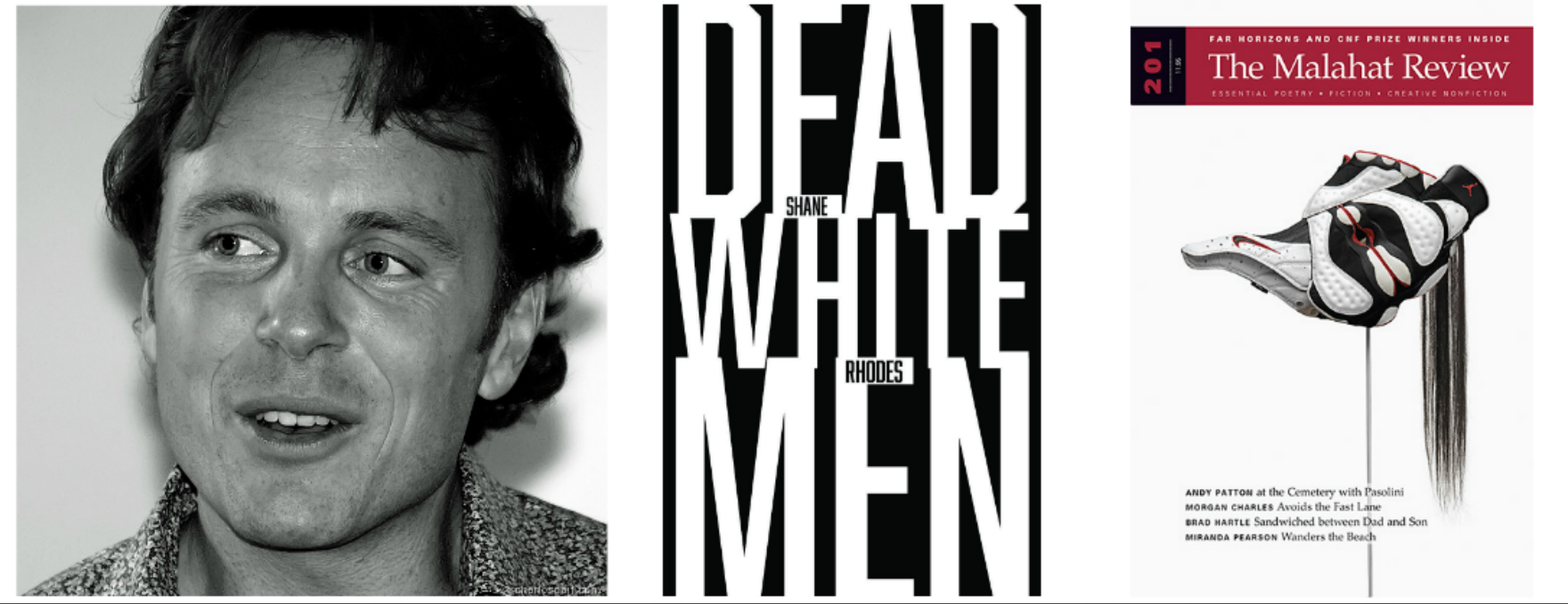
A Review of Shane Rhodes’s Dead White Men

Shane Rhodes’s stunning sixth collection of poetry, Dead White Men, repurposes settler texts with pioneering deftness (words cascade, fonts change, statues silhouette, language obliterates), using poetry to critically interrogate the Eurocentrism found in many foundational settler texts. While the names of many dead white men have faded in the annals of history, their mythopoeic justifications for colonization remain woven into the fabric of Euro-American society. Stories shape our beliefs and ethics, and so there’s good reason to go back to colonial origin stories, especially given the cultural amnesia around them. As Rhodes explains in the Notes section, “I was interested in looking to these past stories (especially those focused on North America and the South Pacific), not to add to the fictions of past white heroism but to better understand the problematic relationship between the stories, the mythologies they have become, and the lands and peoples they describe.”

You can read my full review over at The Malahat Review, here.

Screen Shot 2018-01-27 at 11.15.11 AM

New English Courses at VIU Explore Diverse Ethnic and Cultural Perspectives

Courses are open to the community through the University’s Love of Learning program

VIU’s English Department is pleased to present three new courses next semester that examine literature from a variety of non-traditional perspectives and mediums. From reconciliation, to post-colonial Caribbean lifestyles and cultures, to the quest for unforgettable journeys, these new courses incorporate a diverse range of perspectives and writing styles, and question people’s assumptions about literature and art.

In a rare and unique opportunity for students and community members, English 332: Topics in Indigenous Literatures will include class visits and public readings from some of the authors studied in class, including Eden Robinson, whose novel Monkey Beach won the BC Book Prize’s Ethel Wilson Fiction Prize. While many of the stories deal with the lasting effects of Canada’s colonial past, they are also about healing, reconciliation and hope. Dr. Paul Watkins will explore these stories through several mediums, including fiction, poetry, art, comics, film and music, and students will participate in a creative intervention project.

“The hope is to open up spaces that challenge the colonization that affects us all, whether we are aware of it or not,” says Watkins.

As students read, watch and listen, they will also Tweet with the hashtag #ENGL332. The readings are sponsored by VIU’s Faculty of Arts and Humanities, the First Nations Studies Program, the Office of Aboriginal Education and Engagement, and the Canada Council for the Arts.

If you’re itching for a little taste of the Caribbean then maybe English 333: Topics in Post-colonial Literature is your course. From Rihanna and Bob Marley, to the dub poetry of Jean ‘Binta’ Breeze and the magical realism of Junot Diaz, English 333 delves into anti-colonial, post-colonial, feminist and queer perspectives expressed through various mediums, including literature, art, music, film and literary theory.

“The Caribbean is on the move, and it moves me,” says Dr. Melissa Stephens. “I see it as a shape-shifting constellation of people and places, politics and art, feeling and intellect. This course will help you grasp the enduring impact of colonial violence, but also, and most importantly, the work of resistance and liberation.”

Finally, adventure seekers will want to check out English 222: Travels in World Literature, during which Dr. Jeannie Martin examines a range of provoking historical travel writing along with popular contemporary works that highlight journeys in search of the romantic, the pastoral and the picturesque.

“Books about travel and tourism are wildly popular these days, but often unwittingly extend the enterprise of imperialism,” says Martin. “This course raises questions about the ethics of presenting the truth of another place and another culture. In this age of globalization, we passport-carrying privileged, viewing the world through the limited lens of our own cultures and experiences, are not the only travellers. Raising questions about who travels, why we travel, and why we write about our travels encourages us to form more complex relationships with other peoples, places and cultures.”

These courses are open to the general public via VIU’s Love of Learning program, which allows community members to take an academic course without the stress of exams or assignments at a discounted rate of only $99 per 3-credit course plus ancillary fees. Pre-requisites will be waived for Love of Learning students.

To learn more, visit the VIU English Department news page.

-30-

MEDIA CONTACT:

Jenn McGarrigle, Communications Officer, Vancouver Island University

P: 250.740.6559 | C: 250.619.6860 | E: jenn.mcgarrigle@viu.ca | T: @VIUNews
Wednesday, November 9, 2016 – 1:45pm

Harmonious Dissonance: in Conversation with George Elliott Clarke

To provide Malahat readers with a context in which to read and more deeply appreciate George Elliott Clarke’s “Othello: By Donation Alphonse François, Marquis de Sade,” a bravura long poem appearing in the magazine’s Summer 2016 issue, I explore with the poet his ambitions and the intent he enacts in the writing of such a profoundly engaging and provocative work. Last year I also recorded George reading a few poems when he visited Vancouver Island University last year, and The Malahat Review has published one of these recordings, “The Testament of Ulysses X.” You may read the full text of this poem or listen to George’s performance of it, recorded while he was the 2015 Ralph Gustafson Distinguished Poet at Vancouver Island University in Nanaimo.

George Elliott Clarke is currently  Canadian Parliamentary Poet Laureate. Towards the end of the interview I asked him, why does the world need poetry? To which he responded:

Hal David and Burt Bacharach: “What the World Needs Now is Love, Sweet Love”? That song comes to mind in thinking about why the world should need poetry. But I will also reiterate my sentiments in the Shad/Q interview: poetry exists in the rhythm of pulse and breath; it is “mind-forged” (Blake) language given vocal (originally) expression in tune with the pace of breath and the beat of the heart. The cadences are related to the sounds conjured by the arrangements of tongue, teeth, lips, and lungs. Poetry is organic technology, a physical art—as much as is dance, save that its calisthenics are performed by abstract characters or organically by the movement of the mouth.  In any event, it is the cheapest art and thus the most portable, for it can be memorized and taught to others. It is the first civilizing art, for it is the basis of scripture, whether inscribed or chanted. It conjoins imagination and emotion; so, for so long as human beings dream, recall, and/or have feelings, they/we will always invent poems.

Read the full interview, here.

In addition,

The Presence of the Past

Winfried Siemerling’s The Black Atlantic Reconsidered and Austin Clarke’s In Your Crib prioritize transatlantic Black perspectives from within national paradigms to explore Black Canadian identity, belonging, and the presence of the past. The two works are quite different: Clarke’s text is an introspective long poem that channels the radical spirits and rhythms of the civil rights movement, and Siemerling’s text is a considerable historical undertaking that reconsiders Canada’s place in the Black Atlantic. However, both texts deepen our understanding of Black writing and radical thinking within a Canadian space that belongs to a larger historic transatlantic nexus.

Click here to read my full review at Canadian Literature.