BLOG: RIFFINGS

The Shining: Does Kubrick’s film Redrum King’s novel?

Over the last week I’ve read—or rather engulfed myself within—Stephen King’s The Shining. It is one of my favourite films, and so I thought I should give the novel a chance. In fact, despite the thousands of books I’ve read, studied, and written about, I’ve never actually read a Stephen King novel, and so I wanted to correct this overlook on my part. Fortunately, the hardcover edition I have also contains Carrie and Misery, and so I will likely read those soon, as well as perhaps The Stand, which I’ve heard might be King’s finest work.

Most of the book was read in our cozy 700sq foot apartment as Toronto was hit with one of its biggest snowstorms of the year. While I haven’t quite suffered writer’s block, I have had ten to twelve-hour days cooped up inside the house (I continue to work diligently on my PhD thesis, which is a little over a month away from a full first draft) where I feel like I am going a little crazy. Not that I admire or identify with Jack Torrance as he struggles with his own writing and budding insanity, but I certainly felt a detached and sinister sense of camaraderie with him: all work and no play make Paul a dull boy. The main difference between King’s novel and Stanley Kubrick’s cinematic adaptation is that King’s novel is more human. King is concerned with familial relationships and the internal psyche of his characters; by comparison, Kubrick focuses his lens on larger metaphors, structure, and allegory.

To say one is better than the other is to do both works a disservice. They are vastly different. Personally, I prefer the film. It helps that Jack Nicholson gives one of his most inspired performances and that I am an immense fan of Kubrick’s work. I think the film’s visual images are more potent than in the book, and its finale is more operatic and horrifying. And yet, I appreciate the imaginative prowess and humanity of King’s novel. The love and strong relationship between Jack and Danny was hardly emphasized in the film. Jack’s alcoholism and gradual descent into madness, related to King’s own struggles with alcohol, is also much more developed in the book. Further, in the novel, Wendy is a multifarious and resistive character whose internal struggles are largely reduced to shrieks on the screen. Lastly, and perhaps the most shocking character change—although this one feels like an assassination—is that Dick Hallorann’s role is greatly reduced in the film. He is perhaps the most interesting character in the novel, and in Kubrick’s film he is abridged to just another black man dying on the screen. He is not even mourned by Wendy or Danny. Like all the characters, Danny is much more complex in the book, but it is his lack of complexity on the screen that makes him so damn creepy. We are not meant to identify with Kubrick’s characters; we are victims of Jack and the Overlook Hotel’s history of violence, which makes for a more unsettling film than the book.

Once again, if the medium is the message then Kubrick’s stylistic choices are suitable to the cinematic force of his adaptation. Kubrick’s visual choices have been written about in great detail and even inspired the satisfying, although a little too drenched in conspiracy theory, documentary Room 237. The most arresting element about Kubrick’s adaption is the engrossing labyrinthine structure of the film, which adds a dizzying effect as we get lost deeper and deeper in the film’s maze. Replacing King’s topiary (hedges that come alive) with a maze adds plenty of cinematic verve to the adaptation. Topiary just isn’t scary; on the other hand, a demented Minotaur of a man running through a maze to kill his kid in the dead cold of winter is bone chilling. In fact, I found that, at times, King’s haunted house clichés and ghosts were just not that frightening, although the build-ups in the novel are very captivating. Nevertheless, Kubrick’s version was much more terrifying, for me, largely because instead of ghosts—although mysterious elements are present—we are shown a more mythic and immediate evil. Evil exists in the world of the living and it is our responsibility to contest it. Wendy and Danny do escape Jack (the Minotaur) in Kubrick’s The Shining, but rather than the burning (I will not spoil the ending) and warm ending of King’s book, Kubrick’s finale is ice cold: the world freezes over and evil still waits in the halls of the Overlook Hotel.

Before filming, Kubrick told King on the phone he didn’t believe in hell, and that he “thought stories of the supernatural are fundamentally optimistic.” No wonder King was so disturbed by Kubrick’s film, since King’s book is both supernatural and optimistic, and Kubrick’s film is not. Love conquers evil in King’s novel, and Danny receives some practical advice at the end of his trials: “But see that you get on. That’s your job in this hard world, to keep your love alive and see that you get on, no matter what. Pull your act together and just go on.” It’s hard to think how Danny and Wendy will go on at the end of Kubrick’s film, but somehow they must. Both films are powerful allegories for the darkness of the human spirit. King’s novel is just much more optimistic since love, not perseverance and survival, overcomes evil.

Personally, I enjoyed Kubrick’s film more than the novel, but the source text was a pleasure to read, especially since the novel switches between so many different viewpoints. Most great film adaptations, I also enjoyed Kubrick’s A Clockwork Orange more than Burgess’s novel, are successful because they ignore their source text. King was so angered by Kubrick’s adaption that he eventually remade the movie himself, in what many have described as a painfully boring and uninspired adaption, although wholly faithful to the original. Perhaps King’s version is closer to translation than it is to adaptation. Comparing the book to the film is like comparing apples and oranges. And yet, I’ve been doing that somewhat here, but largely to emphasize they are very different works, and should be thought of as separate entities. Kubrick uses the novel as a starting point for his own unique vision. Maybe the film version should open with the preface: inspired by Stephen King’s The Shining. And while the film has certainly outshined the book (inspiring many other riffings such as in The Simpsons), perhaps another reason King was so frustrated by it, both deserve a place on your bookshelf. In some ways, both the film and novel  complement one another, presenting a fuller picture of how, as King puts it in the book, “Sometimes human places, create inhuman monsters.”

In a moment (flash fiction)

Swirling the sugar round her cup with her spoon she looked up at me with her pearly smile. God dammit she’s beautiful. I hate it when you can’t remember someone’s name, especially since she just told me hers two minutes ago. Ten minutes ago I had saved this girl’s life. That’s right. She had stepped out onto the road anticipating the walk sign. At that same moment a cabby darted through the intersection racing the millisecond between yellow and red. Primal instinct kicked in. Swiftly I reached out and pulled her back. Cars honked their disapproval at the cab’s recklessness. The businessman beside me sounded a racial epithet about cabbies. If you could slow the alacrity of the scene down it would appear as some operatic moment in a movie. I was the hero. I had never been the hero. Our eyes made contact and propelled me into the present.

“It looks like you’re deep in thought. I don’t think I can ever repay you for saving my life,” said the girl.

“Well this coffee is a good start,” I joked.

“You must save distressed girls all the time.”

Was she distressed?  The frightening thought entered my skull: maybe she wanted to be struck by that cab.

“No, actually, you’re the first.”

“You have nice eyes.”

Was she flirting with me? She must have noticed the wedding ring on my finger.

“Thank you. So do you.”

Her eyes were a mesmerizing hazelly-green with a certain sadness to them. I had the impulse to invite her back to my place, only two blocks away. How quickly life can change. Some say the assassination of Archduke Ferdinand lead to WWI. At any moment a nuclear bomb could wipe out an entire city. Dinosaurs went about their routines the day the meteor hit. Someone must have skipped work to play hooky the day the planes crashed into the Twin Towers. I was going for a walk to buy a loaf of bread and now I was on the verge of an affair. It would be easy since I worked from home and my wife did not. I felt like I was in some bad made-for-TV movie.

“Do you live around here?”

“Just a couple blocks away.”

Invite her back for a drink! screamed my dick.

She continued. “You saved my life today. The way I see, I’m yours for the day.”

I boyishly smiled and gestured for our bill.

“I’m going to freshen up,” she said leaving the table.

Was I really going to cheat on my wife? My cell had been incessantly buzzing from a voice message, likely from my wife. I listened to the message. It ecstatically said to grab some champagne and some sparkling juice for her. Could she be pregnant? We had been trying for six months now. Was I going to be a father? What a fucking crazy day.

The girl with no name returned from the bathroom.

Photo by Paul db Watkins.

we’re new h/ear (poem, draft)

I wrote this poem after listening to my baby’s heartbeat on the Doppler fetal monitor. Below the poem is audio of the heartbeat mixed vis-à-vis  my music production, voice, and lyrics.

we’re new h/ear

i heard your heartbeat today, baby.
a fast 180bpm slowed to a steady 160
as you listened to us listening to you
nestled in your echo chamber.

i play buddy holly’s “everyday”
headphones wrapped round mommy’s round belly,
you kick a little more, {your little foot}
everyday it’s a-gettin’ closer.

i wonder what you look like?
can you feel my warm, loving, yet anxious hand
against the walls of your mini-universe,
come what may.

on the news: another war, another shooting, more corruption,
pollution. I question bringing you here.
but then I hear your mommy singing, gently touching her belly
& feel the world—at least ours—is perfect.

besides: we’re all new here.

Photo copyright, Paul Watkins. 

The Story of Film: An Odyssey

I think cinema, movies, and magic have always been closely associated. The very earliest people who made film were magicians.
-Francis Ford Coppola

Film is a language of ideas: each shot a director’s thought, every film a magical world of its own. Recently, on Netflix, I watched Mark Cousins’s monumental The Story of Film: An Odyssey, which consists of 15 one-hour chapters and some 900 minutes covering the history of film. The experience was like taking a semester-long film studies survey course spanning the birth of cinema to the movies of today and the future. Except, rather than travel to campus, take notes, or write an examination, I leisurely embarked on this odyssey from the comfort of my home, often in 30-minute increments over my lunch. Cousins’s thesis is a relatively straightforward one: the story of film is the history of innovation. From the opening chapter it is apparent that The Story of Film is hardly the tale of Hollywood, as Cousins’s radical, at times revisionist history covers not only studio pictures, but also film mavericks on the fringes of the studio system in America, Japan, India, Africa, Mexico, Italy, Britain, China, Korea, France, and elsewhere.

The Story of Film is global in scale, affording the viewer numerous opportunities to engage with the history of cinema from a non-and-decentering American perspective. By the mid-point of the series Cousins’s diatribes against Hollywood start to feel a little predicable and exaggerated, perhaps harder for some to digest given his metric vocal delivery and lilting Irish accent, but it was a pleasant reminder that film hardly belongs to America or Europe, as many of cinema’s greatest innovators/innovations were/happened in India, South America, Africa, Japan, China, or even, Canada. Through dozens of interviews with some of film’s most important progenitors and nonconformists, and hundreds of selected film clips with nuanced analysis from Cousins, the documentary is certainly an epic quest. The documentary played at the 2011 Toronto International Film Festival (TIFF) and I could only imagine what the experience might have felt like for those audience members who watched all 15+ hours over a few days. Watching The Story of Film reminded me that film is much more than a fascination of mine. Like my dedication to reading and music, film viewing is an Odyssean expedition where the discoveries are ongoing and illimitable, often far outside the American moviemaking machine. I also appreciated that The Story of Film introduced me to many great films I’ve never heard of, or had forgotten I had at one point or another intended to watch, or in the case of a few, rewatch. I’ve seen thousands of American films, including most of the AFI Top 100, and so the majority of films on my list were made outside America. I might have to visit an actual video store to find many of these titles, but here are some of the films featured in The Story of Film I hope to watch this year, ideally in chronological order:

Sex Mob Plays Fellini

Sex Mob is a New York City jazz group, which initially began as a way to feature the slide trumpet of leader Steven Bernstein. Since then the band, as Bernstein’s website states, has developed an overarching mandate: “to put the fun back in jazz music.” The band is comprised of Bernstein on slide trumpet, Briggan Krauss on alto sax, Tony Scherr on bass, and Kenny Wollesen on drums. The group first formed in the 1990s as part of a residency at the Knitting Factory, and their early material consisted primarily of Bernstein originals. That changed when Sex Mob played Bond Themes as part of an evening of film music, such as “Goldfinger” and “You Only Live Twice,” which eventually culminated in a 2001 album, Sex Mob Does Bond. To Bernstein’s surprise the crowd went wild, and Bernstein realized that the audience was more in tune with their adventurous music if they could recognize the tune. And so their songbook expanded to feature everything from Prince, Paul McCartney, The Rolling Stones, to The Grateful Dead, and even the “Macarena,” although you’ve never heard the “Macarena” like this before.

The guiding principle to their song selection is that the tune would have to be recognizable enough that it could withstand some serious compositional and improvisational destruction. The group still plays many Bernstein originals, although their sets now feature a great deal of covers given a humorous, yet sophisticated avant-garde reworking. As Bernstein unapologetically states in Jazz Asylum, “I realize that’s what jazz musicians have always done. That’s how Lester Young got popular; it’s how Charlie Parker got popular; it’s how Miles Davis got popular; that’s how John Coltrane got popular. They played the songs that everyone knew and because they could recognize the song, then that invited them into their style.” In many ways Bernstein is right, as the jazz tradition has always included space to take familiar songs and reassemble them with your own unique spin.

Since their 1998 debut, Den of Inequity, Sex Mob has released a diverse oeuvre of radical, yet accessible material. Their 2000 release, Solid Sender, continues their bold prewar jazz spirit through another mix of covers, everything from Nirvana to ABBA, with a dose of Bernstein originals. The same year saw the release ofTheatre & Dance, part Duke Ellington compositions and part Bernstein originals written for a renewal of the 1926 Mae West play “Sex.” Sex Mob continues to defy expectations, and their 2006 release, Sexotica (Thirsty Ear) is a homage to the soundscape of Martin Denny (the “father of erotica”), receiving a Grammy nomination for Best Contemporary Jazz Album.

Their latest release, the 2013 Cinema, Circus & Spaghetti (Sex Mob Plays Fellini: The Music of Nino Rota), contains Sex Mob’s idiosyncratic arrangements over Nino Rota’s memorable scores. The title comes from a quote from Italian director Federico Fellini, who said, “My films, like my life, are summed up in circus, spaghetti, sex, and cinema.” The same could be said of Sex Mob’s exuberant music. Sex Mob Plays Fellini, like their earlier albums, will certainly offend jazz purists. I assume that’s part of the point. Love or hate their brashness, Bernstein summarizes the Sex Mob ethos as about having fun: “Jazz used to be popular music. People would go out to clubs, listen to the music, go home, and get laid. Simple as that. We’re bringing that spirit back” (All Music Guide). Sometimes it’s nice to simply get lost in the music, dance, and go out and enjoy la dolce vita.

Excessus Mentis: A Defence of Scorsese’s The Wolf of Wall Street

How manye maladyes ffolwen of excesse and of glotonyes.
Chaucer, The Pardoner’s Tale 514

Martin Scorsese’s latest offering The Wolf of Wall Street has divided audiences into two camps: those who praise the work as a masterpiece of cinematic verve, and those who say it glorifies white-collar crime along with the film’s antihero, real life penny stock criminal, Jordan Belfort. While not quite the magnum opus some call it, I think The Wolf of Wall Street is an inspired parable and cinematic opera about greed, excess, and the perversion of the American dream.

Perhaps there was a time, as Percy Shelley writes in “A Defence of Poetry,” when “poets [were] the unacknowledged legislators of the world.” I say this with some unease, since my primary field of study is poetry, but today it seems that filmmakers are the cultural legislators of the Western World. Hollywood, like the stock market, is big business, netting profits in the billions every year. In many ways, Hollywood is emblematic of the American dream; certainly the cinema is a place where we exchange money to watch our dreams, fantasies, and even nightmares unfold on a big screen in a dimly lit room. Scorsese, who often challenges Hollywood sensibility, continues to be one of American cinema’s great dream makers and storytellers, gifting the world films like Mean Streets (1973), Taxi Driver (1976), Raging Bull (1980), Goodfellas (1990), and The Departed (2006).

The Wolf of Wall Street continues Scorsese’s fixation with crime, identity, and machismo, as well as his Roman Catholic concerns around guilt and redemption. However, unlike Scorsese’s other gangster films there is hardly any graphic violence in Wolf, although there remains, perhaps more than any of his films, his liberal usage of profanity. It could be argued, and probably should, that Belfort’s obsession with controlling women’s bodies, as well as his betrayal of his victim’s trust, is violence. The narrative techniques and do-it-yourself rise to power in Wolf parallels Goodfellas, but instead of mob bloodshed and revenge, Scorsese focuses his lens on robber baron, capitalistic sociopath, and real life penny stock criminal/self-made multi-millionaire, Jordan Belfort.

The Wolf of Wall Street is an orgiastic, hurly-burly, dizzying cornucopia of sex, drugs, and total debauchery. It is Scorsese’s most excessive film, with a three-hour running time (even after he left an hour on the cutting floor), and so many scenes of Belfort (manically acted by DiCaprio) and Donnie Azoff (Jonah Hill) popping Qualuudes (a very powerful pill based drug) and having sex with prostitutes that you feel, perhaps, an additional hour of the film could have been cut. However, the excessive use of excess in the film highlights the vulgarity of Belfort’s lack of morality, as he travels far beyond the prescribed limit of acceptable capitalist criminality (in the eyes of regulators) and gets lost in the rapturous trance of the game he is playing.

Does the film glorify Belfort’s despicable swindling his clients out of millions, failing to show the effects of his actions, as one victim, Chistina McDowell, insists in an Open Letter? Or, does it sicken the viewer and take Belfort down through its use of raucous and unrelenting satire? For starters, I don’t think the film glorifies white-collar crime, just like I don’t think 12 Years a Slave glorifies slavery. Humour and satire are effective in making the audience realize just how absurd and excessive Belfort’s greed was. Charlie Chaplin’s The Great Dictator was extremely risky in 1939 as it used satire to effectively depict and make fun of Hitler and dictatorships, and it was banned in many countries. Film is representation; otherwise there would not be films about the Holocaust. Great art is often confrontational, and if art is to challenge it needs to be provocative enough to start some important conversations, which Scorsese is thankful that this film did (Screen Rant). DiCaprio has called Wolf a punk rock film about the darker nature of humans. While McDowell’s point is well taken, I don’t think the film would be as punchy, effecting, or vicious if it showed the effect Belfort’s actions had on his victims. It would be Oliver Stone’s 1987 film, Wall Street. 

Unlike many of Scorsese’s films whose protagonists or antiheroes often burst into flames at the end of the film, Belfort hardly suffers for his incendiary crimes. Rather, we are reminded that Belfort is a real person: a cog in a larger system of oppression that makes his actions possible in the first place. People like Belfort often get away with, or face minimal retribution for the crimes they commit. In the end Belford informs on his own associates in order to save his own ass. Henry Hill does the same in Goodfellas, deciding to enroll in a Witness Protection Program, with real-life Hill serving four years and six months of his 10-year sentence in prison. The Wolf shows Belfort entering prison with a look of fear in his eyes, which quickly dissipates when he realizes that prison for him, with tennis courts and other luxuries, would not be that bad: “For a brief, fleeting moment, I’d forgotten I was rich and lived in America.” It should sit uncomfortably with viewers that Belfort never really gets the justice he deserves. In one of the final scenes, FBI agent Patrick Denham (played by Kyle Chandler) apprehends that his pursuit of Belfort and his organization has changed very little about how America operates.

Watching the film I was reminded of the CEOs of the big three automakers who flew in luxurious private jets to Washington to plead for a $35 billion bailout in taxpayer money, or AIG, whose executives, after receiving some 85 billion bailout dollars, headed for a week-long retreat to a luxury resort and spa. Belfort is the bastard child of a much larger malaise of greed in corporate capitalism. Some reviewers have commented that Wolf is essentially propaganda for Belfort’s motivational speaking career, but I can only assume that the individuals who would hire a man like him are already deeply lost in the sea of excess. Or, like millions of Americans, they are chasing a dream. There are those who will watch The Wolf of Wall Street and identify with Belfort. Steven Perlberg of Business Insider described watching the film near the Goldman Sachs building and reported cheers by the audience of financial workers at inappropriate moments, such as “When Belfort—a drug addict who later attempts to remain sober—rips up a couch cushion to get to his secret coke stash, there were cheers.” I’m sure there were also those who watched Christian Bale in American Psycho and wanted to be Patrick Bateman, although they hopefully didn’t cheer openly in the theatre. There will be those who admire DiCaprio’s sinister portrayal of Belfort, similar to how Michael Douglas has had hundreds of people come up to him and say, “I wanted to be like Gordon Gekko” (Greed is Not Good). Many, mostly young men full of bravado, will want to be like Belfort. Can you blame them, especially since our society often promotes men (and sometimes women) who are willing to do anything to get rich? This is hardly Scorsese’s or DiCaprio’s fault—it is simply poor viewer analysis. Think of how many different interpretations there are of Shakespeare, or the Bible? Just because some misguided and bullied kids listened to Marilyn Manson before they shot up their school, hardly means that Manson was the root cause. Such would be an evasion of the larger issues, often ignored by mainstream media.

For me, the film was a little like travelling through Dante’s fourth circle of Hell (greed/avarice) for three hours, although I do admit that I laughed a fair bit, which is sort of the point of the grotesque parody. The Wolf of Wall Street is an irreverent and potent satire about greed, excess, and the perversion of the American dream. The writing is spot on, Scorsese’s directing is inspired, providing lots of room for his actors to improvise, and DiCaprio gives the most dynamic performance of his career. Matthew McConaughey, who also gave a great performance in last year’s Dallas Buyers Club, steals a scene in the movie. Some might feel the film glorifies greed. Jordan Belfort glorifies greed. America glorifies greed. The film does not. In some disturbing ways, Belfort was simply being American. As Belfort belts out in one of his many excessive speeches in the film:

This right here is the land of opportunity. This is America. This is my home! The show goes on!

“Poems are bullshit”: Rest in Power, Amiri Baraka

Amiri Baraka, a poet and playwright of incendiary rage and collective insight, who went from Beat poet to Black Nationalist and finally Marxist-Leninist, died today in Newark. He was 79. Among his most known works are the poetry collections The Dead Lecturer and Transbluesency: The Selected Poetry of Amiri Baraka/LeRoi Jones (1961-1965), his plays Dutchmen and A Black Mass, and his various works on Black music, such as Blues People and Black Music. Along with Ezra Pound, Amiri Baraka remains one of the most controversial and least understood American poets. As M.L. Rosenthal wrote, “No American poet since Pound has come closer to making poetry and politics reciprocal forms of action” (qtd. in Baraka Reader xxi). For Baraka, art was a weapon of revolution. Further, Baraka wrote some of the most insightful works on African American music, appropriately referring to the music as American classical music. His poetry was always musical, for as he states in Blues People, the poem must “swing—from verb to noun.” The “changing same” was his designation of the interplay between tradition and the individual talent in Afro-American music.

His creative writing shows how poetry can move through blues and jazz to black chant and graphic sound. His poem, “In the Tradition,” dedicated to alto saxophonist Arthur Blyth, opens with a slick alliterative line, followed by a quick twist that recalls music as a resistive province to slavery: “Blues walk weeps ragtime / Painting slavery” (Transbluesency 199). “In the Tradition” is an epic poem concerning historical events; like much of Baraka’s work it carefully wields together traditions to assert poetic agency. Baraka’s poem “Black Art” charges forth like a gorilla and  provides an Umwalzung—that is, a revolution—through a complete overturn of prior poetic systems, enacting one of the most ferocious black chants ever to appear on the page. Anti-Semitism aside, which the poem sadly has in abundance, “Black Art” is an improvisatory chant in the form of a free jazz poem. Baraka’s poetic violence disavows lyric voice in favour of a gruffer, more militant poetics: “Poems are bullshit unless they are / teeth or tress or lemons piled / on a step […] Fuck poems […] We want ‘poems that kill.’ / Assassin poems” (Transbluesency 142). While I can’t condone much of the poem’s content, its form, along with Baraka’s opus, altered the course of African American literary culture. It didn’t merely blacken the canon: it blew it into a million pieces.

Baraka is one of the most important poets and music critics of the twentieth century: full stop. The controversy and backlash over his public reading of his poem “Somebody Blew Up America,” as well as some of the homophobic, anti-Semitic, and misogyny of his middle period poems, often overshadow the incredible firebrand prowess and construction of Baraka’s cerebral and polemical thinking. Baraka lived a very tumultuous life and his poetry and social activism reflect that. He showed many young poets—across cultures and generations—that poetry could be a call to arms, as well as a tool to adequately express lived experience. His uncompromising, engaging, and, at times, problematic voice will be missed.

Check out this 2004 piece on why Amiri Baraka matters by poet Saul Williams in Fader.

Check out Baraka reading from “Why’s/Wise”:


Works Cited

Baraka, Amiri. Amiri Baraka/LeRoi Jones Reader. Ed. W.J. Harris. New York: Thunder’s Mouth Press, 1991. Print.

—. Transbluesency: The Selected Poems of Amiri Baraka/ LeRoi Jones (1961-1995). Ed.  Paul Vangelisti. New York: Marsilio Publishers, 1995. Print.

Photo of Amiri Baraka from Wikipedia Commons.

Long Live the New Flesh: David Cronenberg’s Evolution

A progenitor of a genre typically referred to as body horror, Toronto-born and world-renowned auteur David Cronenberg remains one of the most audacious narrative directors working in cinema. Citing literary influences as diverse and incendiary as Vladimir Nabokov and William S. Burroughs (Cronenberg adapted Burroughs’s Naked Lunch), Cronenberg’s films continually blur the line between corporeality and psychological disorder, reality and hallucinatory nightmare. Currently, TIFF features a major exhibit to celebrate the director’s work, David Cronenberg: Evolution, and has been playing Cronenberg’s entire cinematic oeuvre, with special introductions to screenings and talks with those who have worked most closely with him.

To read more, see my full review at Toronto Review of Books.

Totoro

In my opinion, Hayao Miyazaki’s beloved film, My Neighbor Totoro (1988), wondrously envisioned through the eyes of two young Japanese girls, is the most imaginative and ecologically conscious “children’s” film ever conceived. I’ve placed “children” in quotation marks, because I really do feel that Totoro is a film for all people. Unlike the chaotic pacing and bad manners of so much of what passes as children’s entertainment, Totoro offers a warm, often funny, and subtler approach to the imagination. Simply put, the plot involves the Kusakabe family and their move to a new home beside a mysterious forest. It is there that they (Satsuki and Mei) encounter Totoro and his friends (including the very cool Cat Bus).

Last week I had the chance to watch a beautiful print of the film at TIFF, which not only looked fantastic, but also did justice to the great soundtrack by Joe Hisaishi. The same wide-eyed wonderment that I felt watching the film when I was a kid was hardly diminished; if anything, it was enhanced by a greater appreciation of the simple beauty illumining every frame. In a world—and not to judge, I live in downtown Toronto by choice—where technology rules supreme, where music, video, and pornography are available on our phones, and where you can microwave your dinner in a minute and a half, Totoro is a folk tale about a return to a time when, as Tatsuo (the girls’ father) says, “Trees and people used to be good friends. I saw that tree and decided to buy the house. Hope mom likes it too.” Of course, there is a somber element to the film, as the father and two girls move to the country in the first place to be near their ailing mother. We never find out why she is sick; rather, the film focuses on the love, wonder, and bond the family share during this difficult time.

Without a major conflict, or an antagonist (unheard of in 99.9% of films), the film teaches us that wonderment is often enough to sustain hope. As Roger Ebert wrote in his review of the film (and inclusion as a Great Movie) in 2001:

Here is a children’s film made for the world we should live in, rather than the one we occupy […] “My Neighbor Totoro” is based on experience, situation and exploration — not on conflict and threat […] It depends on a situation instead of a plot, and suggests that the wonder of life and the resources of imagination supply all the adventure you need.

It’s a shame that more children’s films lack the wonderful, cooperative, and imaginative spirit that charges through Totoro. Most animated films require a suspension of disbelief, but something about Totoro feels particularly natural, which makes the leap into enchantment easier. The film is beautifully handcrafted, long before CGI and Pixar, and the scenes feel very naturalistic, as do the interactions between the girls and their loving father, another positive portrayal in the film. The film is drawn the classic way, frame by frame, with Hayao Miyazaki contributing thousands and thousands of frames himself.

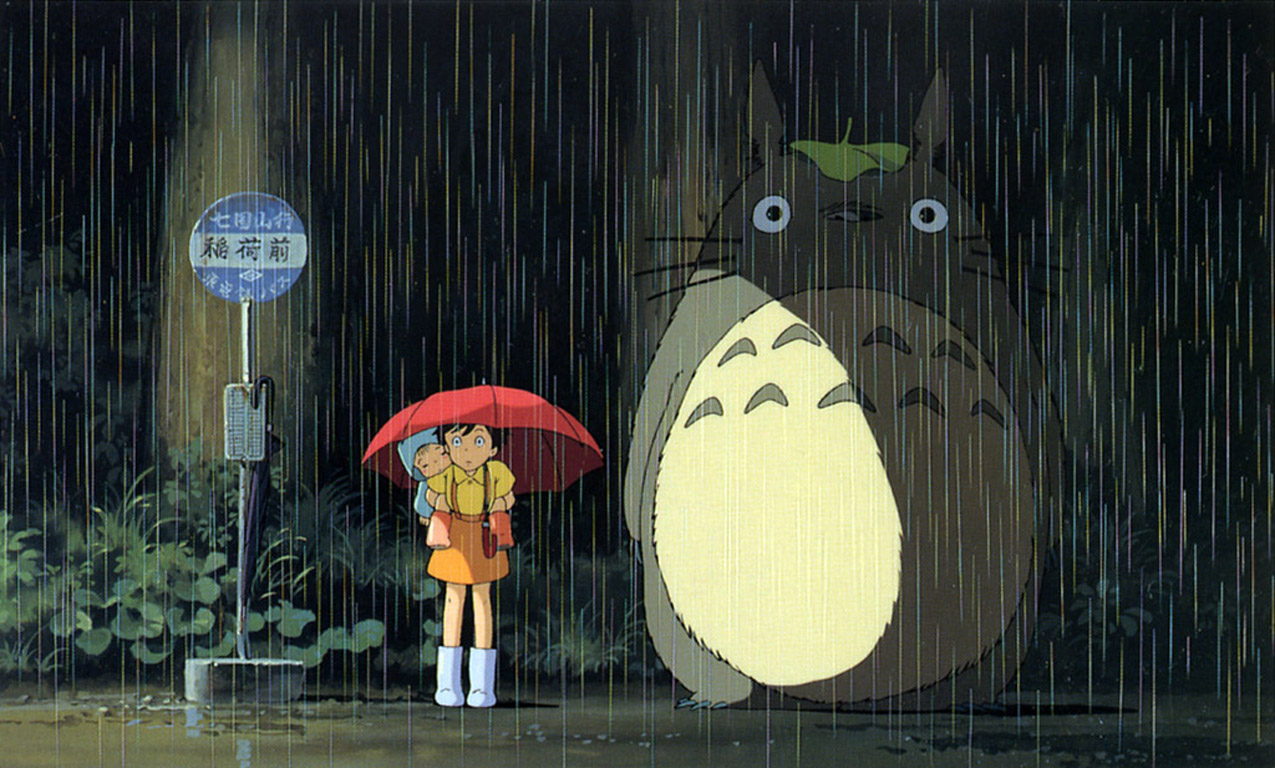
Notice the detail and wonderment in this scene where Totoro shows up to wait with the girls for their father who is late to arrive from work.
Notice the detail and wonderment in this scene where Totoro shows up to wait with the girls for their father who is late to arrive from work. Check out the scene, here.

Set in a period that is both modern and nostalgic, Totoro is a fable that captivates with little tension or plot twists, working against the mythology of the evil troll. Rather, forest spirits or trolls represent the bond that used to (and still could) exist between humans and spirits in a traditional village. In this way, Totoro is not just about conservation of the forest, but also of a certain way of living that is slowly disappearing due to urbanization. Few animated films have had the impact on me that Totoro has, other than Miyazaki’s phantasmagorical Spirited Away, and the haunting anti-war film, Grave of the Fireflies (a Studio Ghibli production that played with Totoro as a double feature). Set in Japan during World War II, Grave of the Fireflies, like Totoro, but for entirely different reasons, will challenge you to reconsider the possibilities of animation to convey a deep message.

Globally, the impact of Totoro has been enormous. For Japanese children Totoro is as famous as Winnie-the-Pooh is for children in North America. Like Winnie-the-Pooh, and a few select animated characters, Totoro reminds us of the human capacity to imagine a world that is more creative and loving. Sadly, Miyazaki announced on September 1, 2013 that The Wind Rises will be his final feature-length film. Totoro, along with his large catalogue of films, will continue to live on in the collective imagination.

Totoro, along with other Studio Ghibli films in various versions (dubbed, subtitled), is playing at TIFF until January 3rd.

My wife and Totoro-fan-to-be posing with Totoro cutout.

A Christmas Sermon on Peace

In November and December in 1967, Martin Luther King, Jr. delivered five lectures for the renowned Massey Lecture Series on the Canadian Broadcasting Corporation (CBC), released initially as Conscience of Change, and then as The Trumpet of Conscience. His polemical, “A Christmas Sermon on Peace” was first delivered at Ebenezer Baptists Church where he served as a co-pastor. On Christmas Eve, in 1967, the CBC aired his sermon as part of its 7th annual Massey Lecture.

It made sense that Martin Luther King, Jr. reached out to other, often international, audiences given the growing scope of his message for world peace through the mobilization of united people around the world. Further, King thought highly of Canada, praising the country for its role as a haven (Canaan land) for the escaped slave: “So standing today in Canada I am linked with the history of my people and its unity with your past” (Trumpet 3). Moreover, while King, Jr. is often remembered for his approaches to civil liberty through nonviolence, the Massey Lectures display how his approach towards justice became more radical and layered, avowing civil disobedience: “Massive civil disobedience is a strategy for social change” (Trumpet 55).

Some attribute King, Jr.’s assassination on April 4, 1968, to his outspoken stance against the American government as “the greatest purveyor of violence in the world today” (24), stating that the “war in Vietnam is but a symptom of a far deeper malady within the American spirit” (32). In his “A Christmas Sermon on Peace” he articulates his vision of peace as antiwar, criticizing then President Johnson for his hypocritical stance towards achieving peace:

Every time we drop our bombs in North Vietnam, President Johnson talks eloquently about  peace. What is the problem? They are talking about peace as a distant goal, as an end we seek, but one day we must come to see that peace is not merely a distant goal we seek, but that it is a means by which we arrive at that goal. We must pursue peaceful ends through peaceful means. All of this is saying that, in the final analysis, means and ends must cohere because the end is preexistent in the means, and ultimately destructive means cannot bring about constructive ends. (73)

As the above passage shows, King’s “Christmas Sermon” is more global in vision than his powerful 1963 “I Have a Dream Speech.” Many applaud the King who was opposed to violence, but then ignore the King who called for massive nonviolent demonstrations to end war and poverty in America and throughout the world. As he says in “Christmas Sermon”: “I tried to talk to the nation about a dream that I had had, and I must confess to you today that not long after talking about that dream I started seeing it turn into a nightmare” (78). That nightmare came just a few weeks after King’s speech when four innocent black girls were murdered in a church in Birmingham, Alabama.

Once the Civil Rights Act was signed in 1964, of which King was present and instrumental in bringing about, he noticed that while much had changed in America, the larger racist and globally oppressive systems of injustice remained intact. Hence, in “Christmas Sermon” his ideological compass was much more international, as he described how more “than half a million sleep on the sidewalks of Calcutta every night,” declaring: “No individual can live alone; no nation can live alone, and as long as we try, the more we are going to have war in this world” (70). King’s new message, which still related to his hope for fraternity between humankind and God, was ecologically and theologically based on the notion that all life is related. In the same speech he said: “all life is interrelated. We are all caught up in an inescapable network of mutuality, tied into a single garment of destiny. Whatever affects one directly, affects all indirectly” (71). Given the global economy we now live in, and depend upon, King hit the nail on the head with the lightning of prophecy.

He optimistically argued that solving these ever growing problems was perfectly achievable, since the wealth of the United States alone makes the elimination of poverty perfectly practicable. His overall message always remained the same, which was that love overcomes all. He didn’t mean love merely in the romantic or friendship sense, but in the Greek language usage of the word, Agápē, which basically translates as “unconditional love.” He describes Agápē as “understanding, creative, redemptive goodwill towards all men. Agapē is an overflowing love which seeks nothing in return” (75). For King, this love was tied to the love of God operating in the human heart.

And how hard is it to love our enemies, or those who disagree with our viewpoints? King’s message was built on the teachings of Jesus who didn’t say, “like you enemies,” which King distinguishes as an imperative difference, “because there are some people that I find it pretty difficult to like. Liking is an affectionate emotion, and I can’t like anybody who would bomb my home. I can’t like anybody who would exploit me […] We must work passionately and unrelentingly for first-class citizenship” (76). Like Gandhi, King was someone able to match others capacity to inflict suffering by his capacity to endure it and love them in return. Even though King became “personally the victim of deferred dreams, of blasted hopes” (79), he chose to go on loving.

King’s “A Christmas Sermon on Peace” remains as powerful as when it was delivered 46 years ago today. He argued that in Christ there is neither male nor female, communist or capitalist, but human beings as one in the love of God. I am no longer a practicing Catholic, but I find his message of acceptance and the will to help those who have less than us an overwhelmingly powerful one, especially during the time of year when many of us reflect on how much we have compared to those who have so little. Imagine if we thought this way throughout the year?

There are those who try to label King as non-subversive, but Malcolm X and King are really two necessary sides of the same coin. Many Christians fail to remember that Jesus was a radical in his time, a man who hung around lepers and prostitutes, was anti-public prayer (Matthew 6:5), was anti-wealth, and who never once mentioned abortion or birth control, and who was not white. Too often people judge others based on the colour of their skin, their sexual preference, religious or non-religious beliefs, rather than choosing to love them unconditionally.

King’s love was unconditional enough that he was willing to die for it. In Canada, King’s notions of what he termed The Just Society greatly inspired Pierre Elliott Trudeau who was the only candidate to mention Martin Luther King, Jr. King and Trudeau’s notions of The Just Society present an opportunity to negotiate disorder and fragmentation by embracing difference and trying to come together as a holistic group. There are only people and the hope, to quote the late and great Martin Luther King Jr., “that we, as a people, will get to the promised land!” (“Mountaintop”), whatever that land might represent for us now, and the hope of a still more free future. Every year my wife and I listen to King’s “A Christmas Sermon on Peace.” Its message of goodwill and peace on earth through “cosmic companionship” (78) is a vital trumpeting amid the hurly-burly atmosphere of the holiday season. Agápē.

You can view the full transcript here.

Audio is available, from here.

Works Cited

King, Martin Luther, Jr. “A Christmas Sermon on Peace.” The Trumpet of Conscience. Boston: Beacon Press, 2010. 67-80. Print.
—. “I Have a Dream.” 28 Aug. 1963. American Rhetoric. Web
—. “I’ve Been to the Mountaintop.” 3 April. 1968. American Rhetoric. Web.

Feature image is of Martin Luther King, Jr., speaking against the Vietnam War, St. Paul Campus, University of Minnesota, from Minnesota Historical Society.