
Special Issue of Critical Studies in Improvisation on Hip-Hop is Now Live

Cyphers: Hip-Hop and Improvisation

Vol 10, No 1

Edited by Paul Watkins and Rebecca Caines

To cypher is to rap, break, beatbox tightly together in a circle where each person just might get a moment in the spotlight. To cypher is to borrow and to lend, to playfully freewheel through whilst taking an exacting care for each word and carefully considering all the sounds, meanings, and interpretations. It is to fight back, to borrow, to steal, to represent, and to collaborate, whilst suddenly—surprisingly—at times aggressively claiming your own voice, your own right to speak. A cypher is a gathering of rappers, beatboxers, and/or breakers in a circle, extemporaneously making music together. In recent years, the cypher has also grown to include the crowd and spectators who are integral to maintaining the energy of a given cypher. In a cypher, one emcee will rap about a certain topic, which is quickly taken up or flipped by another emcee who plays off the prior words and themes. Each artist takes his or her respective turn, much like in a jazz solo. Cyphers flow freely between diverse performers who improvise their words, sounds, or movements to create a complex matrix of sharing. The circle can go on continuously, as long as emcees, beatboxers, dancers, and the crowd keep the fluidity of the cypher going. The cypher is welcoming and thus models a pedagogy that is inclusive and improvisational in nature.

This issue of Critical Studies in Improvisation/ Études critiques en improvisation aims to act as a cypher, engaging with the embodied practice of locally specific yet globally implicated hip-hop, as we consider the cypher as a metaphor for the complexities of critically thinking about improvisation more broadly. Appropriately, our theme of “Cyphers” attracted a wide range of analyses with many points of intersection. Our final selection ranges from discussions with historically significant scholars and practitioners in hip-hop and Black expressive culture to newer texts at the intersections between hip-hop and other art forms, as well as those tracing the improvisatory affects of hip-hop across cultural and technological boundaries.

Each paper in this issue addresses specific responses to the improvisatory impulse in hip-hop. We start the issue with a number of interviews. We are honoured that George Lipsitz agreed to interview Tricia Rose for this issue, bringing two significant scholars in Black Studies into conversation. This interview emphasizes Rose’s vital contributions to the field of hip-hop scholarship and addresses the broader importance of improvisatory Black expressive cultural practices as “sites and sources of knowledges, as repositories of collective memory, as sights of moral instruction, as ways of calling communities into being through interaction and through performance.” Rebecca Caines’ interview with leading Canadian hip-hop researcher Charity Marsh focuses on Marsh’s creation and leadership of the Interactive Media and Performance Labs in Saskatchewan as an innovative, exploratory space for disenfranchised communities to meet and learn about themselves through hip-hop practices. In conversation with Vancouver-based poet/scholar/DJ Wayde Compton, Paul Watkins addresses Compton’s work on history, identity, and race, exploring the idea of improvising Blackness from within both local (BC) and transnational contexts. This audio interview is then remixed a number of times to allow the conversation to interact with Compton’s readings of his own poetry and with a number of different music samples. Watkins then continues this exploration of critically engaged approaches to artistic practice with his review of Flying Lotus’s (aka FlyLo, born Steven Ellison) 2014 release, “You’re Dead!

Jesse Stewart examines the form of “jazz-rap” that emerged in the 1980s and ’90s. He charts the use of improvisational jazz forms in this type of hip-hop music and perceives this act as a kind of cultural memory practice that “mobilizes the musical past in the service of a socially progressive cultural politics of difference.” Niel Scobie addresses dissonance and “noise” in improvisation and in hip-hop music, with special attention to the music of Public Enemy. For Scobie, “anti-musical” aesthetics allow the group to create lineage with the “discordant cries” of African-American past practices whilst developing a potent improvisatory musical urgency and a call to arms.

Both Marcel Swiboda and Mark Campbell address technological mediation in hip-hop practices. Swiboda addresses “the break,” developing a new critical history of electronic tools for beatmaking to supplement existing scholarship, which has tended to focus more on the use of turntables for isolating and manipulating the breakbeat. Swiboda suggests that technological and material histories of improvisatory beatmaking practices can be “technologically driven, idiomatically specific vernacular modes of critical knowledge practice” and can also bear an “intimate link to improvisatory practices.” Campbell, on the other hand, focuses on current digital DJ practices. His ethnographic project is to discover how newer digital interfaces affect younger DJs in live performance and in radio settings. He argues that digital DJ interfaces might represent “ways to continue to humanize technology as a subversive afrosonic activity, while evolving the practice of DJing.”

See the full editorial and issue, here.


Critical Studies in Improvisation / Études critiques en improvisation is generously supported by the Social Sciences and Humanities Research Council of Canada (through both its Major Collaborative Research Initiatives and Aid to Scholarly Journals programs) and by the University of Guelph Library.

You’re Dead!: The Afrofuturistic Sounds of Flying Lotus

“The future is always here in the past.”
-Amiri Baraka, “Jazzmen: Diz & Sun Ra”

From Sun Ra to Janelle Monáe, Afrofuturism lets us know where we’ve been (from griot traditions and Egyptian pyramids and astronomy) to where we are going (mixing culture, technology, liberation, and imagination), particularly as a new generation of artists embody the movement’s philosophy and push jazz and hip-hop into new realms. As Afrofuturist Ytasha Womack writes of the movement, “It’s a way of bridging the future and the past and essentially helping to reimagine the experience of people of colour.” Few working DJs in the “beat scene,” particularly with mainstream recognition, embody the creative spirit of Afrofuturism as much as experimental electronic artist Flying Lotus, whose aunt is the legendary Alice Coltrane. He’s also the cousin of saxophonist Ravi Coltrane, and the grandson of singer/songwriter Marilyn McLeod (notable for writing Diana Ross’s “Love Hangover” and Freda Payne’s “I Get High (On Your Memory).”

Rather than letting his deep musical roots hold him down, Flying Lotus (aka FlyLo, born Steven Ellison) forges forward, sounding futures and making music that uses past recordings—made live through scratching and remix—as sources for improvisation. Flying Lotus first came to recognition making beats for Cartoon Network’s Adult Swim, eventually releasing a full-length record in 2006 entitled 1983. 1983 (of which I have a hard to find copy on vinyl), like its follow up, Los Angeles (2008), is a fairly straight ahead and accessible beats record, although it comes from the left field of jazz-based eletronica, video game music, and experimental hip-hop. His more recent releases include the albums Cosmogramma, and 2012’s sparse sounding and critically acclaimed, Until the Quiet ComesUntil the Quiet Comes displays the complexity of Ellison’s production, characterized by consonant and dissonant sounds, counterpoint, diverse shifts in tone and feel, and various improvisational modifications in mood, time signature, and overall structure. The psychedelic undertones, a mixture of downtempo jazz and post-rock ethos, add a dream quality to the album. Andy Beta of Spin described the record as the “dreams within dreams within dreams” concept of the 2010 film Inception while Karen Lawler of State insists that, “If the limbo between awake and sleeping, dreams and nightmares could be expressed through music, this album might well be it.”

Unique to Flying Lotus is how much sound he can get using a computer and digital production tools. Often he performs with live musicians (such as Ravi Coltrane) and his complex melodies, syncopated rhythms, and textured productions are largely a product of his own diverse interests. Some of his favourite albums, as he describes in one interview, include Alice Coltrane’s Lord of Lords; Radiohead’s Amnesiac; Charles Mingus’s Black Saint and the Lady Sinner, and J Dilla’s Ruff Draft. Stylistically, Ellison’s music reflects these diverse records, as Lotus’s albums contain free form jazz undertones and jazz-based patterns and time signatures. In 2010, Flying Lotus worked with the Ann Arbor Film Festival in a live scoring of the 1962 avant-garde film, Heaven and Earth Magic. Flying Lotus continues to surprise his audiences with imaginative live performances and by remaining true to the cross-fertilization of ideas and technological manipulation so present in Afrofuturism, Lotus (and the larger movement of young creative artists) continues to imagine possible futures.

Flying Lotus’s latest release, You’re Dead! (October 2014), embodies his mind-bending Afrofuturism more than any of his earlier recordings. The album is perhaps what Sun Ra’s and Miles Davis’s sonic child would sound like if they birthed an album together under the auspices of hip-hop. You’re Dead! is a breaking away and fresh approach to jazz-influenced hip-hop that feels a lot like Miles Davis’s On the Corner or Bitches Brew. In the liner notes of Bitches Brew, Ralph Gleason argues that “electric music is the music of this culture and in the breaking away (not breaking down) from previously assumed forms a new kind of music is emerging.” The great thing about You’re Dead! is that it recalls and echoes other fusion records, and yet its sounds are distinctive and in some ways unparalleled. You’re Dead! digs deep into jazz fusion, and takes the listener on a psychedelic journey into the unknown of the infinite afterlife. The exclamatory title (You’re Dead!) signals both the intensity and enthralled irreverence with which Ellison approaches death. Ellison’s own singing on the record is both goofy and haunting. Most impressive about this album is the well-orchestrated panoply of ideas, which are channeled through a tapestry of spirits and friends who converse together in the sonic afterlife.

You're_Dead!
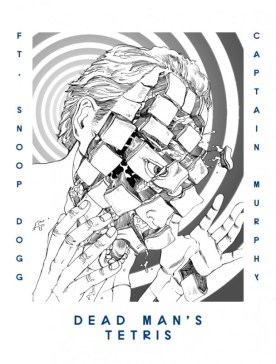
Flying-Lotus-Dead-Mans-Tetris-608x804The artwork for the album is in itself a psychedelic trip.

The album’s musical influences range from the spiritual jazz of the Coltranes, the prog jazz fusion of Weather Report (a major stylistic conduit for Ellison on the record), to the humour and cosmic tones of Sun Ra. Such a mix makes You’re Dead! Ellison’s most free sounding album to date; impressively the record never spirals out of control because it clocks in at less than 40 minutes. In those 38 minutes we encounter a wide spectrum of sounds (and silences) with more live instrumentation than any prior Lotus album. The collaborative cast on the album is diverse, and includes Herbie Hancock, Kendrick Lamar, Captain Murphy, Snoop Dogg, Thundercat, Angel Deradoorian, and others. Given his role at the helm of the fusion movement, Herbie Hancock is well deployed and his mellifluous keys on “Telsa” and “Moment of Hesitation” add to the jazz feel of the album. To really appreciate You’re Dead! you need to listen to the album in one continuous sitting: preferably in a smoky moon-lit room. The smoke could just as fittingly be from incense or cannabis. The tracks seamlessly flow together and the intense opening to the ethereal closing creates a cinematic experience that juxtaposes life and death, heaven and hell. This is cosmic music that is more meditative than it is consumptive. Yes, it is anthropophagic (cannibalistic) of other musical forms, but its channeling is meditative. We are not given a concrete answer to the nature of the afterlife, but I think that’s largely the point. The shamanistic journey FlyLo takes us on is Afrofuturistic because it lets us know that our past contains portals to explore the future of unknown horizons. You’re Dead! might just be the most exciting and confounding musical experience released this year.

images-4images-4images-4images-4 record 1:2(4.5 spins out of 5)

Check out some of Ellison’s music below, including the Kendrick Lamar collaboration on “Never Catch Me.”

Featured image from, here.

On Lower Frequencies: Ralph Ellison’s Invisible Man

“Who knows but that on the lower frequencies, I speak for you?”
-Ralph Ellison, Invisible Man 581

Set primarily in 1948 tumultuous America, Ralph Ellison’s Invisible Man is an evocative novel that deals with black identity, technological manipulation (Afrofuturism), social disillusionment, racial oppression, and invisibility. More broadly, the novel concerns individuality, tracing the numerous ways we sound our identities within political or communal networks. In the novel, an unnamed black man embarks on a Dantean journey from the South—where local white men mock him in the infamous “Battle Royal” scene and offer him a scholarship to a black college—to the basement streets of Harlem where the narrator finds a new brand of racism and where everyone he encounters, whether white or black, has an idea of who he is and what purpose he can play in their destiny. Invisible Man, which appears as one of the 100 Best English Novels (Time), is, as Lev Grossman wrote, “far more than a race novel, or even a bildungsroman. It’s the quintessential American picaresque of the 20th century.”

Although published in 1952, Invisible Man remains as pertinent as ever, particularly against the recent backdrop of race riots and social unrest in Ferguson and all too frequent incidents of racial profiling, often with dire consequences as in the cases of Oscar Grant III and Trayvon Martin; within a Canadian framework, the novel’s theme of invisibility heartbreakingly relates to the general invisibility of First Nations people, specifically the disappearance and murder of Indigenous women. Beyond its continued relevance, Invisible Man remains controversial for its honest depiction of racist America, as well as its voyeuristic sexual content, particularly the story of incestuous rape told by the signifying blues singer, Jim Trueblood. In fact, last year the Randolph County School Board voted to remove Ellison’s novel from its library shelves. Aside from the graphic content, abstract language, and historical scope of the novel, Invisible Man is also a difficult novel to teach because of its sheer size—a robust 581 pages.

Yet it is for all these historical reasons and challenges that I recently taught Invisible Man and will continue to do so. In a course structured around Sonic Afro-Modernity and Social Change we used the theme of sonic Afro-modernity (a term that comes from theorist Alexander G. Weheliye) to examine how Ellison’s interplay between sound technologies (the phonograph) and Black music and speech produced new modes of thinking and becoming, particularly allowing for new ways to engage with identity, temporality, and community.

Ellison’s Invisible Man opens with the unnamed protagonist getting into the “grooves of history,” listening to Louis Armstrong’s “Black and Blue” on the phonograph—locating the music’s aura, as Wehelyie argues, “not in the original musical utterance but in the mode of mechanical reproduction itself, making him one of the foremost intellectual architects of sonic Afro-modernity” (47). Ellison’s unnamed narrator states: “Now I have one radio-phonograph; I plan to have five. There is a certain acoustical deadness in my hole, and when I have music I want to feel its vibration, not only with my ear but with my whole body. I’d like to hear five recordings of Louis Armstrong playing and singing ‘What Did I Do to Be so Black and Blue’—all at the same time” (7-8). Ellison’s choice to foreground Armstrong’s performance of “Black and Blue” (initially composed by Fats Waller) in the prologue to his circulatory text highlights how one articulates one’s historical somatic experience through the performance of identity.

The surreal hallucinatory episode of listening to the nodes of music via Armstrong’s own listening and discord of identity (with the aid of some reefer) becomes the act of improvised identity-performance for the narrator. The Invisible Man’s reimagining of the performance through a recorded performance—with a desire for simultaneous recordings—is the “authentic act” (in the non-authentic sense: that is, the performative nature of identity resists closure), where the grooves take the narrator inside and outside of history. Ellison—like a DJ mixing records to navigate a murky topology—creates a “mix” and becomes an innovator of “sonic Afro-modernity.” I use this example to show how there can be a politics at work in the DJ’s mixing (that “the mix” can articulate the layered nature of history, identity performance, and racial politics), and to emphasize that the DJ mix—certainly for Ellison—is an act of citizenship.

Through music I was able to index many of Ellison’s signifying strategies and show my students how identity—much like community and society itself—is a process that is always changing. As Ellison writes in his work Shadow and Act, “because jazz finds its very life in an endless improvisation upon traditional materials, the jazzman must lose his identity even as he finds it” (234), suggesting that Black identity, or any identity formed within improvising principles, is continually in process. Hence, jazz and, more ubiquitously, improvisation are about finding alternatives to dominant modes of being, which is why Ellison’s nightmare of living as a black man in America is also filled with possibility and hope.

There are moments when we realize (along with the narrator) that freedom can be as simple as walking down the street in our own skin proudly displaying our cultural heritage. For the narrator that comes in one moment (there are others) where he eats a cooked, syrupy yam on the streets of Harlem: “I walked along, munching the yam, just as suddenly overcome with a sense of freedom—simply because I was eating while walking on the street” (Invisible 263-64). No longer compelled to hide his Southern Black identity, the narrator ponders the connection between food and identity, feeling a profound sense of self-determination and autonomy—a sense that comes with progressing forward while simultaneously embracing, confronting, and remixing the past.

In this way, Ellison’s novel is prophetic (and Afrofuturistic): it speaks of change and resistance while acknowledging the cyclical nature and echo effect of oppression. History, as a metaphorical record, is distressed, scratched, and in need of a DJ (and an audience) to make it sound. Ellison, as a sonic architect, is an early progenitor of Afrofuturism: a movement that lets us know where we’ve been (from griot traditions and Egyptian pyramids and astronomy) to tell us we are going (mixing culture, technology, liberation, and imagination). As Afrofuturist Ytasha Womack writes of the movement, “It’s a way of bridging the future and the past and essentially helping to reimagine the experience of people of colour” (Guardian). Combating visions of tomorrow that view blackness as the failure of progress and technological cataclysm, Ellison shows that through the manipulation of technology, Black culture actually helped create modernity and notions of subjectivity, temporality, and community. History as remix, as a cyclical boomerang, allows Ellison to dig into the crates of the past to explore and expose the effects racism has on both victims and perpetrators.

Invisible Man deals with an entire “unrecorded history” (471) that is open for (re)interpretation and (re)examination, particularly by and for those groups of people who were once relegated to historical footnotes. We are thus challenged, as Robin D. G. Kelley argues in Race Rebels, to “not only redefine what is ‘political’ but question a lot of common ideas about what are ‘authentic’ movements and strategies of resistance” (4). Politics, as a “history from below” (5), also functions by what Kelley defines as “infrapolitics” (8), a term he uses to describe the circumspect struggle waged daily by subordinate groups who function beyond the visible spectrum. It is from “the lower frequencies” (581)—those subtonic bass notes—that the unnamed narrator (as a representative of the oppressed) continues to speak to a contemporary North America still recovering and living with the legacy and malaise of slavery, reformulated in some respects, under the guise of capitalism. Under this lens, we cannot trivialize contemporary acts of resistance by political youth movements like Occupy, Idle No More, or the Egyptian Revolution (2011, Tahrir Square), which effectively connected various people and global media outlets together to enact change—however grand or relative in scale and action. The recent First Nations Idle No More movement was the result of legislation (most directly Bill C-45) introduced by the Harper government, which violated treaty and land rights. Again and again: the record of history continues to spin.

Ellison’s Invisible Man remains a multifarious DJ mix of apposition and amalgamation. We encounter characters that personify actual historical figures like Booker T. Washington, Emerson, and Marcus Garvey and cultural references and influences that include Dante, Dostoevsky, T.S. Eliot, Melville, and Louis Armstrong. It is in this mixing, between Western classical and Negro Folk traditions (Shadow 190) that Ellison creates a polyphonic dialogue, displaying that Black music, literature, and culture are never fixed or stable, but rather layered and complex: the novel, like Brother Tarp’s chain, “signifies a heap” (388). Invisible Man matters because race and culture still matter. On a more global level, especially in the age of information and censorship, art still matters.

Reading (and making space to teach Invisible Man) remains an act of allowing one’s own identity position to be moved by the lower bass registers of sound. We are called to listen to those deemed to be on the lower registers of society. Ultimately, identity and, by extension, community involve the precarious act of yielding to others’ voices, which is at the crux of genuine multiculturalism and, often, interesting literature. I have an original first edition of the novel (3rd printing) and I can only imagine how people felt reading the novel for the first time in 1952. As I leaf through its taupe and textured pages, I realize that in spite of much change in terms of citizenship rights in North America, many of the power structures in the novel remain entrenched in our current society. When we finish the novel, a long endeavour, we (as the narrator does) are challenged to leave our holes of hibernation, “shake off the old skin and come up for breath […] even an invisible man has a socially responsible role to play” (581). The landscape might have slightly changed, certainly our understanding of the world via technology has, but our responsibility to make the world a better place remains as pertinent as ever. No wonder the highly visible want the book taken off the shelves.

Works Cited

Ellison, Ralph. Invisible Man. New York: Vintage International Edition, 1995. Print.

—. Shadow and Act. New York: Random House, 1964. Print.

Kelley, Robin D. G. Race Rebels: Culture, Politics, and the Black Working Class. New York: The Free Press, 1996. Print.

Weheliye, Alexander. Phonographies: Grooves in Sonic Afro-Modernity. Durham: Duke UP, 2005. Print.

Bassist and Free Jazz Pioneer Charlie Haden Has Left the Planet

On July 11th, at the age of 76, Charlie Haden passed away. Described by Time magazine as “one of the most restless, gifted and intrepid players in all of jazz,” Haden left his mark on hundreds of records as both a member and a leader. He was the anchor of the Ornette Coleman Quartet and helped define The Shape of Jazz to Come. In recent years he struggled with the degenerative effects of post-polio syndrome, and up until 2010 he was still in the studio and performing live. A month before his passing ECM released Last Dance, a set of informal songs between Haden and Keith Jarrett recorded at Jarrett’s Cavelight home studio in 2007.

While Haden is known as one of the most significant bassists in jazz, his influences and recordings touch on many musics, from classical to his own country, spiritual, and bluegrass roots. His early music roots culminate on his 2008 recording Rambling Boy, an album that features his immediate family, all of whom follow his musical path. His music and art will live on and continue to inspire others. As Haden once said, “We’re here to bring beauty to the world and make a difference on this planet. That’s what art forms are about.”

We Can Never Tell the Entire Story of Slavery: In Conversation with M. NourbeSe Philip

The Toronto Review of Books has just published my interview with the renowned poet, M. NourbeSe Philip. In the interview we focus on her work Zong!, and touch on music, improvisation, slavery (including the film 12 Years a Slave), the haunting of modernity, and more!

Read the full interview, here.

Photo by Paul Watkins of M. NourbeSe Philip leading a book-length reading of Zong! on November 29th, 2013.

Chinua Achebe on Jazz

But, in any case, did not the black people in America, deprived of their own musical instruments, take the trumpet and the trombone and blow them as they had never been blown before, as indeed they were not designed to be blown? And the result, was it not jazz? Is any one going to say that this was a loss to the world or that those first Negro slaves who began to play around with the discarded instruments of their masters should have played waltzes and foxtrots? No! Let every people bring their gifts to the great festival of the world’s cultural harvest and mankind will be all the richer for the variety and distinctiveness of the offerings.
-Chinua Achebe, “Colonialist Critique”

achebeIn the above quote, Chinua Achebe uses the example of jazz to articulate his right and necessity to use the Western novel form to express the particular experience of African people. Achebe’s argument, with his cross-cultural and anticolonial positioning, describes how African Americans utilized the instruments they had access to in order to create a music that was uniquely their own: a music contributing to the “world’s cultural harvest,” growing and taking root in a variety of musics, cultures, and soils.
Achebe was a Nigerian novelist/storyteller, poet, professor, critic, and humanitarian. His most well known novel, Things Fall Apart (1958), which many consider his magnum opus, is the most widely read book in modern African literature. His critiques of racism in Joseph Conrad’s Heart of Darkness were instrumental to the postcolonial critical movement. Recalling his time as political prisoner, Nelson Mandela referred to Achebe as a writer “in whose company the prison walls fell down.” Last year, on March 21st, 2013, Achebe passed away. He remains an inspiration to people and writers around the world for the liberating potential of his literature and his depictions of life in Africa.

Photo from here.

Sex Mob Plays Fellini

Sex Mob is a New York City jazz group, which initially began as a way to feature the slide trumpet of leader Steven Bernstein. Since then the band, as Bernstein’s website states, has developed an overarching mandate: “to put the fun back in jazz music.” The band is comprised of Bernstein on slide trumpet, Briggan Krauss on alto sax, Tony Scherr on bass, and Kenny Wollesen on drums. The group first formed in the 1990s as part of a residency at the Knitting Factory, and their early material consisted primarily of Bernstein originals. That changed when Sex Mob played Bond Themes as part of an evening of film music, such as “Goldfinger” and “You Only Live Twice,” which eventually culminated in a 2001 album, Sex Mob Does Bond. To Bernstein’s surprise the crowd went wild, and Bernstein realized that the audience was more in tune with their adventurous music if they could recognize the tune. And so their songbook expanded to feature everything from Prince, Paul McCartney, The Rolling Stones, to The Grateful Dead, and even the “Macarena,” although you’ve never heard the “Macarena” like this before.

The guiding principle to their song selection is that the tune would have to be recognizable enough that it could withstand some serious compositional and improvisational destruction. The group still plays many Bernstein originals, although their sets now feature a great deal of covers given a humorous, yet sophisticated avant-garde reworking. As Bernstein unapologetically states in Jazz Asylum, “I realize that’s what jazz musicians have always done. That’s how Lester Young got popular; it’s how Charlie Parker got popular; it’s how Miles Davis got popular; that’s how John Coltrane got popular. They played the songs that everyone knew and because they could recognize the song, then that invited them into their style.” In many ways Bernstein is right, as the jazz tradition has always included space to take familiar songs and reassemble them with your own unique spin.

Since their 1998 debut, Den of Inequity, Sex Mob has released a diverse oeuvre of radical, yet accessible material. Their 2000 release, Solid Sender, continues their bold prewar jazz spirit through another mix of covers, everything from Nirvana to ABBA, with a dose of Bernstein originals. The same year saw the release ofTheatre & Dance, part Duke Ellington compositions and part Bernstein originals written for a renewal of the 1926 Mae West play “Sex.” Sex Mob continues to defy expectations, and their 2006 release, Sexotica (Thirsty Ear) is a homage to the soundscape of Martin Denny (the “father of erotica”), receiving a Grammy nomination for Best Contemporary Jazz Album.

Their latest release, the 2013 Cinema, Circus & Spaghetti (Sex Mob Plays Fellini: The Music of Nino Rota), contains Sex Mob’s idiosyncratic arrangements over Nino Rota’s memorable scores. The title comes from a quote from Italian director Federico Fellini, who said, “My films, like my life, are summed up in circus, spaghetti, sex, and cinema.” The same could be said of Sex Mob’s exuberant music. Sex Mob Plays Fellini, like their earlier albums, will certainly offend jazz purists. I assume that’s part of the point. Love or hate their brashness, Bernstein summarizes the Sex Mob ethos as about having fun: “Jazz used to be popular music. People would go out to clubs, listen to the music, go home, and get laid. Simple as that. We’re bringing that spirit back” (All Music Guide). Sometimes it’s nice to simply get lost in the music, dance, and go out and enjoy la dolce vita.

“Poems are bullshit”: Rest in Power, Amiri Baraka

Amiri Baraka, a poet and playwright of incendiary rage and collective insight, who went from Beat poet to Black Nationalist and finally Marxist-Leninist, died today in Newark. He was 79. Among his most known works are the poetry collections The Dead Lecturer and Transbluesency: The Selected Poetry of Amiri Baraka/LeRoi Jones (1961-1965), his plays Dutchmen and A Black Mass, and his various works on Black music, such as Blues People and Black Music. Along with Ezra Pound, Amiri Baraka remains one of the most controversial and least understood American poets. As M.L. Rosenthal wrote, “No American poet since Pound has come closer to making poetry and politics reciprocal forms of action” (qtd. in Baraka Reader xxi). For Baraka, art was a weapon of revolution. Further, Baraka wrote some of the most insightful works on African American music, appropriately referring to the music as American classical music. His poetry was always musical, for as he states in Blues People, the poem must “swing—from verb to noun.” The “changing same” was his designation of the interplay between tradition and the individual talent in Afro-American music.

His creative writing shows how poetry can move through blues and jazz to black chant and graphic sound. His poem, “In the Tradition,” dedicated to alto saxophonist Arthur Blyth, opens with a slick alliterative line, followed by a quick twist that recalls music as a resistive province to slavery: “Blues walk weeps ragtime / Painting slavery” (Transbluesency 199). “In the Tradition” is an epic poem concerning historical events; like much of Baraka’s work it carefully wields together traditions to assert poetic agency. Baraka’s poem “Black Art” charges forth like a gorilla and  provides an Umwalzung—that is, a revolution—through a complete overturn of prior poetic systems, enacting one of the most ferocious black chants ever to appear on the page. Anti-Semitism aside, which the poem sadly has in abundance, “Black Art” is an improvisatory chant in the form of a free jazz poem. Baraka’s poetic violence disavows lyric voice in favour of a gruffer, more militant poetics: “Poems are bullshit unless they are / teeth or tress or lemons piled / on a step […] Fuck poems […] We want ‘poems that kill.’ / Assassin poems” (Transbluesency 142). While I can’t condone much of the poem’s content, its form, along with Baraka’s opus, altered the course of African American literary culture. It didn’t merely blacken the canon: it blew it into a million pieces.

Baraka is one of the most important poets and music critics of the twentieth century: full stop. The controversy and backlash over his public reading of his poem “Somebody Blew Up America,” as well as some of the homophobic, anti-Semitic, and misogyny of his middle period poems, often overshadow the incredible firebrand prowess and construction of Baraka’s cerebral and polemical thinking. Baraka lived a very tumultuous life and his poetry and social activism reflect that. He showed many young poets—across cultures and generations—that poetry could be a call to arms, as well as a tool to adequately express lived experience. His uncompromising, engaging, and, at times, problematic voice will be missed.

Check out this 2004 piece on why Amiri Baraka matters by poet Saul Williams in Fader.

Check out Baraka reading from “Why’s/Wise”:


Works Cited

Baraka, Amiri. Amiri Baraka/LeRoi Jones Reader. Ed. W.J. Harris. New York: Thunder’s Mouth Press, 1991. Print.

—. Transbluesency: The Selected Poems of Amiri Baraka/ LeRoi Jones (1961-1995). Ed.  Paul Vangelisti. New York: Marsilio Publishers, 1995. Print.

Photo of Amiri Baraka from Wikipedia Commons.

Improvisation as an Act of Faith

On December 6th, Improvisation, Community, and Social Practice (ICASP) presented a symposium (“Spirit(s) Improvise”) on improvisation and spirituality. “Spirit(s) Improvise” brought together distinguished scholars, musicians, and spiritual practitioners to explore the relationship between improvisation and spirituality. One of the primary questions asked was how can improvisation and spirituality, broadly defined as frameworks through which people imagine and enact alternative ways of being in the world, contribute to our understandings of imagination and creativity, community and space, and transcendence and hope?

Held at and co-sponsored by the Macdonald Stewart Art Centre, the well-attended event sparked animated conversations and debates about the relationship between improvisation and spirituality from a variety of perspectives: musical, political, social, and theological.

For speaker bios and abstracts, click here.

Below are some photos from the event.

DSC_1038
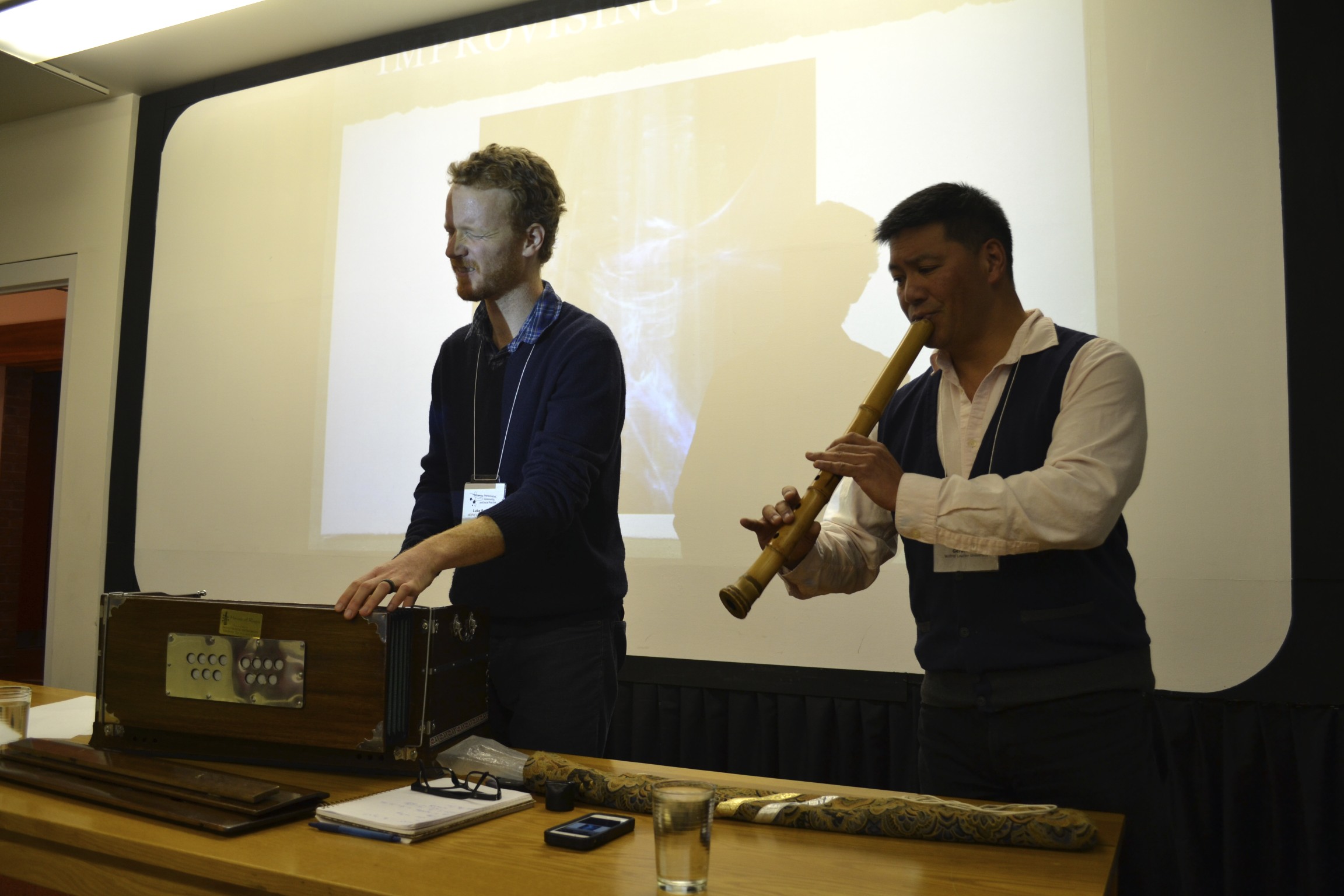
Gerard Yun (Music, University of Waterloo) and Luke Burton (Wilfrid Laurier Unviersity) “Beyond Traditions: Yogic Chant and Shakuhachi in Contemporary Improvisation.”
DSC_1045
Ajay Heble introduces the keynote speaker.
DSC_1048
Anglican Priest, Jamie Howison, delivers a keynote entitled, “Improvisation as an Act of Faith.”
DSC_1049
There were lots of engaged questions from the audience.
DSC_1053
Lauren Levesque (Improvisation, Community, and Social Practice, University of Guelph), “Protest Music Performances as Methodological Frameworks for Re-envisioning Engaged Spirituality: Implications for Improvisation.”
DSC_1057
The event concluded with a fully improvised performance.
DSC_1058
David Lee.

DSC_1059  DSC_1063

Adapted from a write-up by  Lauren Levesque.
All Photos by Paul Watkins.